Though John T. Riddle, Jr. is known as an influential teacher, his equally important work as an artist only started to garner critical attention in the 2010s. Both aspects of his practice reflect his belief—formed in the crucible of the 1965 Watts Rebellion—that art has value only if, in Riddle’s own words, “it advances social consciousness and promotes Black development.” Riddle was born in Los Angeles in 1933; he was the son of a former University of Southern California fullback thought to be the first Black person to play in a Rose Bowl (1923) and who later worked with trailblazing Black architect Paul Williams, and of the first Black woman to graduate from the University of Southern California Law School. After receiving his Associate of Arts degree from Los Angeles City College, Riddle spent four years in the Air Force, where he gave up on a career as a pilot after realizing that Black servicemen were limited to food service and cleaning jobs. Instead, he attended night school on the G.I. Bill for nine years, ultimately earning a BA in education (1966) and an MFA (1973) from California State University, Los Angeles. In 1974 he moved to Atlanta, where he taught art at Spelman College and continued his own practice. He returned to Los Angeles in 1999 to become the Program Manager of Visual Arts at the California African American Museum, remaining in that post until his untimely death in 2002 at age 68.
Like his mentor Noah Purifoy and his peer John Outterbridge, Riddle was deeply affected by the destruction of the Watts Rebellion. He turned to welding sculptural assemblages from the torched debris he found in the neighborhood then known as South Central, creating works with a social message that evoked rage and possibility simultaneously. One of Riddle’s self-imposed rules in making his sculptures was that “you couldn’t take the found object in its exact context and stick it in some art. You had to cut a piece off; you had to do something so it wasn’t the same as what you found.”
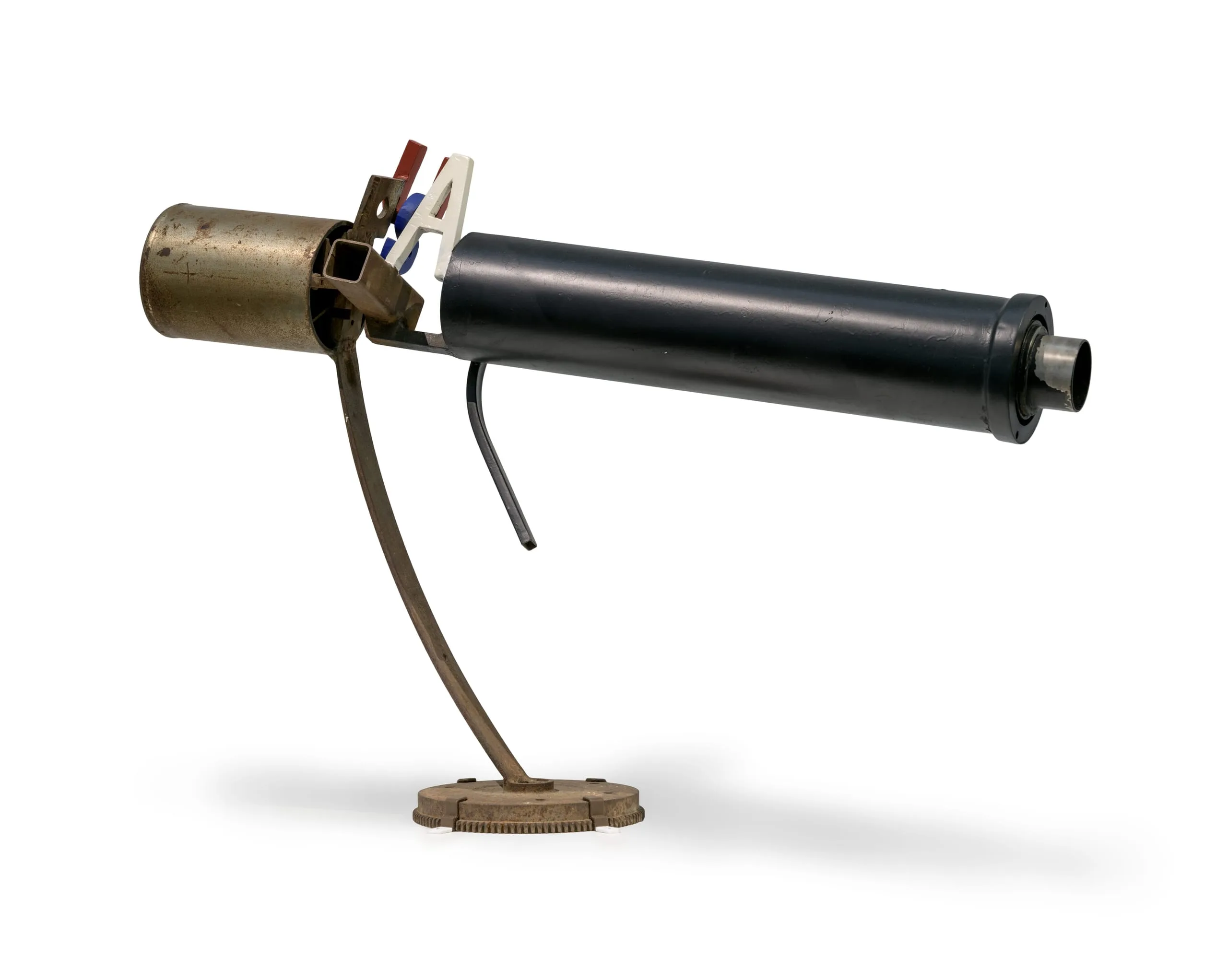
America’s Problem Solver is an assemblage—of just such doctored found objects—that evokes both a weapon and a telescope. Created at the height of the Vietnam War, the sculpture suggests that not only did the United States have other countries and cultures in its sights but also that our country itself was under scrutiny. As a former serviceman who felt the sting of institutional military racism, Riddle would certainly have been aware that Blacks—who represented approximately 11 percent of the United States population in the 1960s—represented 16.3 percent of draftees and up to 25 percent of all combat deaths in Vietnam during those same years. America’s Problem Solver thus implies a need to look both afar and within to solve our national problems.