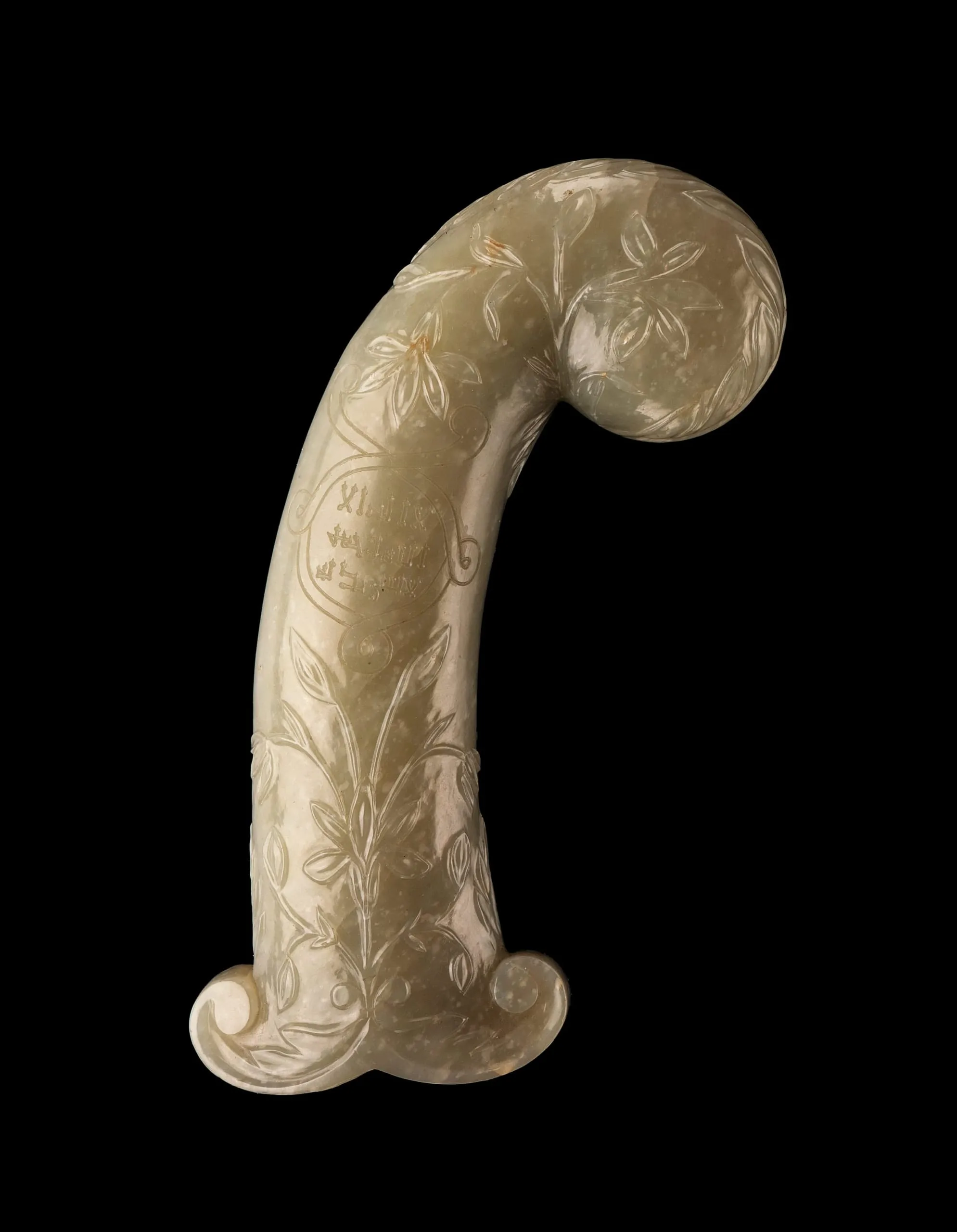
This dagger hilt is fashioned from light green nephrite jade in the conventional form of a pistol grip with a rounded pommel, a shape initially inspired by European weaponry. Executed in shallow relief, a blossoming iris issues from the crook of the grip. A foliated branch encircles its periphery. The mouth of the hilt has plain scrolling quillons (cross guards) embellished with split acanthus leaves and a flowering iris rising from the center. In the originally plain reserve between the upper and lower irises, a double helix scroll cartouche containing an inscription was added at a later date, probably in the 19th century. (The intrusive nature of the inscription is apparent where the upper left volute cuts into the preexisting iris petal.) Engraved in Kufic script on both sides of the hilt, the inscription is the standard "profession of faith," the Shahada. (Translation by Simon Digby and Z. A. Desai.)
Introduced during the reign of the Mughal Emperor Jahangir (r. 1605-27) and codified under Emperor Shah Jahan (r. 1628-58), an aesthetic expression was created that highlighted formalized representations of flowering plants for use as the dynastic leitmotif in architecture, painting, and the decorative arts. This distinctive artistic style was perpetuated by the succeeding Mughal emperors.