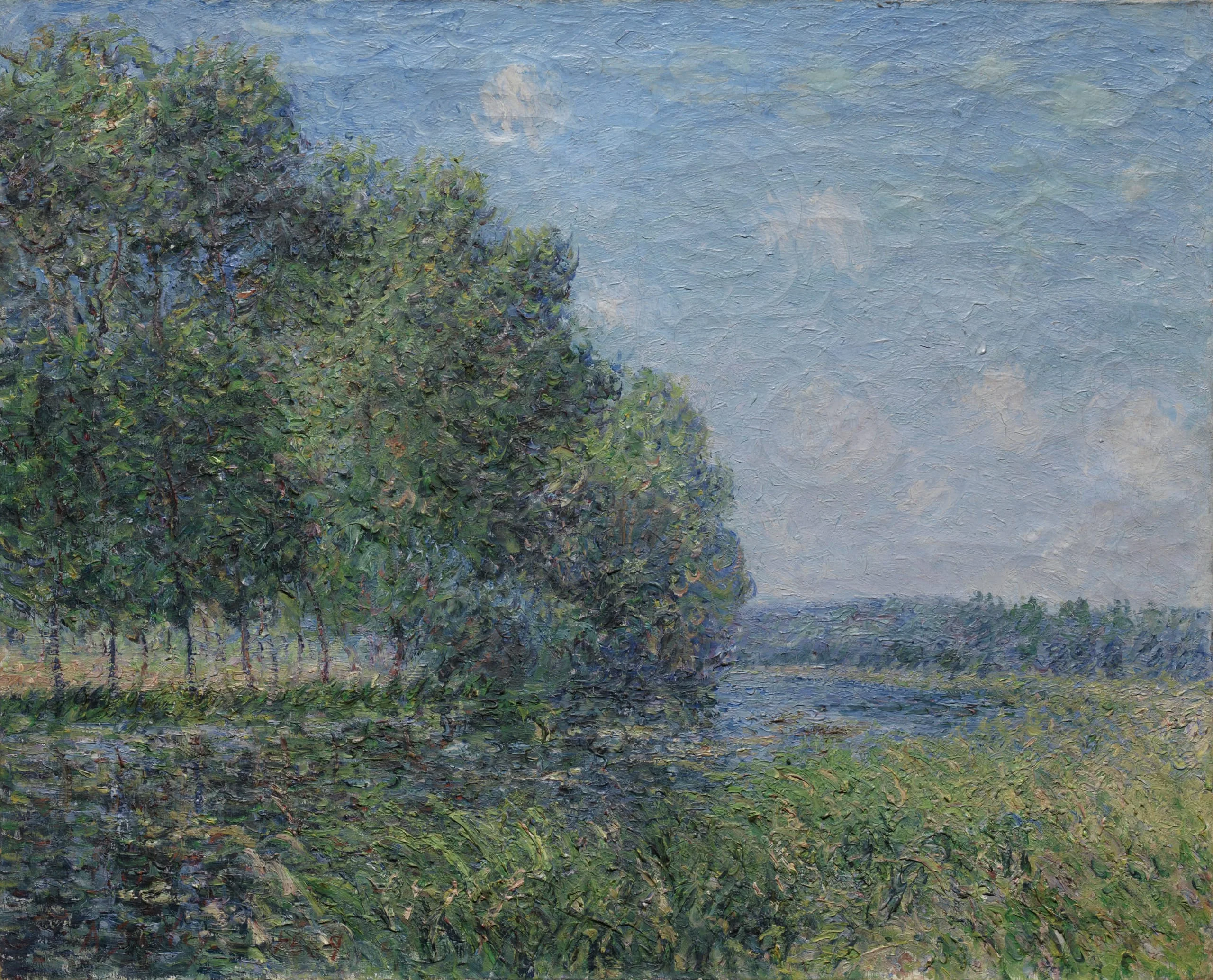
Alfred Sisley wrote of Moret-sur-Loing, “It is at Moret—in this thickly wooded countryside with its tall poplars, the waters of the river Loing here, so beautiful, so translucent, so changeable; at Moret my art has undoubtedly developed most . . .” River View exemplifies the qualities that made his paintings of this area so admired. Painted outdoors, it presents a stand of poplars along a bend in the river, rendered in a harmoniously restrained palette of blues and greens. Sisley’s brushwork is animated and varied, building subtle shifts of texture, light, and tone across the canvas. Trees anchor one side of the foreground, while the water and bank recede into depth on the other, creating a composition that feels both carefully structured and immediately observed.
Painted during the last decades of Sisley’s life, when he was working primarily in and around Moret-sur-Loing, River View reflects Sisley’s mature landscape practice. It belongs to a group of works that many scholars consider the fullest expression of his art. Waterways had long been central to his landscapes, and here the river becomes not simply a setting but a vehicle for studying reflection, movement, and atmospheric change. His handling is sensitive rather than dramatic, attentive to the movement of water, the shimmer of reflected light, and the dense yet airy presence of foliage. Like many of his finest pictures, River View captures a specific place and moment while also conveying the broader Impressionist interest in transience, weather, and sensation. The canvas remains unlined and unvarnished, preserving the directness of Sisley’s surface and the freshness of his paint handling.
British by birth and trained in France, Sisley was one of the key painters of the Impressionist circle and is often regarded, after Claude Monet, as its most dedicated landscape specialist. In 1862, he entered the studio of Charles Gleyre, where he met Monet, Frédéric Bazille, and Pierre-Auguste Renoir. Their shared commitment to painting outdoors, especially in the forests around Fontainebleau, helped define the language of Impressionist landscape. Although Sisley’s life was marked by financial instability, particularly after the collapse of his father’s silk business during the Franco-Prussian War, he remained unwavering in his devotion to painting. Over time, he settled with his family in villages southeast of Paris, developing a focused and increasingly self-contained practice while continuing to exhibit in both the Salon and the Impressionist exhibitions and to work with important dealers such as Paul Durand-Ruel and Georges Petit.
River View entered LACMA through the generosity of the Henry and Rose Pearlman Foundation. Henry and Rose Pearlman assembled an exceptional collection of Impressionist and modern art and were deeply committed to sharing it with the public. This painting is one of six gifts from their descendants to LACMA, continuing that legacy of stewardship and access.