- Artist or Maker
- Mark Rothko
Latvia, active United States, 1903-1970 - Title
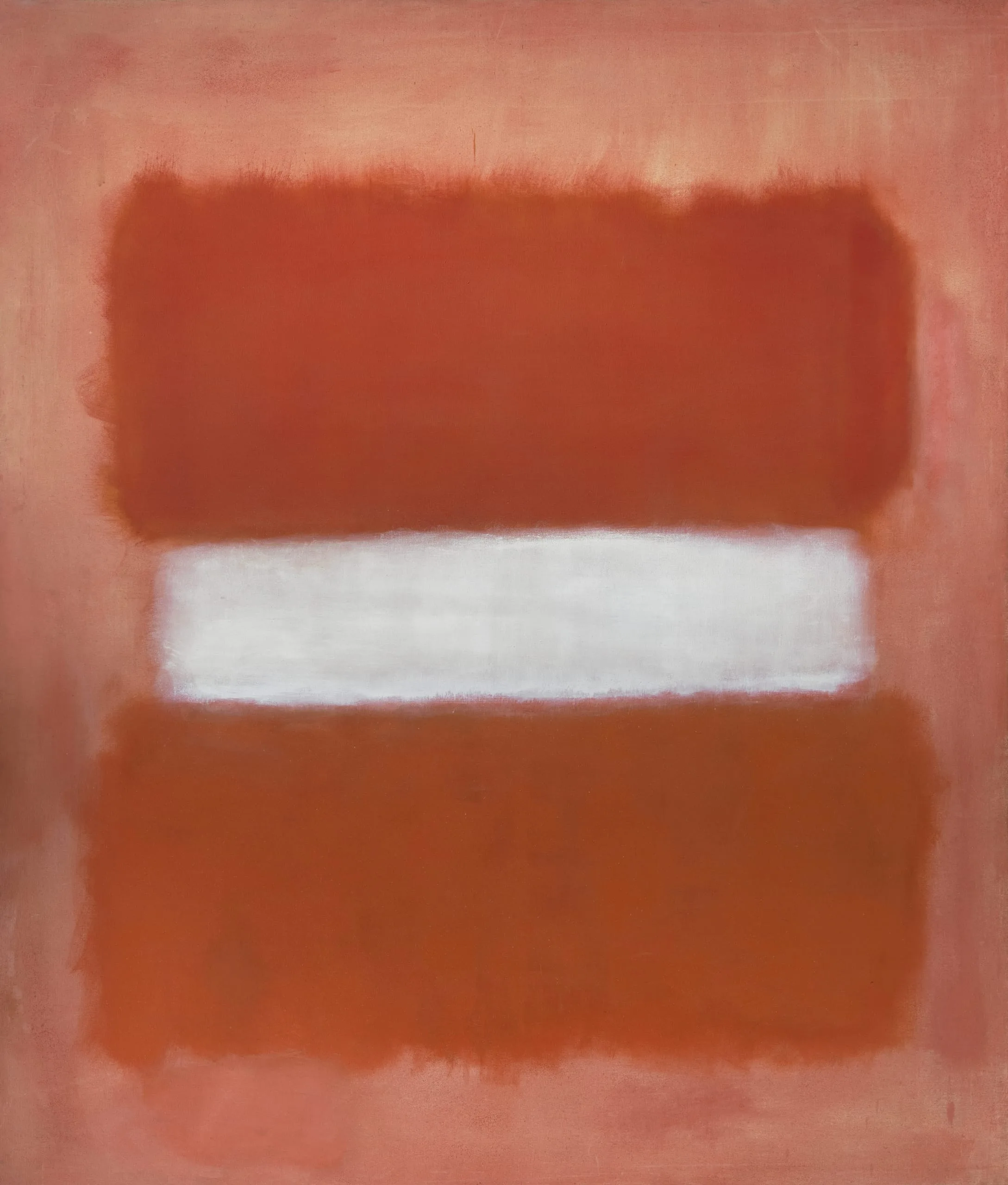
- White Center
- Date Made
- 1957
- Medium
- Oil on canvas
- Dimensions
- 84 x 72 in. (213.36 x 182.88 cm)
- Accession Number
- M.67.25.21
- Curatorial Notes
Abstract Expressionist Mark Rothko is known for the hovering, shimmering fields of color in his mature paintings. In his early works of the 1930s, including works made under the auspices of the Works Progress Administration, Rothko explored Social Realist themes. By the early 1940s, he was exploring Surrealism as well as mythic and so-called primitive art. By the end of that decade, Rothko had rejected the representational subject matter of Surrealism and arrived at his mature style.
The color fields of White Center reflect Rothko's fascination with the emotional and visual power of the color red, which dominates his canvases of the 1950s and 1960s. The red rectangles suggest ritual and elemental associations (blood and fire, life and death), while an inner light seems to emanate from the white center, suggesting an ethereal, numinous glow. For Rothko, color was the key to a spiritual realm, evoking transcendental truths that could not be expressed through recognizable imagery.
Excerpted from Los Angeles County Museum of Art (World of Art series). Los Angeles: Los Angeles County Museum of Art; London: Thames & Hudson, 2003.
- Provenance
The artist (1903-1970); [Sidney Janis Gallery, New York]; sold in 1959 to Mr. and Mrs. Robert C. Scull, Great Neck, New York; [sold in 1962 to Lawrence Rubin, New York]; sold by1964 to David E. Bright (1908-1965), Los Angeles; bequeated in 1964 to LACMA.
- Selected Bibliography
- Los Angeles County Museum of Art. New York: Thames and Hudson, 2003.
Tuchman, Maurice, editor. New York School, The First Generation: Paintings of the 1940s and 1950s. Los Angeles: Los Angeles County Museum of Art, 1965.
- Price, Lorna. Masterpieces from the Los Angeles County Museum of Art. Los Angeles: Los Angeles County Museum of Art, 1988.
- Powell III, Earl A., Robert Winter, and Stephanie Barron. The Robert O. Anderson Building. Los Angeles: Los Angeles County Museum of Art, 1986.
- Goldman, Judith. Robert & Ethel Scull: Portrait of a Collection. New York: Acquavella Galleries, 2010.
- Muchnic, Suzanne. LACMA So Far: Portrait of a Museum in the Making. San Marino, California: Huntington Library, Art Collections, and Botanical Gardens, 2015.
- Copyright
- © Kate Rothko Prizel & Christopher Rothko/Artists Rights Society (ARS), New York