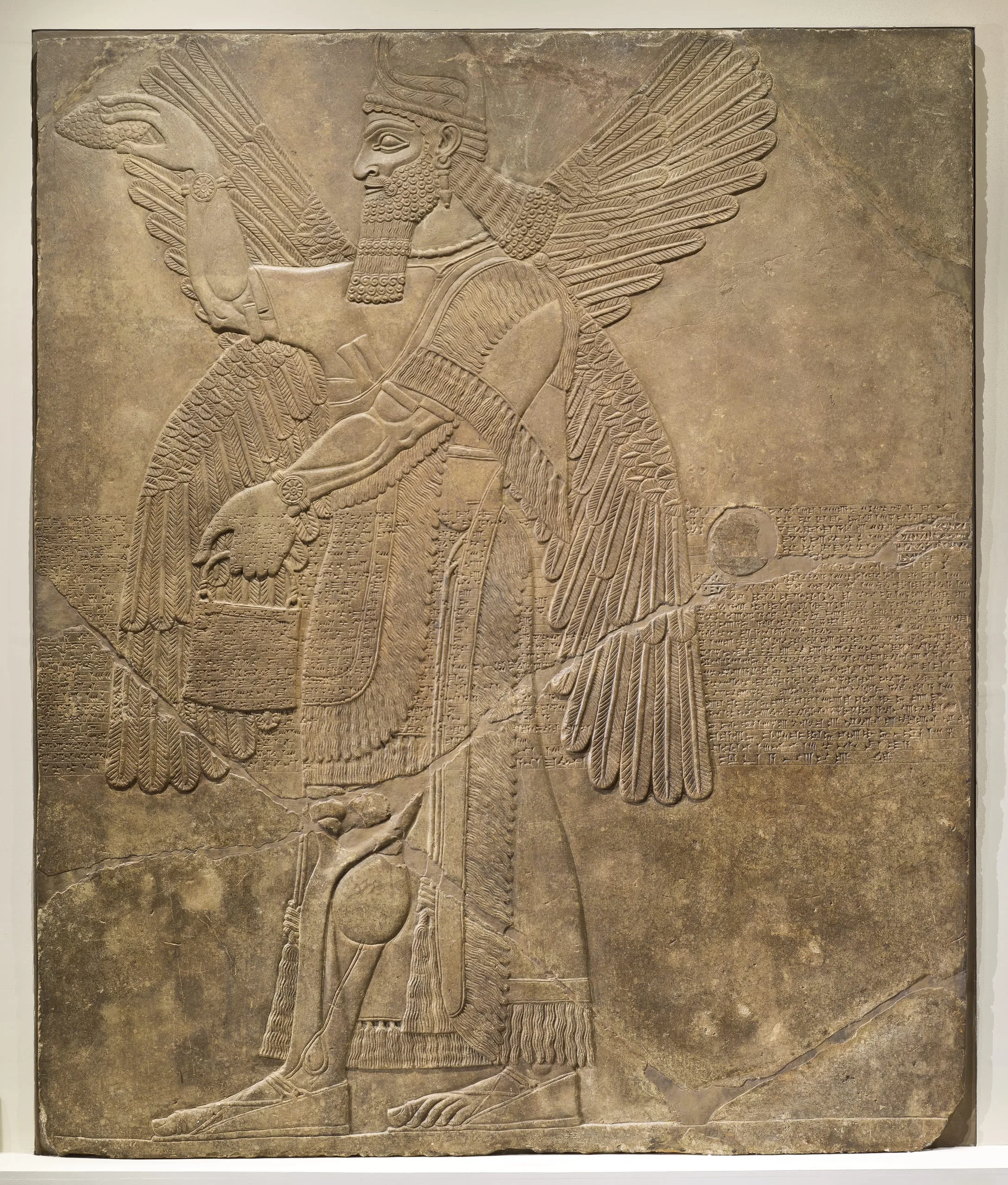
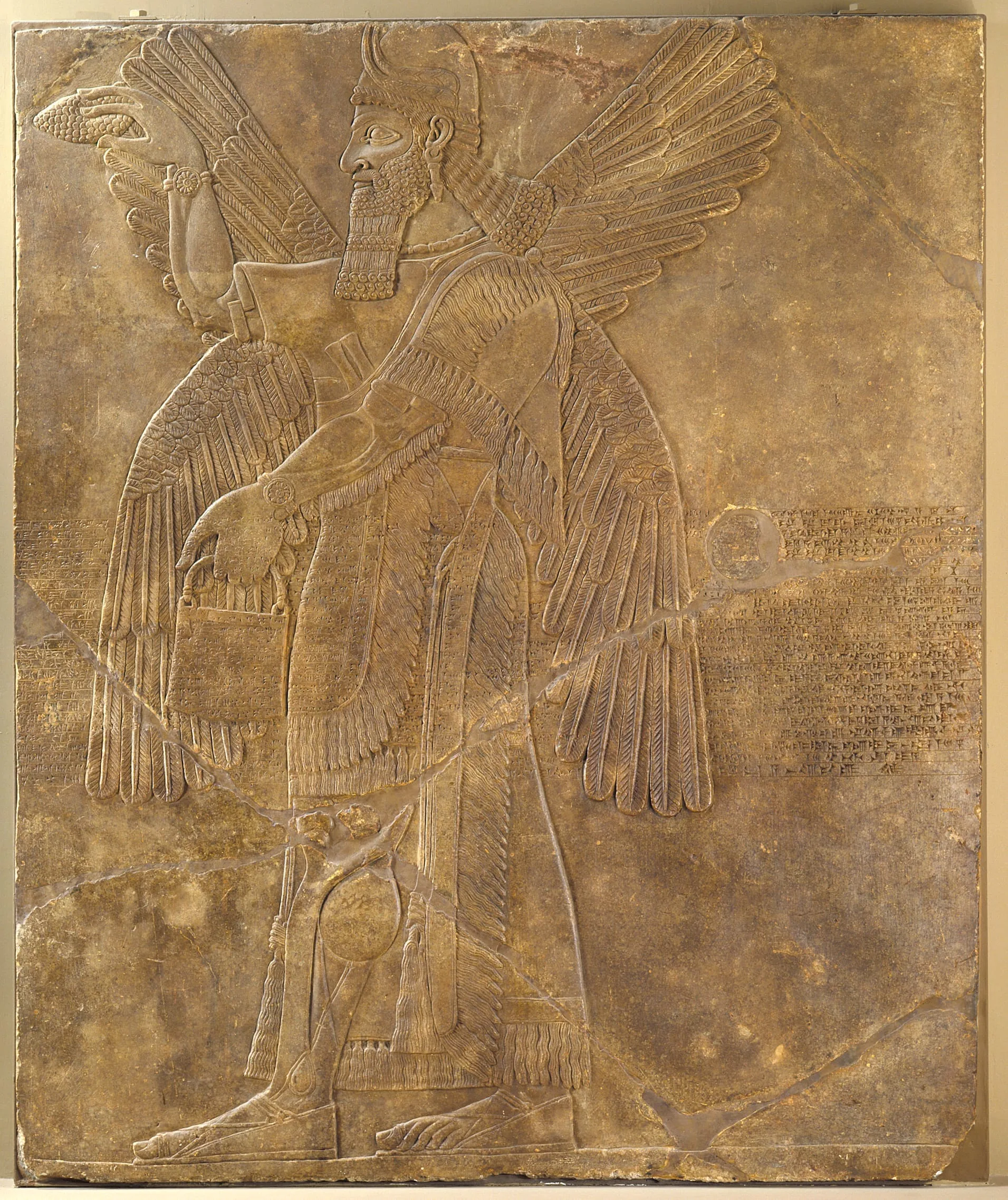
This splendid panel is one of a group of five low-carved reliefs (see also 66.4.1, 66.4.2, 66.4.3, and 66.4.4) from the northwest palace of the Assyrian king Ashurnasirpal II (r. 883−859 BCE), at Nimrud (ancient Kalhu). Located on the Tigris River in northern Iraq, the site was first excavated by Austen Henry Layard, an English diplomat, politician and archaeologist, in 1845. Built of mud brick on stone foundations, the lower interior levels of the palace were decorated by an extensive sequence of alabaster slabs that were carved in place and originally painted in black, white, red, and blue. Rendered with remarkable detail, this panel depicts a majestic winged supernatural being holding a bucket and a cone, possibly connected with some purifying or protective ritual. Here and across the center of the other panels is a cuneiform inscription enumerating the king’s accomplishments.
The LACMA reliefs were discovered in adjacent rooms; this panel and 66.4.3 probably came from one room, and 66.4.4 from the other. In 1855, William Kennett Loftus, who had succeeded Layard, offered the panels to the Literary and Philosophical Society of Newcastle upon Tyne, England, and for more than a century they were displayed near the entrance of that institution. By the 1960s they had come on the art market and were subsequently acquired by Anna Bing Arnold for LACMA in 1966.