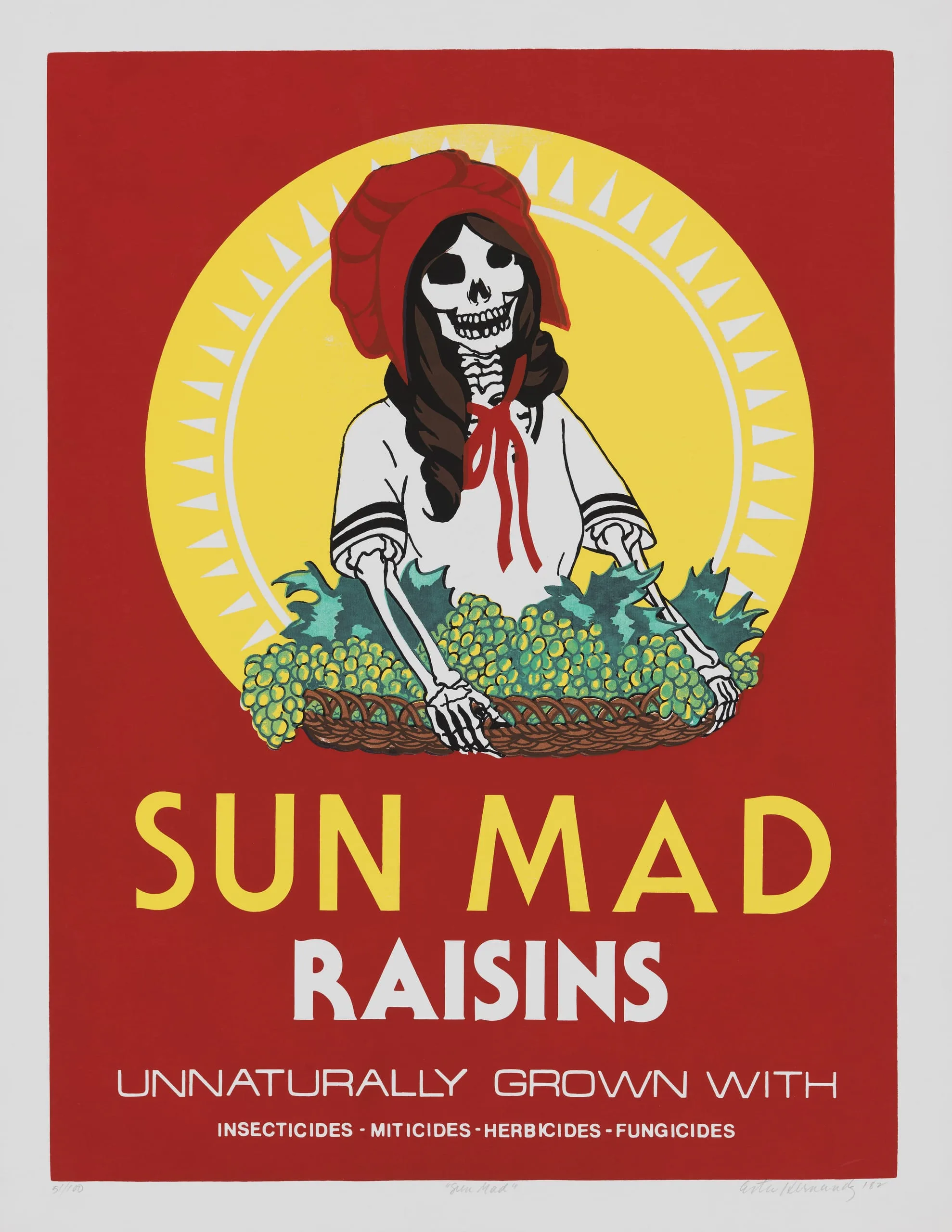
Artist and activist Ester Hernández uses witty, often biting appropriations of cultural icons to convey the Chicanx experience and advocate for marginalized people, particularly farmworkers. Sun Mad draws on her family’s experiences living and working in the San Joaquin Valley of Central California. In 1979, she learned from her mother that the water in her hometown had been contaminated for decades. Enraged by the unthinkable damage to her community, the artist struggled with how to respond. In 1981, she found the answer in a billboard for Sun-Maid, a privately owned cooperative of raisin growers whose large commercial farms dominated the area where she grew up. Sun-Maid’s iconic logo, introduced in 1916, depicts a smiling white farmworker holding a basket overflowing with juicy green grapes. Hernández transformed this edenic image to convey the harsh realities of farmworker life, replacing the original model with a leering skeleton and underscoring her anger with the altered slogan “Sun Mad Raisins, unnaturally grown with insecticides, miticides, herbicides, fungicides.”
This powerful critique references the work of Mexican printmaker José Guadalupe Posada (1852−1913), who used skeleton figures (sometimes referred to as calaveras) in his dark, satirical images (https://unframed.lacma.org/2023/06/14/graphic-legacy-jos%C3%A9-guadalupe-posada-two-lacma-exhibitions). This copy of Sun Mad is from the first edition, which was completed and signed in 1982. While Hernández employed master printers for the two subsequent editions (1992 and 2008), she printed the original run herself in her kitchen assisted by her young son. The print has been included in numerous publications and exhibitions, becoming one of the most reproduced images from the Chicano Movement.
Staci Steinberger
2019/2021