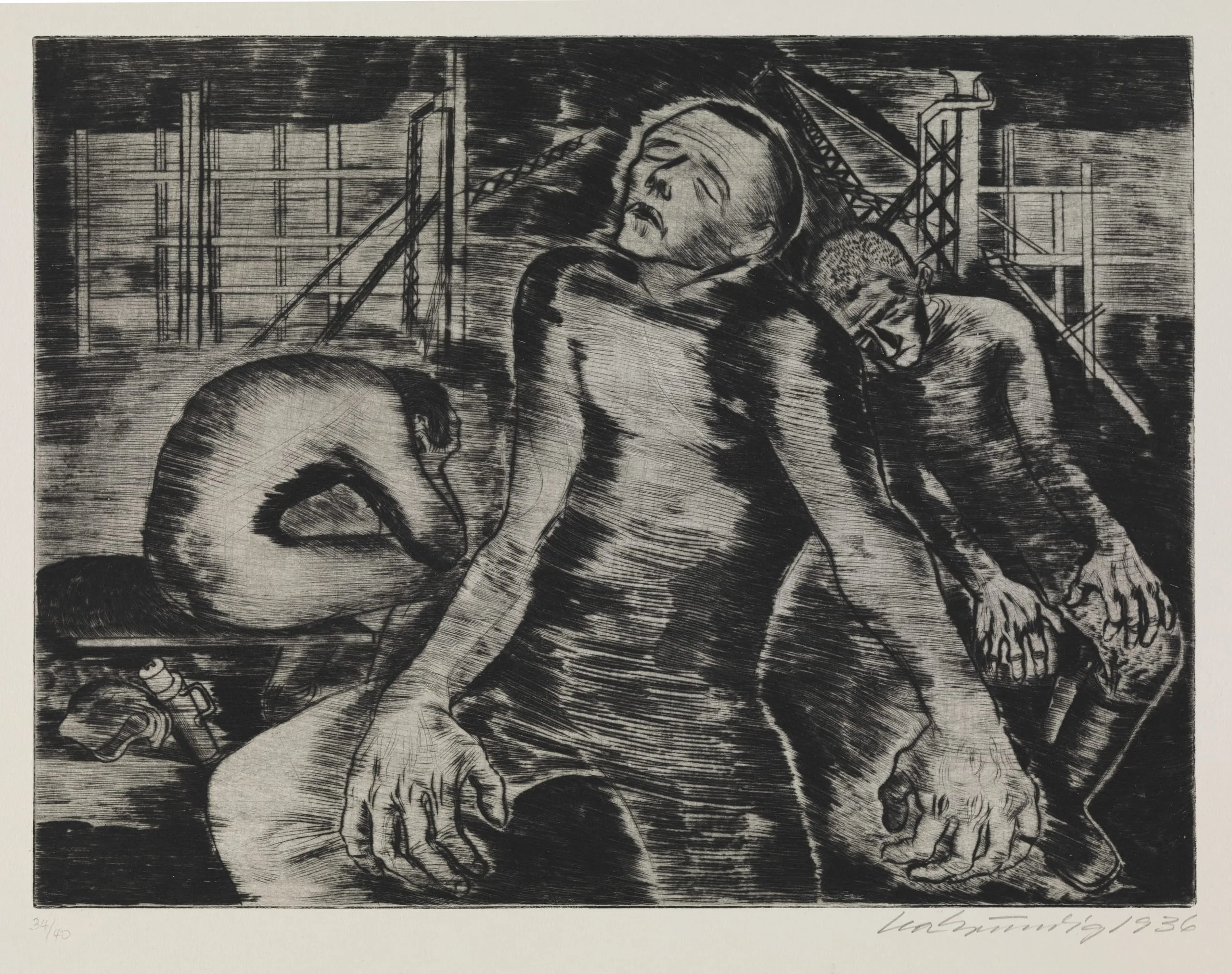
Lea Grundig was primarily a graphic artist, and her work reflected her ideological commitments, focusing on the lives of the working poor. When the Nazis came to power in 1933, her art became explicitly antifascist. After Work on the Highway (Nach der Arbeit auf der Autobahn) depicts the physical exhaustion and misery of laborers constructing the Autobahn. Their hands are as large and as lined as their faces; both manifest the physical toll of this unrelenting work. The image counters Nazi propaganda that celebrated the new German highway system as a symbol of modernization and progress. Construction of the Autobahn was overseen by the Organisation Todt (OT), a military and civil engineering firm whose founder, Fritz Todt, was an ardent Nazi. OT relied on compulsory labor from the Reichsarbeitsdienst (Reich Work Service) to build the Autobahn, but would later employ forced labor from concentration camps and occupied areas.
Raised in an Orthodox Jewish family, Grundig rejected the strict limitations placed on women in her community and left home in 1922 to study at the Dresden Academy of Fine Arts, where she met artist Hans Grundig, whom she later married. The two shared political views: both joined the Communist Party in 1926 and were founding members of Dresden’s chapter of the Association of German Revolutionary Visual Artists. The Grundigs were immediate targets of Nazi authorities for their overtly political art and their communist activism, and both were imprisoned in concentration camps at different times. Lea managed to flee Germany for Palestine in 1938, but Hans remained in custody until the end of the war. Lea returned to Germany in 1949, where she was reunited with Hans in Dresden, then part of the communist East German Democratic Republic.
Erin Sullivan Maynes
2022 (adapted from Pressing Politics: Revolutionary Graphics from Mexico and Germany, 90)