LACMA

ShopMembershipMyLACMATickets
LACMA
Los Angeles County Museum of Art
5905 Wilshire Blvd.
Los Angeles, CA 90036
info@lacma.org
(323) 857-6000
Sign up to receive emails
Subscribe
© Museum Associates 2025

Museum Hours

Monday

11 am–6 pm

Tuesday

11 am–6 pm

Wednesday

Closed

Thursday

11 am–6 pm

Friday

11 am–8 pm

Saturday

10 am–7 pm

Sunday

10 am–7 pm


  • About LACMA
  • Jobs
  • Building LACMA
  • Host An Event
  • Unframed
  • Press
  • FAQs
  • Log in to MyLACMA
  • Privacy Policy
© Museum Associates 2025
Collections

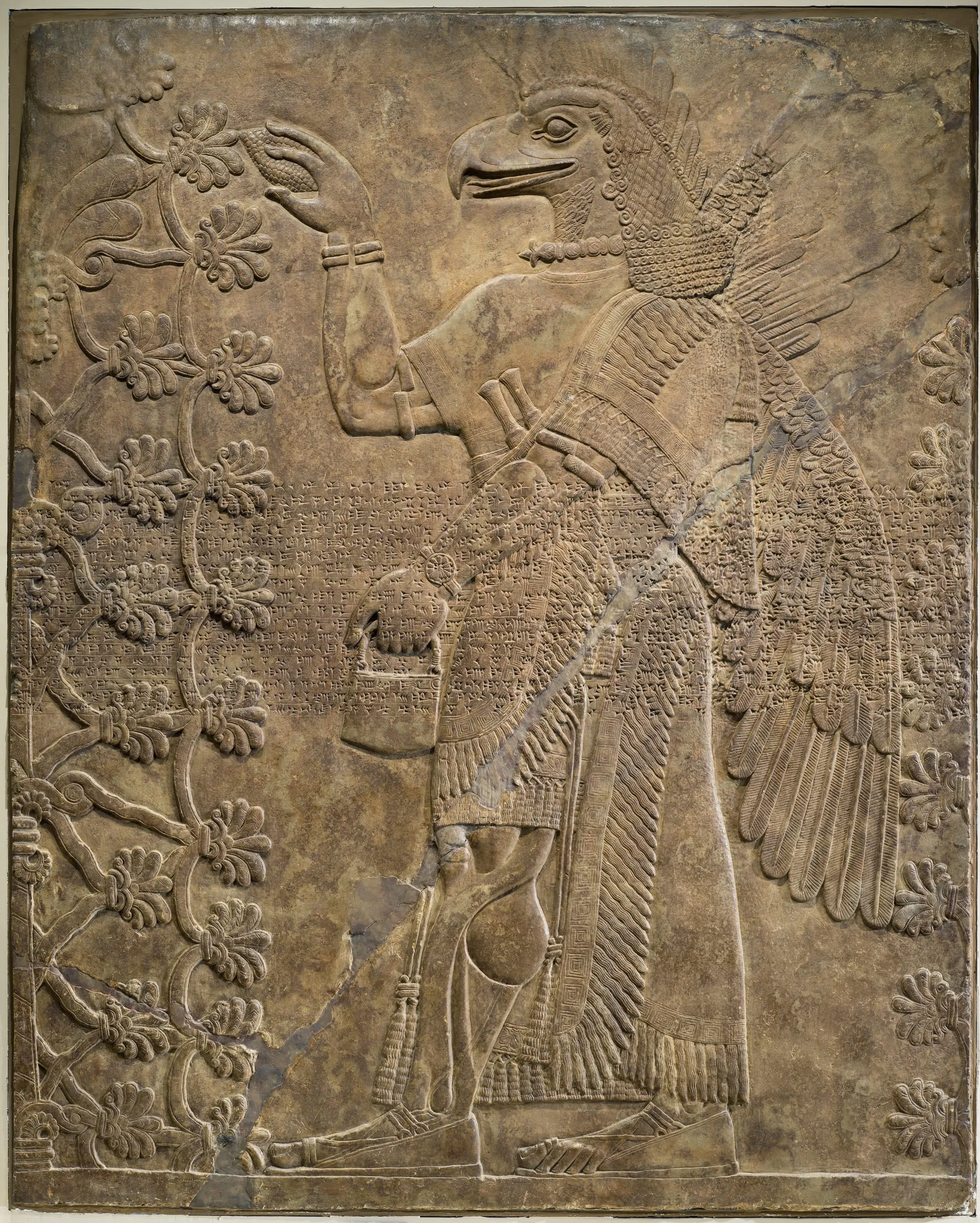
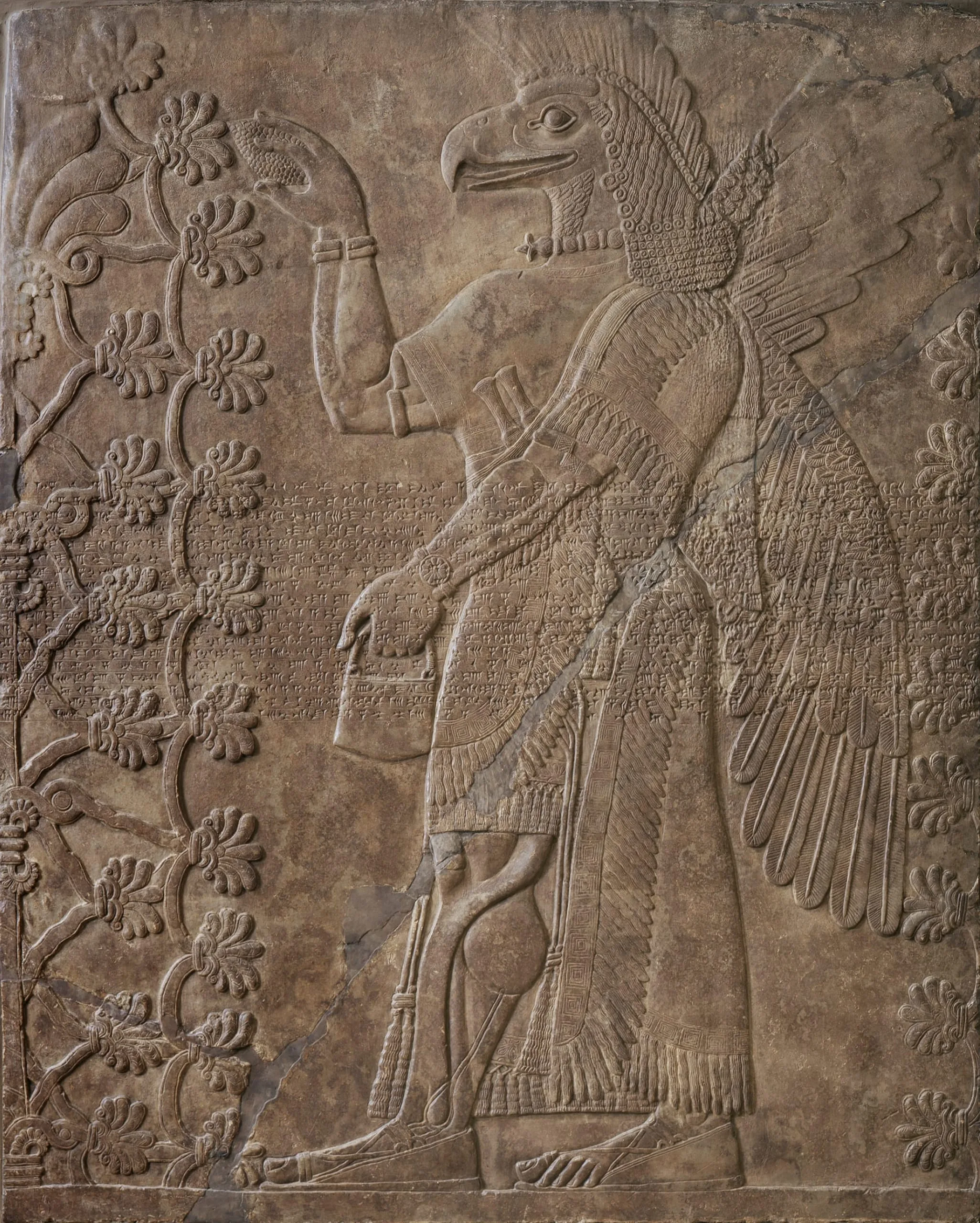
Eagle-Headed Supernatural BeingNeo-Assyrian Period (9th century B.C.)

On view:
Geffen Galleries, Assyrian Reliefs
Stone relief panel depicting a winged, eagle-headed human figure in profile holding a pinecone and bucket, with cuneiform inscription across the middle and stylized flowering vines to the left
Assyrian gypsum relief panel depicting a winged, eagle-headed figure in profile, holding a vessel and a staff, with finely carved feathered wings and fringed robes; flanked by a stylized flowering tree at left and rows of cuneiform inscription across the center.
Title
Eagle-Headed Supernatural Being
Place Made
Northern Iraq, Nimrud
Date Made
Neo-Assyrian Period (9th century B.C.)
Medium
Alabaster
Dimensions
99 1/4 × 71 1/2 × 6 in. (252.1 × 181.61 × 15.24 cm) Weight: 1 Ton 1500 lb. (1587.6 kg) Mount: 12 × 72 × 18 in. (30.48 × 182.88 × 45.72 cm)
Credit Line
Purchased with funds provided by Anna Bing Arnold
Accession Number
66.4.4
Classification
Sculpture
Collecting Area
Art of the Middle East: Ancient
Curatorial Notes

This splendid panel is one of a group of five low-carved reliefs (see also 66.4.1, .2, .3, .5) from the northwest palace of the Assyrian king Ashurnasirpal II (r. 883-859 BC), at Nimrud (ancient Kalhu). Located on the Tigris River in northern Iraq, the site was first excavated by British archaeologist Austen Henry Layard in 1845. Built of mud brick on stone foundations, the lower interior levels of the palace were decorated by an extensive sequence of alabaster slabs that were carved in place and originally painted in black, white, red and blue. Rendered with remarkable detail, this panel depicts an eagle-headed supernatural being holding a bucket and a cone, possibly connected with some purifying or protective ritual. Here and across the center of the other panels is a cuneiform inscription enumerating the king’s accomplishments.

The LACMA reliefs were discovered in adjacent rooms in 1855 by William Kenneth Loftus, who succeeded Layard. They were subsequently offered to the Literary and Philosophical Society of Newcastle upon Tyne, England, and for more than a century they were displayed near the entrance of that institution. In 1966, thanks to the generosity of Anna Bing Arnold, the reliefs were purchased and presented to the Los Angeles County Museum of Art.


Selected Bibliography
  • Mousavi, Ali. Ancient Near Eastern art at the Los Angeles County Museum of Art. Los Angeles: Los Angeles County Museum of Art, 2012.
  • Muchnic, Suzanne. LACMA So Far: Portrait of a Museum in the Making. San Marino, California: Huntington Library, Art Collections, and Botanical Gardens, 2015.
  • Gifts on the Occasion of LACMA's 50th Anniversary. Los Angeles: Los Angeles County Museum of Art, 2015.