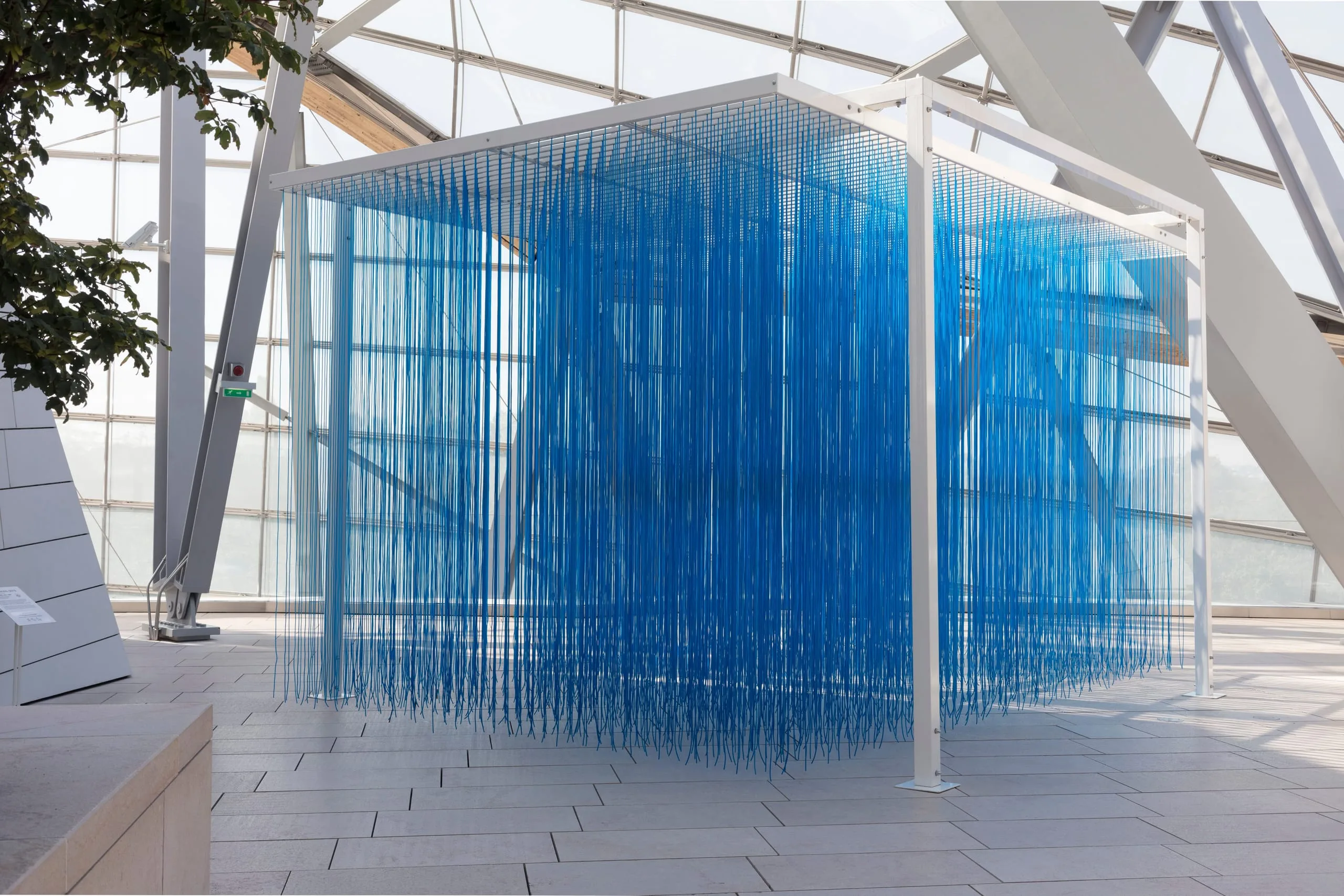
Jesús Rafael Soto was an internationally renowned figure associated with Op and kinetic art. He created his first Penetrable in 1966–67 using simple materials—plastic tubes and metal. The Penetrables are a series of optical, kinetic, and tactile environments meant to be traversed physically. The works vary in size and can be placed anywhere. These immersive installations of hundreds of precarious dangling tubes absorb viewers in a boundless field of light and color, at once solid and ethereal. Viewers are encouraged to step in and become part of the artwork, rather than contemplate it from a distance. By giving the spectator agency, Soto challenged traditional ways of seeing and promoted a more democratic approach to art. Through this radical form of engagement, he hoped to alter viewers’ perceptions and unleash their imaginations.
The Penetrables embody Soto’s interest in the intangible quality of light and the dematerialization of solid matter—what he called the “density of space, its fullness.” As he explained: “My concept of space is very different from that of the Renaissance, where man was in front of space, he was the viewer, the judge of that space. . . . [With] the Penetrables, I show how people . . . are part of space. This is the sensation of those who enter them; their feeling of joy is similar to getting in the water and being completely liberated from gravity.”
Soto’s interest in art developed in his native Ciudad Bolívar, in Venezuela, where he worked as a sign painter for cinemas. There he employed inexpensive industrial paints (cobalt blue, black, white, green, yellow, and red), which became the trademark colors of his mature work. From 1942 to 1947, he studied fine arts at the Escuela de Artes Plásticas (School of Fine Arts) in Caracas but became disillusioned with its conservative teaching methods. Fascinated with Cubism and Constructivism (especially the works of Georges Braque, Piet Mondrian, and Kazimir Malevich), which he knew only through reproductions, in 1950 he relocated to Paris—a hub of artistic experimentation and a mecca for Latin American artists. There he met the legendary gallerist Denise René (1913–2012) and participated in her historic 1955 kinetic exhibition Le Mouvement, which helped launch his international career.
Ilona Katzew