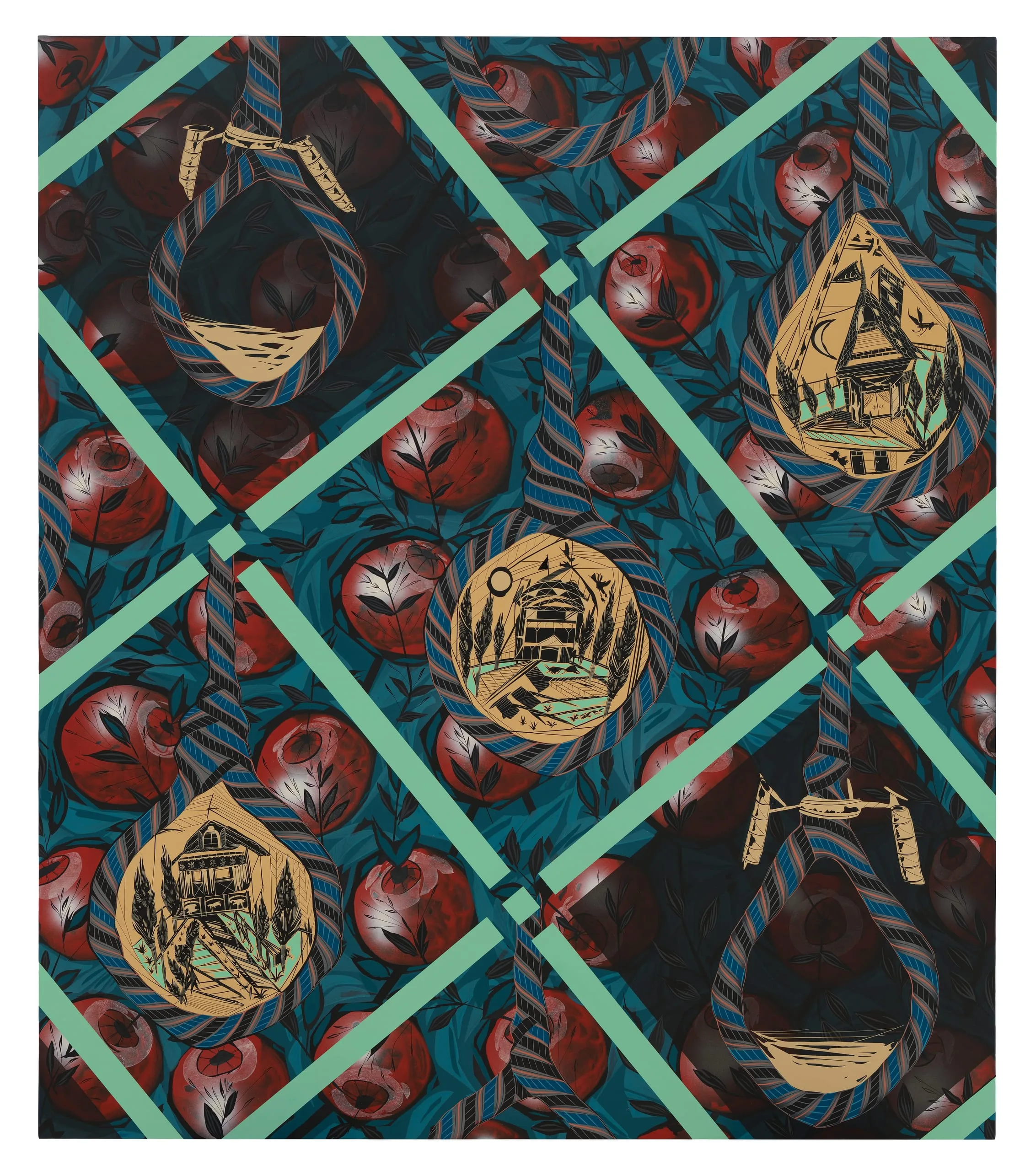
Lari Pittman is known for his intricately constructed and exquisitely detailed paintings that draw on the history of art, with an emphasis on decoration. Each of his works typically features a glossary of decorative marks, codes, and signifiers with references to sexuality, gender, and other current social issues. He was also a long-time influential teacher at UCLA.
Pittman has long been interested in textiles and textile/costume design. Each of the paintings in his 2018 “Portrait of a Textile” series is a "portrait" of a particular kind of fabric (damask, brocade, taffeta, etc.). Portrait of a Textile (Damask) harks back to the early history of this fabric, whose name derives from the city of Damascus, which was active both in the manufacture and trading of textiles in general and damask in particular in the early Middle Ages. Crusaders who passed through Damascus introduced the fabric to Europe in the eleventh century, where it was soon produced in France, Flanders, Italy, and elsewhere. Damasks typically include only one or two colors, which accounts for the relatively subdued (for Pittman) coloration of this painting (though his extraordinary color sense is still very evident).
The imagery of Portrait of a Textile (Damask) includes pomegranates, a fruit that originated in the ancient Near East, was introduced into Spanish America in the late sixteenth century and into California in the eighteenth century (thus combining aspects of Pittman’s personal heritage—his mother was Colombian, and he was born, educated, and continues to work in Los Angeles). Nooses likewise figure prominently in the painting, perhaps alluding to contemporary social and political threats related not only to Syria and the Middle East but closer to home as well.