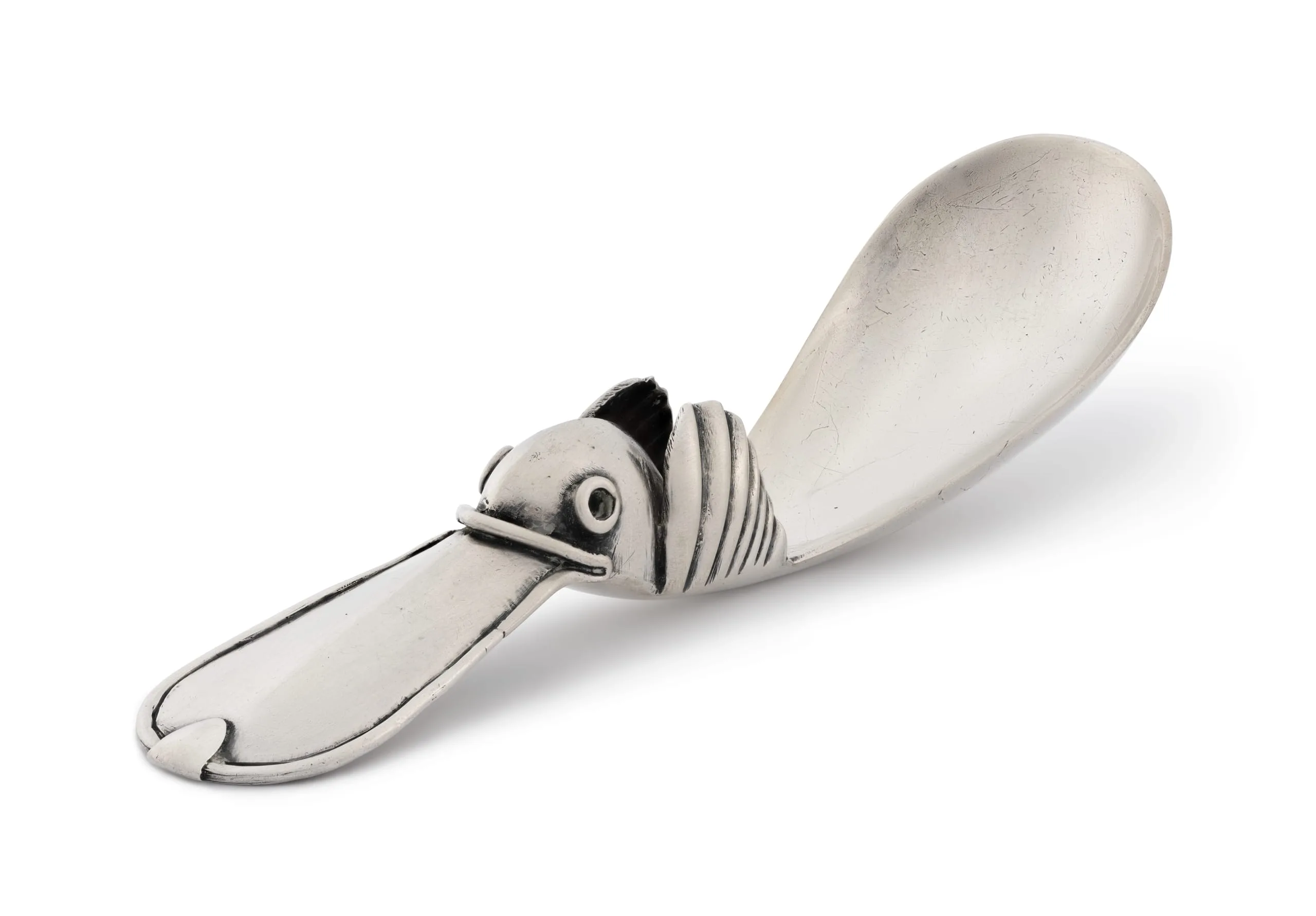
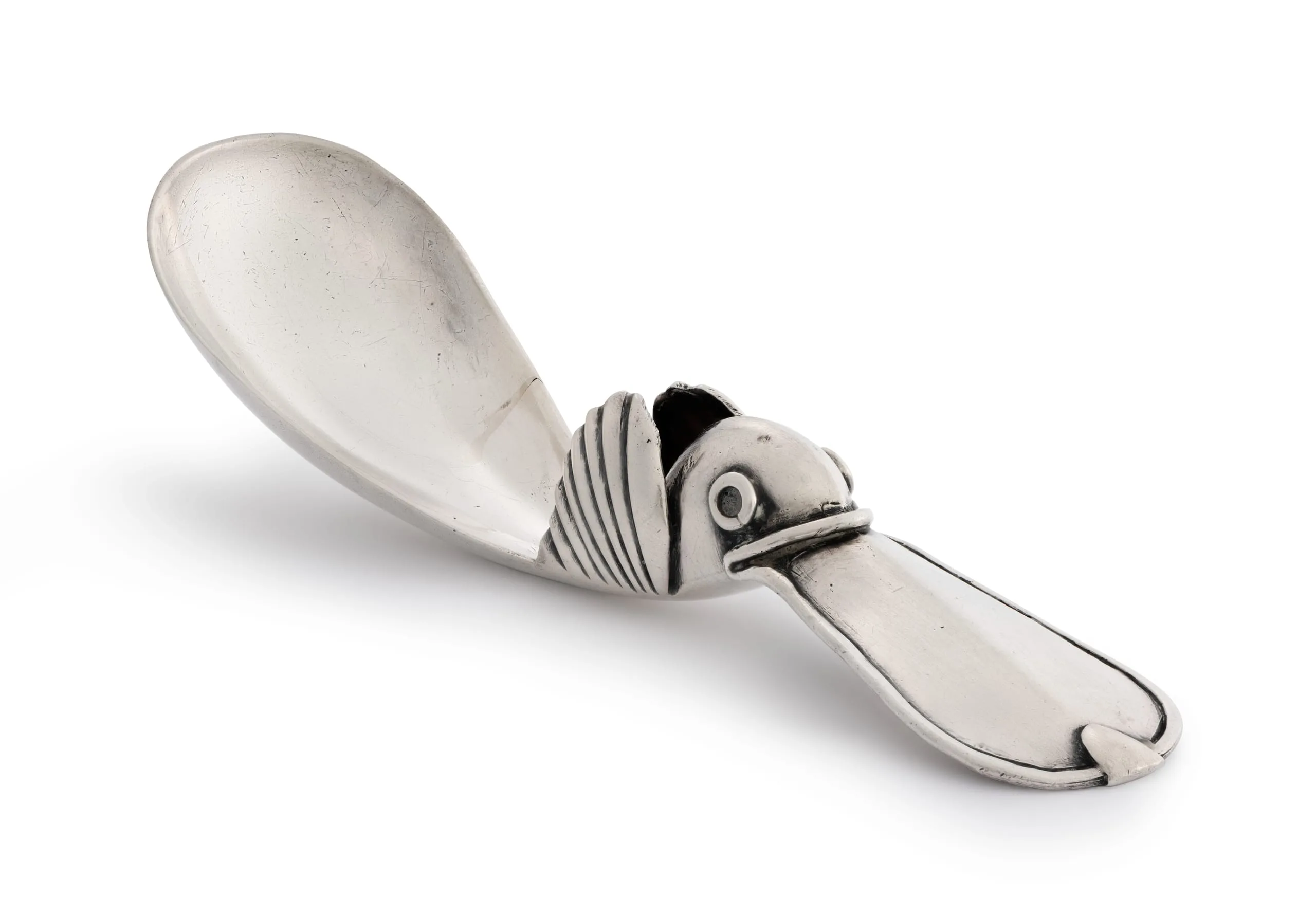
William Spratling described this design as an “Aztec duck.” An avid collector of Mesoamerican art, he frequently adapted ancient motifs in his modern designs. Many of his works reinterpret animals, which were important subjects in Mesoamerican art. The exaggerated bill of Spratling’s duck recalls Olmec duckbill pendants (https://www.doaks.org/resources/olmec-art/catalogue/36-duck-billed-pendant), an example of which was recorded by Spratling’s friend, the artist Miguel Covarrubias (1904–1957), in his notebooks (https://www.mesoweb.com/olmec/publications/Covarrubias.pdf). In Spratling’s version, the duck’s short wings are raised in flight and its curved body forms the bowl of the spoon. Spratling introduced this design in the early 1950s, and its popularity kept it in production until his death in 1967.
LACMA has two later examples of this spoon (M.2018.68.38; M.2018.68.60). Hallmarks, stamped into the silver, are helpful tools that allow us to more precisely date the spoons as Spratling slightly modified his marks over time. The hallmarks also tell us that this spoon was produced by Conquistador, the largest silver factory in Mexico at the time, toward the end of its contract with Spratling. Each spoon is handwrought, possibly by different makers, accounting for slight differences in the shape and angle of the wings.
Trained as an architect, Spratling moved from New Orleans to Taxco, Mexico, where he established his first silver workshop in 1931. Working alongside master silversmiths and local apprentices, in 1935 he opened his famed Taller de Las Delicias, which attracted a cohort of international artists, intellectuals, and Hollywood celebrities. Spratling’s emphasis on craftsmanship and his experimentation with different sources, including Mesoamerican art, Art Deco, and modernism, contributed to his great success and helped revitalize the Mexican silver industry.
Rachel Kaplan
2025