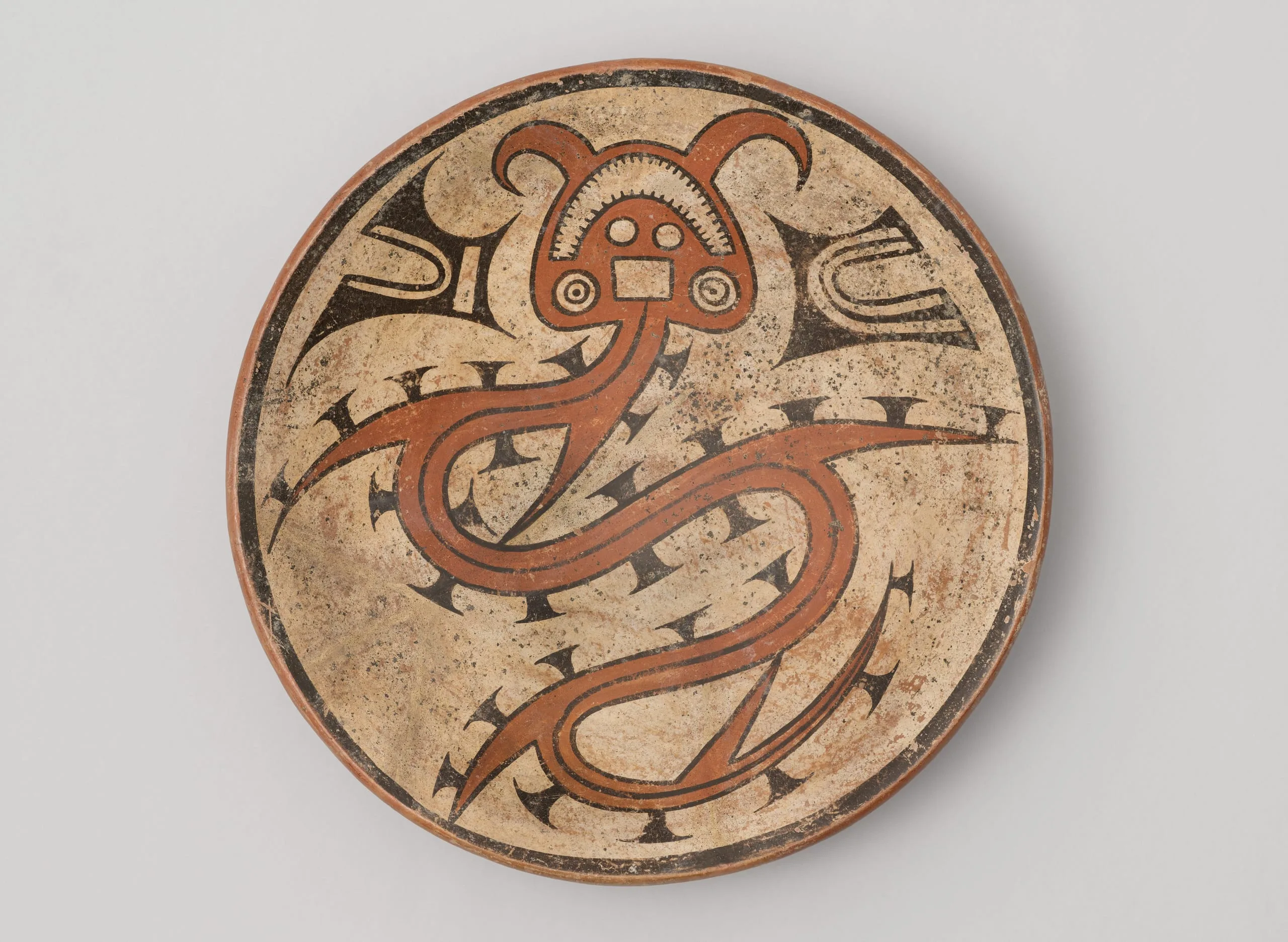
Serpentine beings are common in Panamanian iconography from about the sixth century onward. Here, the sinuous body forms an exaggerated S-shape and is covered in sharp, jagged appendages rendered in black. The artist painted it onto a whitish background using deep orange and black slip, not yet employing the blue and purple colors that come to define the unique polychrome palette of ancient Panamanian ceramics, in particular the Joaquín and Macaracas styles. We will never know the significance of the striking, toothy smile, but it does contrast with the more ferocious appearance of similar beings found on other Panamanian ceramics.
The swirling form is strongly evocative of an aquatic setting, suggesting its significance lies in its association with a watery underworld or primordial ocean. The black appendages have also been interpreted as feathers, linking this depiction to Mesoamerican feathered-serpent mythologies. That said, the two protrusions from the lower jaw seem to represent barbels, characteristic of catfish, indicating that this design may be a predecessor to the later, more clearly identifiable catfish seen on Macaracas-style pedestal plates (see M.2016.348.17, M.2006.170.2, M.2007.227.1, and M.2016.348.23).
Selected Bibliography
Grinnell, Alan. Painting the Cosmos: Art and Iconography of the Ceramics of Ancient Panama. University of New Mexico Press, 2025.