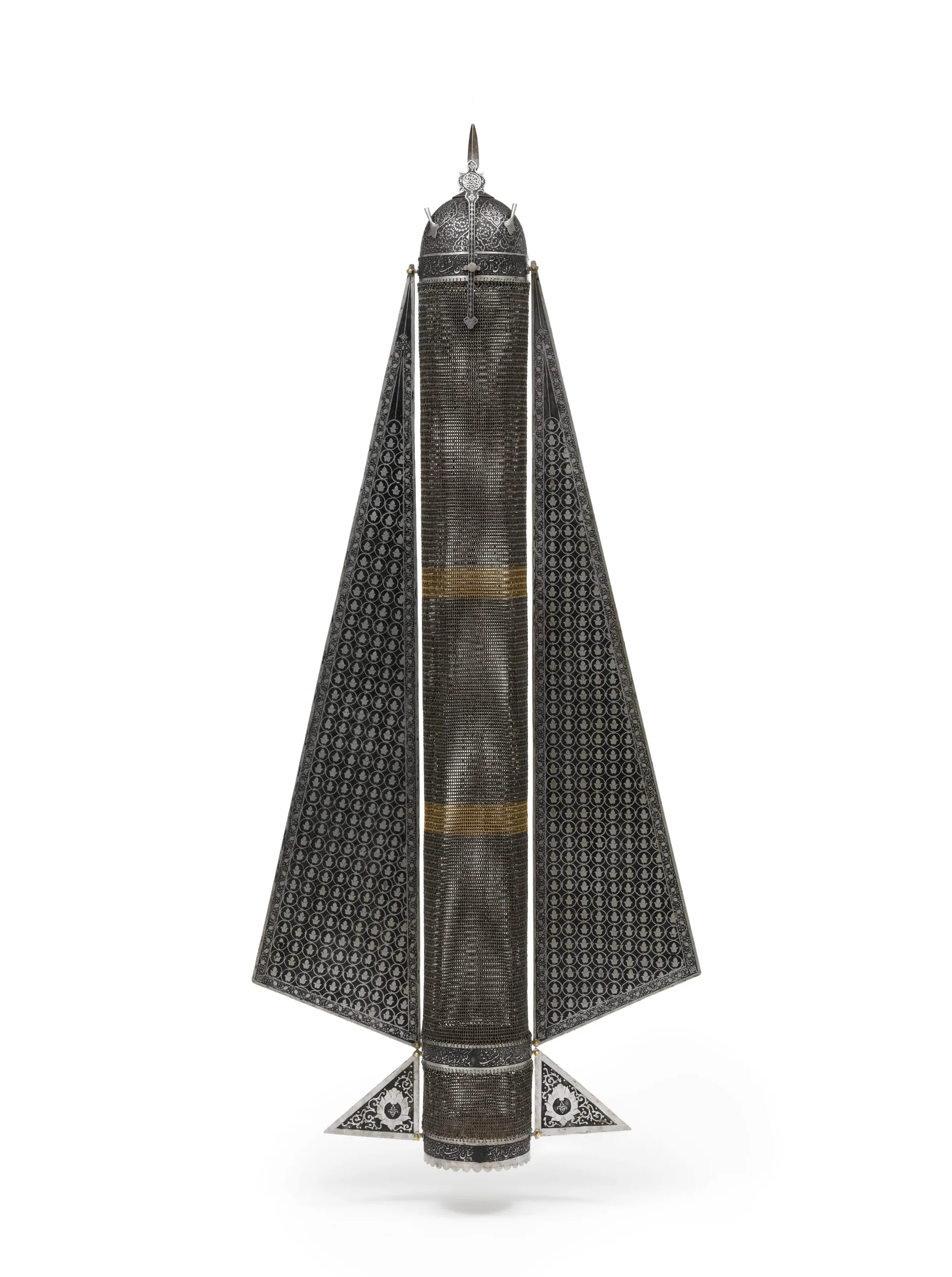
At 6 feet tall, Shahpour Pouyan’s sculpture Projectile 8 looks at once like a missile used in modern warfare and a medieval warrior standing at the ready. A battle helmet sits atop a cylinder of chainmail from which wings and fins protrude, resulting in a silhouette that accentuates the work’s anthropomorphism. The metalwork is finely decorated with calligraphy and ornate floral designs. It is an imposing construction, but also one that connotes an air of elegance. To produce it and other works from his Projectiles series, Pouyan worked with Iranian artisans trained in creating traditional armor ensembles for ta’ziya, Shi’ite passion plays whose anachronistically costumed reenactors memorialize the death of Imam Hussein.
Pouyan, now based in New York, was born in Isfahan the same year as the Islamic Revolution and his childhood coincided with the prolonged, bloody war between Iran and Iraq. At the same time, he developed an appreciation for the long and varied history of Persian art and architecture. His own practice reflects this dual fascination between militaristic force and refined cultural traditions like miniature painting or epic poetry, which he explores through various media including metalwork, ceramics, painting, and installation pieces. Central to his work is an examination of power and wealth, and in particular the ways that violence and patriarchy intersect with art and aesthetics.