- Artist or Maker
- Lyonel Feininger
United States, New York, New York City, also active Germany and France, 1871-1956 - Title
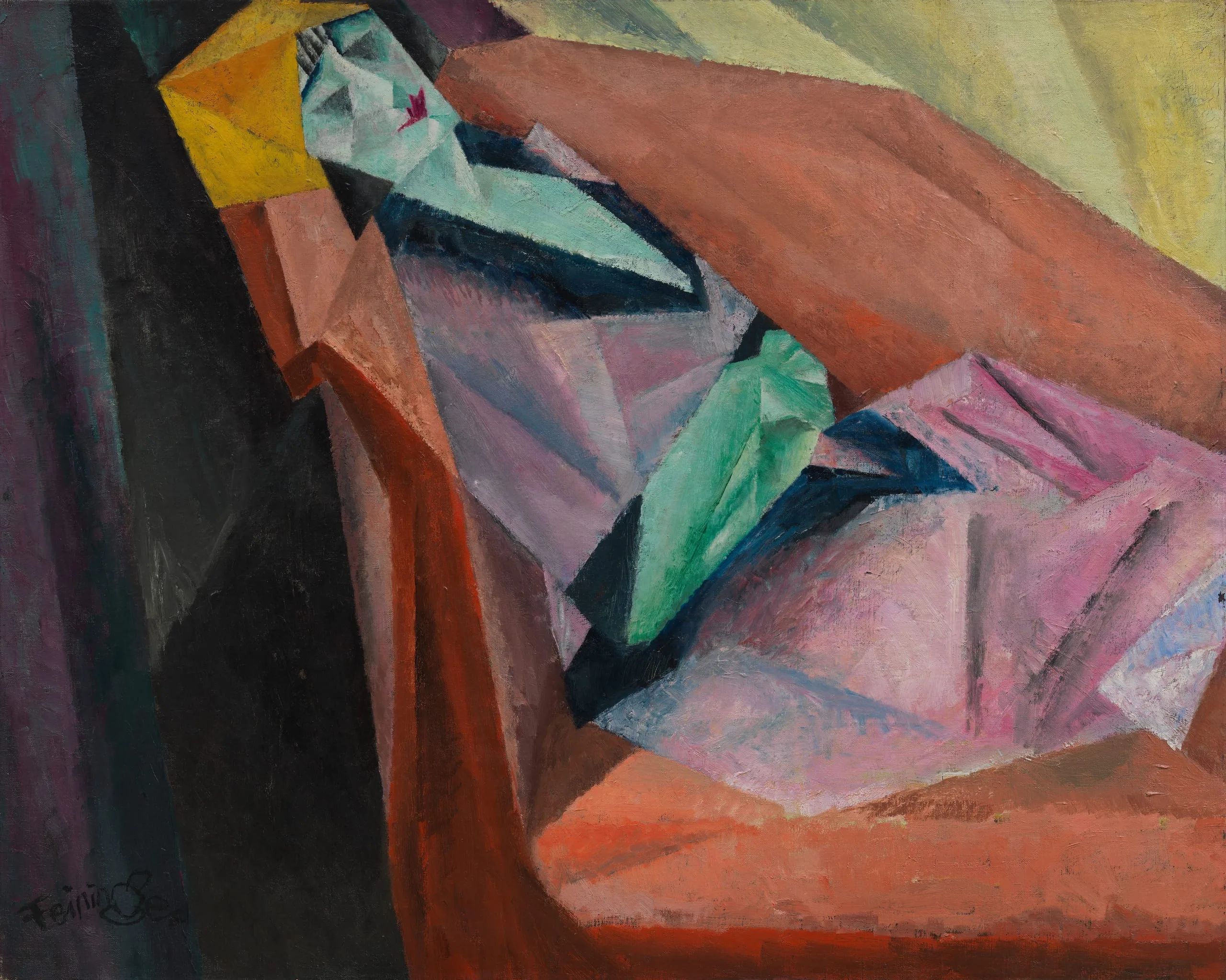
- Sleeping Woman – Julia (Die Schläferin – Julia)
- Date Made
- 1913
- Medium
- Oil on canvas
- Dimensions
- 31 1/2 × 39 1/2 in. (80.01 × 100.33 cm)
- Accession Number
- M.2017.1.1
- Curatorial Notes
Lyonel Feininger, born in New York to German parents, was sent to Hamburg at age sixteen to study music. Instead, he studied art at the Applied Art College and by 1906 began a twenty-year career as a cartoonist for the Chicago Sunday Tribune while living temporarily in Paris. By 1912 he had made a transition away from cartoon work to a style of intersecting planes and overlapping surfaces influenced by Cubism, which he had seen during a return to Paris from Berlin in 1911.
Sleeping Woman – Julia, which portrays the subject realistically as she reclines along the picture plane’s diagonal, is perhaps Feininger's most intimate study of his wife. Her facial features and folds of clothing seem to resemble a mountainous landscape, indicative of Feininger’s response to Cubism, wherein he equates “living form” with the crystalline shapes that were so much a part of the heritage of the literary and artistic era of German Romanticism of the early nineteenth century. The luminosity and transparency of the faceted forms lend the work a transcendent quality in keeping with Feininger’s belief, expressed to publisher Paul Westheim, that artists must go beyond nature to “portray our inner vision, find our ultimate form uninfluenced by nature in order to express our longing.” The year he painted this portrait he was invited to exhibit with the German Expressionist group Der Blaue Reiter (The Blue Rider), whose works demonstrate a commitment to spirituality and subjective expression. Of twenty-one paintings completed in 1913, only two are devoted to the human figure; both are portraits of his wife.
Provenance :
This painting was first exhibited in 1913 at Neue Kunst Hans Goltz gallery in Munich.
- Provenance
The artist (1871-1956); Estate of the Artist; by inheritance to his wife Julia Feininger (1880-1970), New York; Estate of Julia Feininger; [sold to Marlborough Gallery, New York]; [Sold at Christie’s, London, Sale 6027, Lot 115 “German Pictures,” October 9, 1998]; to Robert (1922-2012) and Mary M. Looker (1925-2025); given in 2017 to LACMA.
- Selected Bibliography
- Gifts from Mary and Robert Looker, Los Angeles County Museum of Art, December 2017. Los Angeles: Los Angeles County Museum of Art, 2017.
Moeller, Achim. Lyonel Feininger: The Catalogue Raisonné of Paintings. "Die Schläferin (Julia), 1913," no. 122. Moeller Fine Art, 2018. Online catalogue raisonné, http://feiningerproject.org/catalogue/entry.php?id=240.
- Copyright
- © Artists Rights Society (ARS), New York / VG Bild-Kunst, Bonn