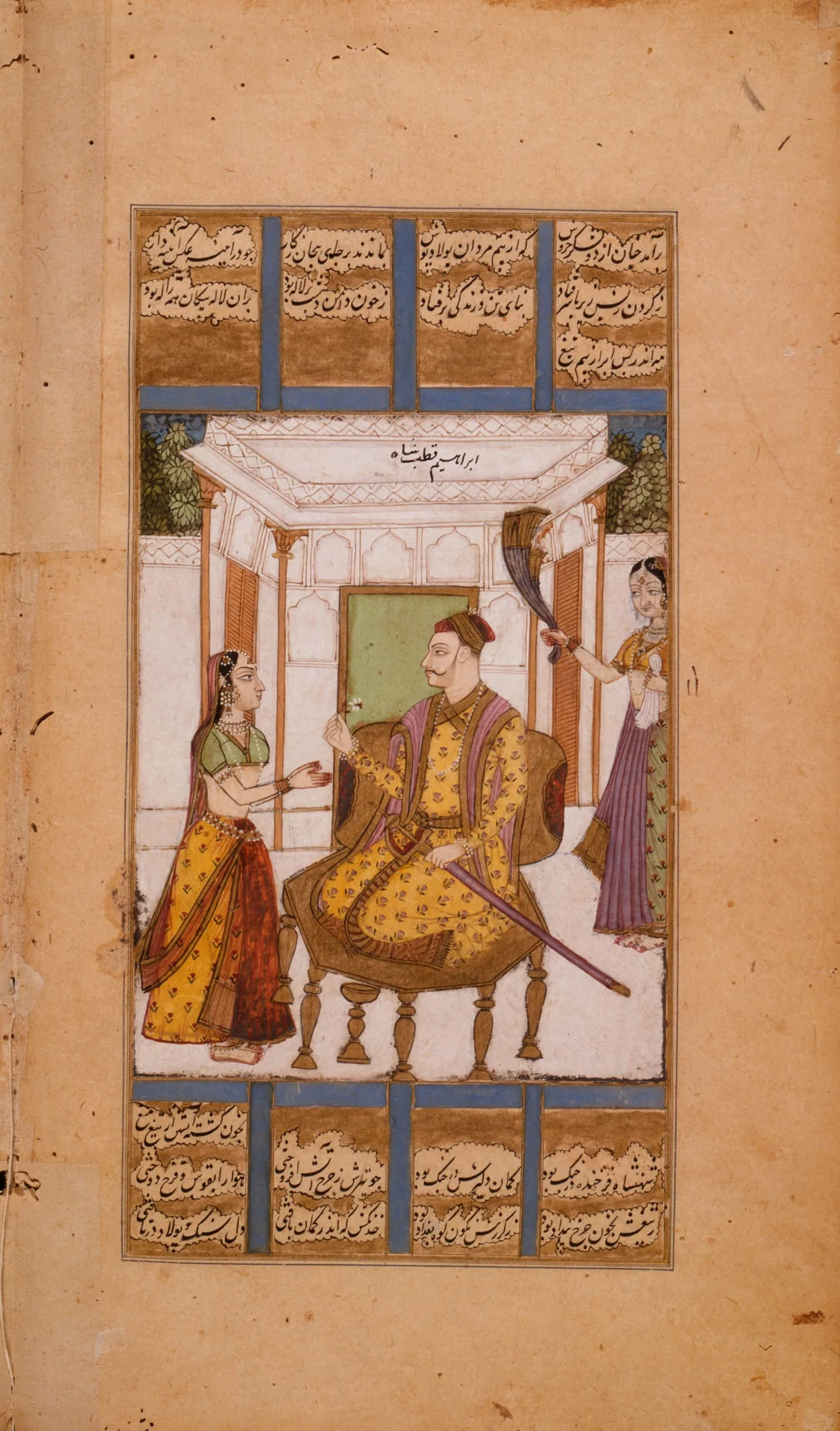
- Title
- Sultan Ibrahim Qutb Shah (r. 1550-1580), Folio from an Illuminated Manuscript of the History of the Qutb Shahi Sultans of Golconda and Hyderabad
- Date Made
- manuscript dated 1610-1611; illustrations: circa 1700
- Medium
- Opaque watercolor, gold, and ink on paper
- Dimensions
- Sheet: 12 1/2 × 7 1/8 in. (31.75 × 18.1 cm)
Panel (Text): 8 7/8 × 4 1/2 in. (22.54 × 11.43 cm)
- Accession Number
- M.89.159.4d
- Curatorial Notes
The Qutb Shahi dynasty (or the Golconda Sultanate, 1518–1687) ruled from Golconda Fort and, after 1591, nearby Hyderabad, Telangana. The dynasty was founded in 1518 when Sultan Quli Qutb Shah (or Sultan Quli Qutb al-Mulk, r. 1496-1543) declared his independence from the Bahmani Sultanate (1347-1527), which splintered into the independent sultanates of Ahmadnagar, Bijapur, and Berar in 1490; Golconda in 1518; and Bidar in 1528. This illuminated manuscript consists of 450 pages with five illustrations. Its colophon states it was copied by the scribe Habibullah Gilani in 1610-1611 (AH 1019) during the reign of Sultan Muhammad Quli Qutb Shah (r. 1580-1612). The illustrations were likely added in circa 1700.
Sultan Ibrahim Qutb Shah (r. 1550-1580) was born in 1518. He was the fourth sultan ruler of Golconda in the Qutb Shahi dynasty. After his father Sultan Quli Qutb Shah was assassinated in 1543 by his brother Jamshid Quli Qutb Shah (r. 1543-1550), Ibrahim Qutb Shah fled to the court of Vijayanagara, Karnataka to seek refuge under the regent Ramaraya (officiated 1542-1565). When Jamshid Quli Qutb Shah died in 1550, Ibrahim Qutb Shah returned to Golconda and claimed the throne. During his stay in Vijayanagara, he became enamored of Hindu Telugu culture and took on the Telugu names Malki BhaRama and Ibharama Chakravarti. He was an ardent patron of Telegu poetry. Nonetheless, in 1565 he joined an alliance of the Deccani Sultanates to overthrow Vijayanagara.
- Selected Bibliography
- Pal, Pratapaditya. Indian Painting, vol.1. Los Angeles: Los Angeles County Museum of Art, 1993.