Weber painted still lifes throughout his career. In Essays on Art he expressed his reverence for the simple objects of a still life: "We speak about things, but we seldom hear things speak to us. Things, objects, mutely cry to us: Touch us, taste us, feel us, see us, understand us, make us more than we are through your association, through your tactile and spiritual intimacy" (p. 31). His still-life paintings of the 1920s and 1930s reflect Weber’s move away from abstraction toward a more naturalistic art. While Weber was often more adventuresome in his figure paintings, in his still lifes he remained conservative for a longer period of time. Well into the 1930s his still lifes reflected the influence of Cézanne.
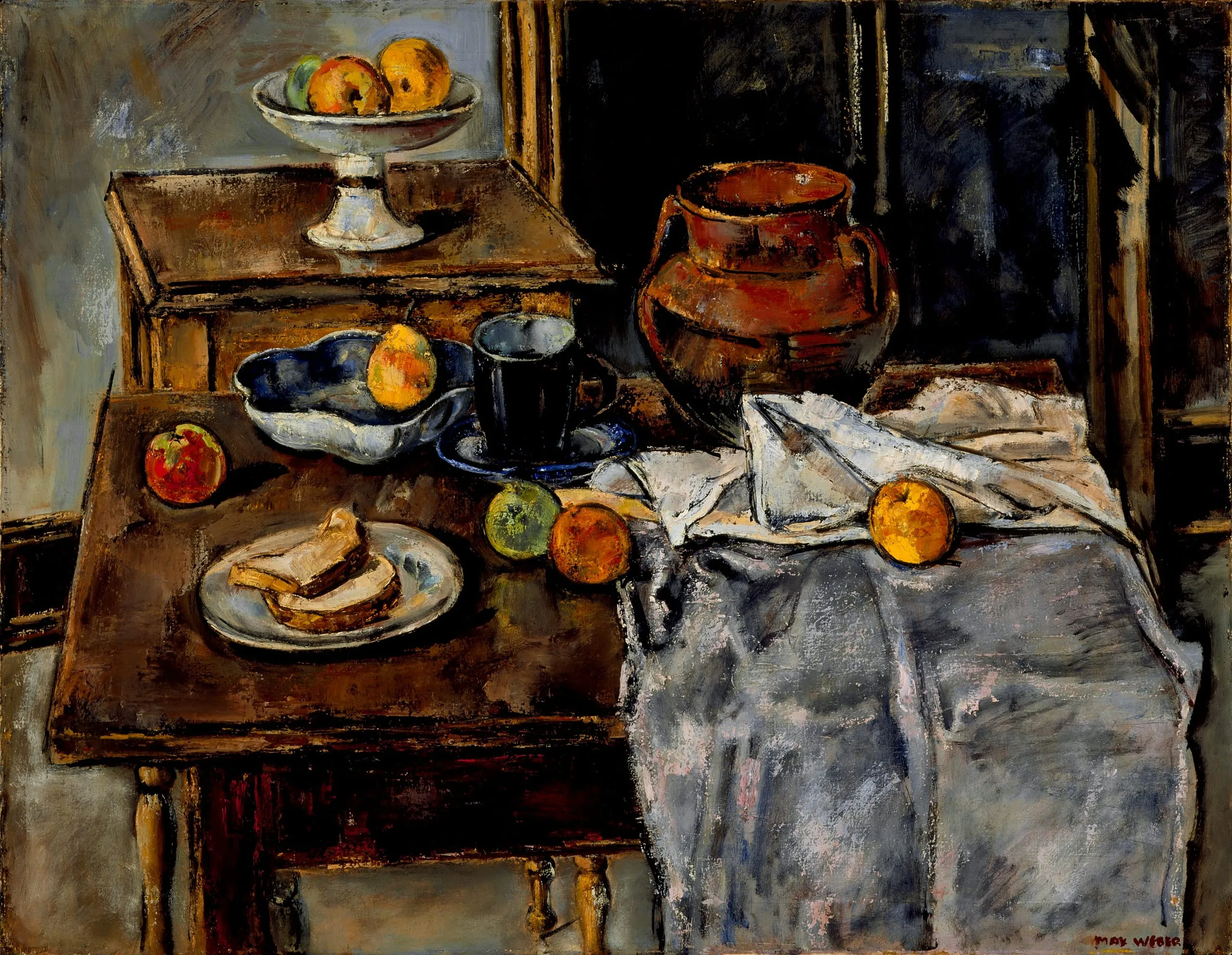
Almost all of Weber’s still lifes are tabletop arrangements. Still Life with Two Tables is among the most complex, including two tables laden with many objects. Following Cézanne, Weber tilted the tables up and arranged the fruit in and around dishes and drapery in a seemingly haphazard arrangement. The apparent casualness of the scene belies the carefully constructed composition. Weber subtly balanced the smaller table on a slightly oblique angle behind the larger one. Details are also orchestrated for total harmony: the crumpled white drapery on the right of the large table is balanced by the exposed wood of the table on the left, just as the large, circular orange vase echoes the shape of the light blue plate with bread.
In Still Life with Two Tables forms are constructed with contrasting shades of color, heavy black outlines, and built-up paint. Although Weber presents commonplace objects, he creates a sensuous beauty out of the richness of his pigments, boldly stroked on the canvas, and the delicacy of his palette. While Weber was heavily indebted to Cézanne in the compositions of his still lifes, he differed from the French master in his use of color. In his still lifes of the 1930s Weber turned more to a grayed palette, which he referred to as "mellow," to achieve a greater range of delicate tones. He felt that with this coloring he could achieve more control and serenity. Paintings such as Still Life with Two Tables, with its cool blues, grays, and browns, became studies of hushed silence, reflecting the artist’s controlled interior world.