- Title
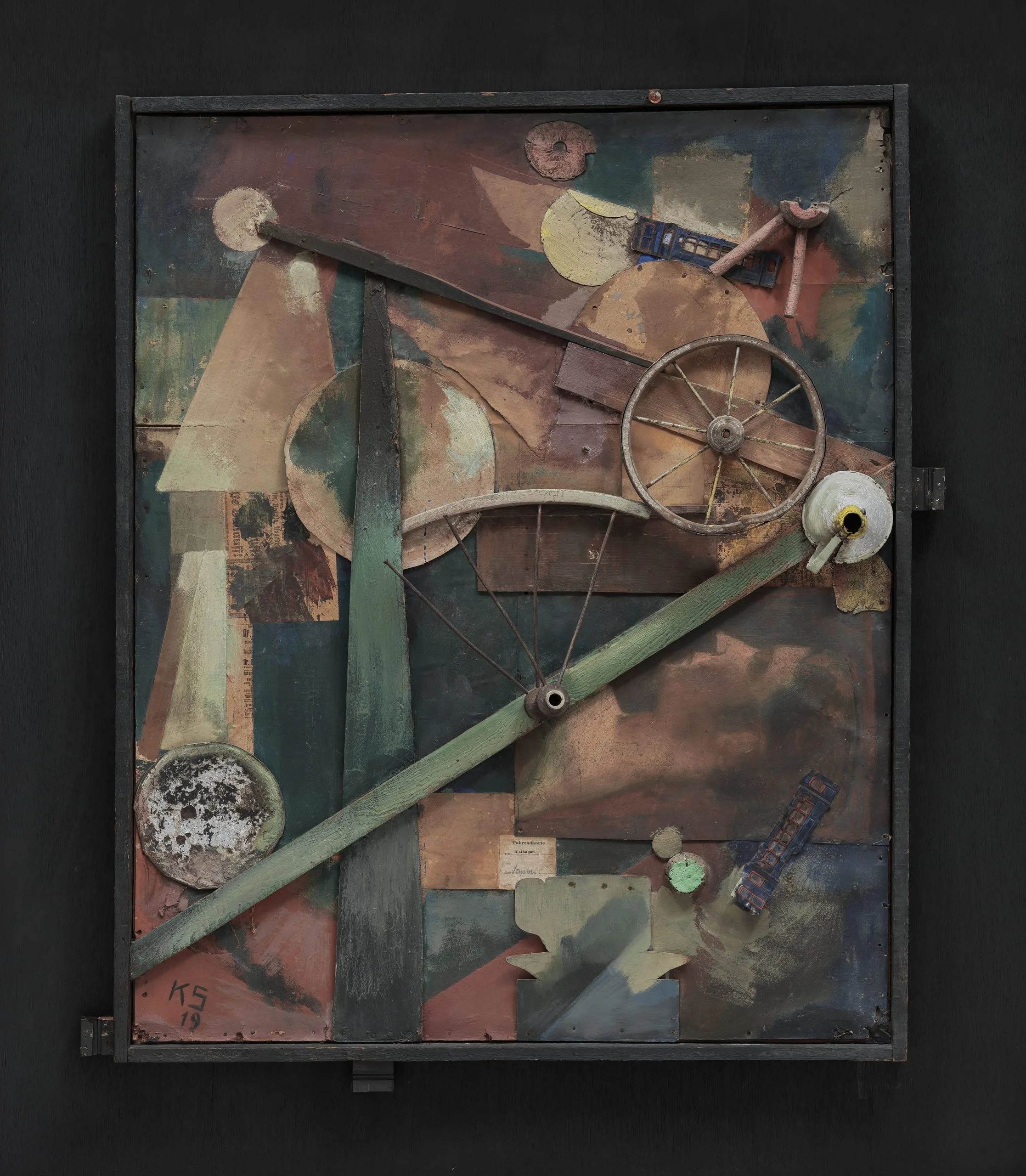
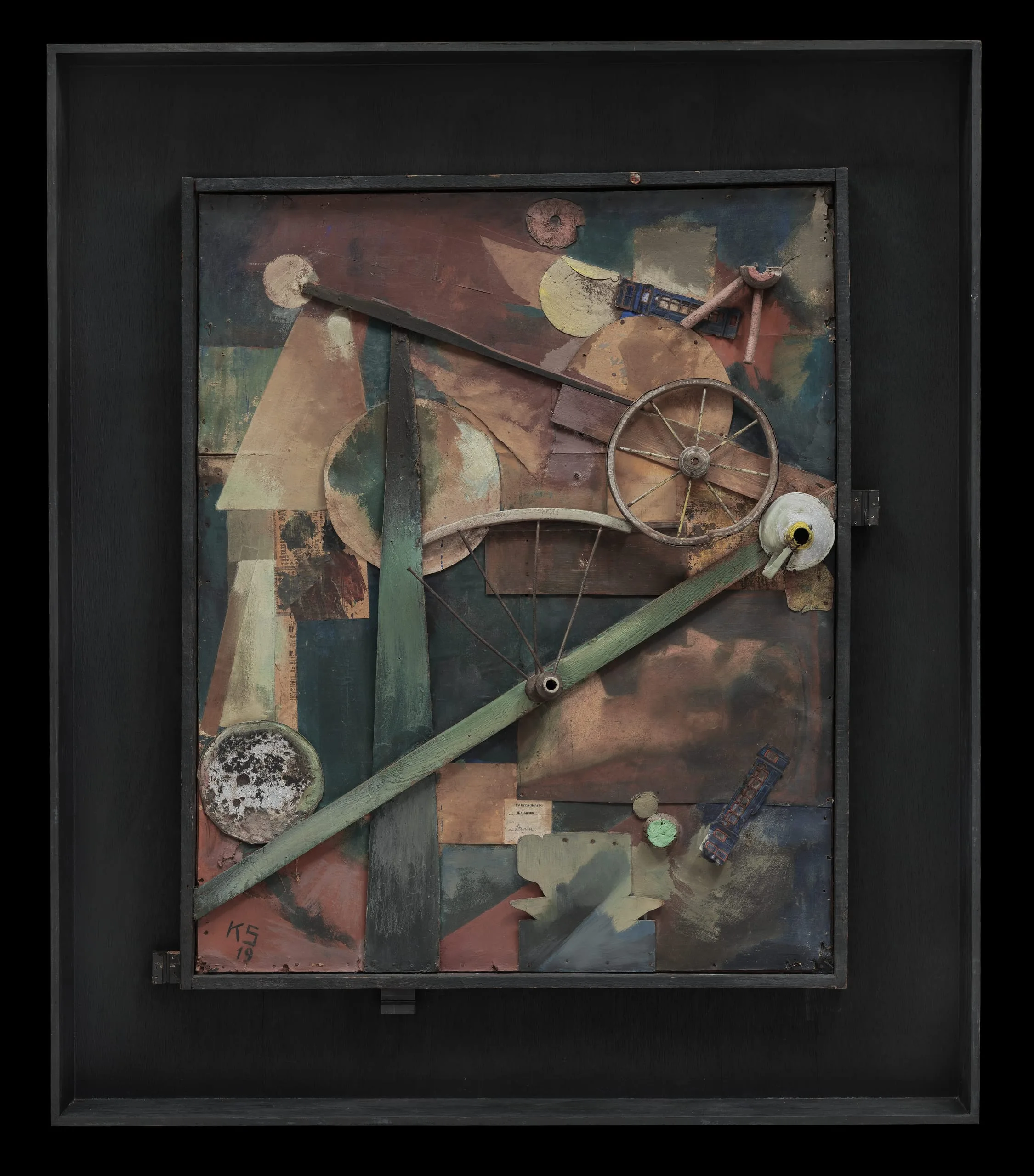
- Construction for Noble Ladies
- Date Made
- 1919
- Medium
- Oil, watercolor, gouache, wood, metal, leather, cork, paper, and board on board, mounted on wood
- Dimensions
- 40 1/2 × 33 in. (102.87 × 83.82 cm)
- Accession Number
- M.62.22
- Curatorial Notes
Artist, poet, theorist, sound artist, and composer Kurt Schwitters was affiliated with many of the most important art movements of the early twentieth century, including Expressionism, Dada, De Stijl, Constructivism, and the Bauhaus. But beginning in 1918, the final year of World War I, Schwitters pioneered a wholly unique visual idiom he called Merz, a term he used for the rest of his life to describe the collage and assemblage works he made with scavenged and discarded materials.
Construction for Noble Ladies is one of the largest and most important of Schwitters’s Merz pictures. It was constructed in 1919, a period of intense creative energy and experimentation in German society, which was being remade from top to bottom following wartime defeat, the fall of the monarchy, revolution, and ongoing rampant inflation. The assortment of everyday detritus within the work includes a funnel, a broken carriage wheel, a flattened toy train, and a ticket for shipping a bicycle by rail. The picture’s “noble lady” has been tipped over, her profile visible on the lower right, gazing upward.
>
Wall label, 2021.
- Provenance
The artist (1887-1948); in 1948 by inheritance to his son Ernst Schwitters, Lysaker; [sold in 1960 to Marlborough Fine Art, London]; sold in 1962 to LACMA.
- Selected Bibliography
- Powell III, Earl A., Robert Winter, and Stephanie Barron. The Robert O. Anderson Building. Los Angeles: Los Angeles County Museum of Art, 1986.
- Hopkins, Henry T., ed. Illustrated Handbook of the Los Angeles County Museum of Art. West Germany: Bruder Hartmann, 1965.
- Los Angeles County Museum of Art. New York: Thames and Hudson, 2003.
- Price, Lorna. Masterpieces from the Los Angeles County Museum of Art. Los Angeles: Los Angeles County Museum of Art, 1988.
- Der Hang Zum Gesamtkunstwerk: Europäische Utopien seit 1800. Aarau: Verlag Sauerländer, 1983.
- Seldis, Henry J. "West Coast Milestone." Art in America 53, no.2 (1965): 92-109.
- Orchard, Karin, and Isabel Schulz, eds. Catalogue raisonné: Kurt Schwitters. Ostfildern-Ruit: Hatje Cantz, 2006.
- Copyright
- © Artists Rights Society (ARS), New York / VG Bild-Kunst, Bonn