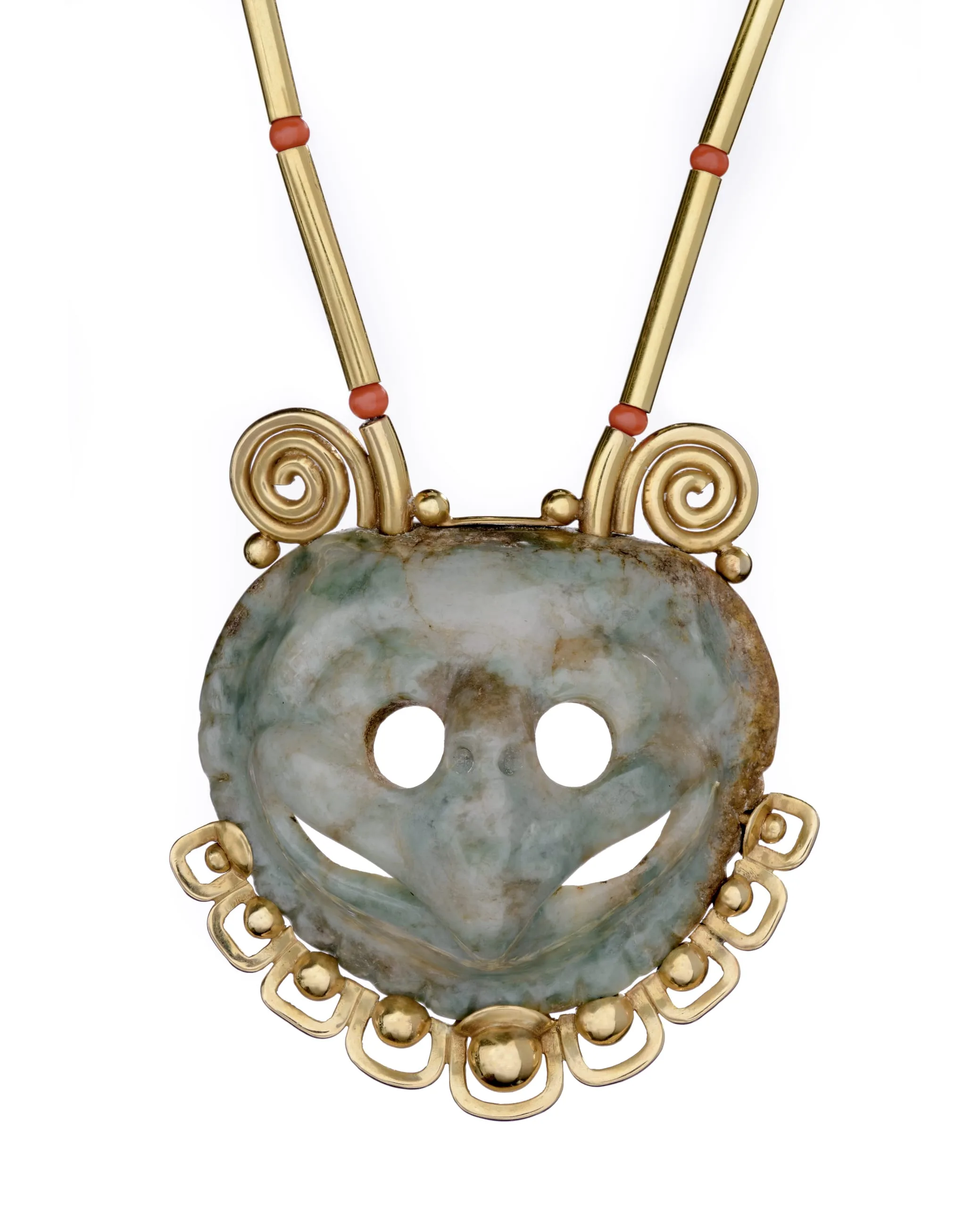
While William Spratling is best known for his innovative silver designs, in 1959 his workshop introduced a group of striking new works in gold. Spratling hired Jorge Ortiz Muñoz and Fernando García, two goldsmiths from Oaxaca trained in traditional filigree. Working from Spratling’s drawings, they translated his designs into gold, as in the case of this unique necklace inspired by Mesoamerican stone sculpture. The carved jade pendant of a bird of prey with a pronounced beak recalls the pectorals worn by Maya nobles. This necklace was owned by the painter Millard Sheets (1907–1989), a friend of Spratling who similarly had a strong interest in Mesoamerican art. Sheets owned two other Spratling works that are now in LACMA’s collection—a second necklace (M.2018.68.62) and a pitcher (M.2015.249.12)—and also reference ancient forms.
Trained as an architect, Spratling moved from New Orleans to Taxco, Mexico, where he established his first silver workshop in 1931. Working alongside master silversmiths and local apprentices, in 1935 he opened his famed Taller de Las Delicias, which attracted a cohort of international artists, intellectuals, and Hollywood celebrities. Spratling’s emphasis on craftsmanship and his experimentation with different sources, including Mesoamerican art, Art Deco, and modernism, contributed to his great success and helped revitalize the Mexican silver industry.
Rachel Kaplan
2024