LACMA

ShopMembershipMyLACMATickets
LACMA
Los Angeles County Museum of Art
5905 Wilshire Blvd.
Los Angeles, CA 90036
info@lacma.org
(323) 857-6000
Sign up to receive emails
Subscribe
© Museum Associates 2026
  • About LACMA
  • Jobs
  • Building LACMA
  • Host An Event
  • Unframed
  • Press
  • FAQs
  • Log in to MyLACMA
  • Privacy Policy
© Museum Associates 2026
Collections

Pablo Picasso
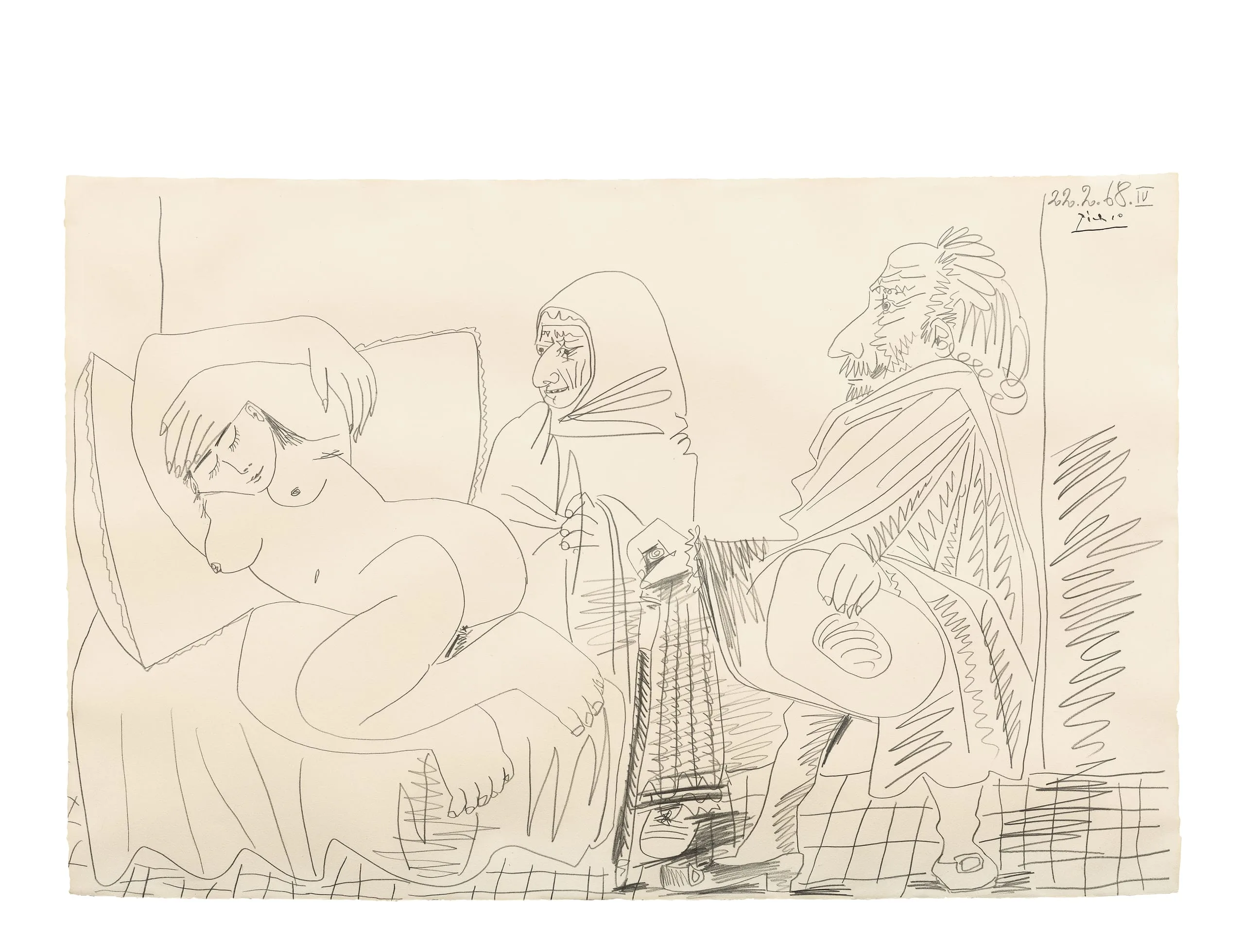
Musketeer and Courtisan1968

Not on view
Ink drawing on cream paper of a reclining nude and two standing robed figures, rendered in loose fluid lines with minimal shading, signed in the upper right corner
Artist or Maker
Pablo Picasso
Spain, 1881-1973, active France
Title
Musketeer and Courtisan
Culture
Spanish
Date Made
1968
Medium
Pencil on paper
Dimensions
Sheet: 19 1/4 × 30 in. (48.9 × 76.2 cm) Frame: 29 3/4 × 40 3/8 × 1 1/4 in. (75.57 × 102.55 × 3.18 cm)
Credit Line
Gift of A. Jerrold Perenchio
Accession Number
M.2025.64.44
Classification
Drawings
Collecting Area
European Painting and Sculpture
Curatorial Notes

In 1967, after recovering from a period of poor health, Picasso began the final phase of his long and storied career. Though nearing ninety, he worked relentlessly, creating a body of work focused around a few key characters and themes. One recurrent figure was the musketeer. During his illness, Picasso had become absorbed by the characters in Alexandre Dumas’s The Three Musketeers, and the musketeer became yet another of the artist’s alter egos, a swashbuckling avatar of adventure and eroticism. Here, standing in a statuesque pose on the far right, the musketeer observes a sleeping courtesan, another recurring character in the artist’s oeuvre. The musketeer’s elegant dress—hat, cape, and phallic staff—contrasts with the young woman’s total nakedness. She, meanwhile, is impossibly positioned to show off her body to best effect. Between them stands Celestina, a female figure drawn from Spanish literature. Like the musketeer, she appears frequently in Picasso’s late work, a representative of old age and withered sexuality.

Picasso worked prolifically in graphic media—prints and drawings—during this final stage of his career. Just a few weeks after the completion of Musketeer and Courtesan, he embarked on his largest series of prints, which focused on many of the same themes: a portfolio of etchings and aquatints titled 347.

Leah Lehmbeck and Erin Sullivan Maynes

2016/2024

Provenance

The artist’s estate. [Berggruen & Cie., Paris, still by 17 March 1981];(1) [Waddington Galleries, London (possibly on consignment), sold November 1981 to];(2) [Acquavella Galleries, New York, sold 5 November 1982 to]; A. J. Perenchio (1930–2017), Los Angeles, gifted 2025 to; Los Angeles County Museum of Art

Footnotes

(1) According to Olivier Berggruen, his father Heinz sold the Berggruen gallery archives in 1991, and the family is uncertain where they currently reside. However, they may be with Guy Loudmer in Paris (email to lacma, 13 October 2015).

(2) According to Acquavella Galleries’ object record, “Private Collection, USA” is listed after Berggruen & Cie, and Acquavella believed the source of this information was possibly Waddington Galleries (email to Casie Kesterson, 28 September 2015). However, Waddington Galleries confirmed that the work came directly from Berggruen, and there was no record of a private collection (email to Casie Kesterson, 20 October 2015). Thus, we have interpreted the inclusion of “Private Collection, USA” to be a cataloguing mistake, and have removed it from the provenance.
Selected Bibliography
  • Lehmbeck, Leah, ed. Impressionist and Modern Art: The A. Jerrold Perenchio Collection. Los Angeles: Los Angeles County Museum of Art; Munich: DelMonico Books/Prestel, 2016.
Copyright
© Estate of Pablo Picasso / Artists Rights Society (ARS), New York, photo © Fredrik Nilsen