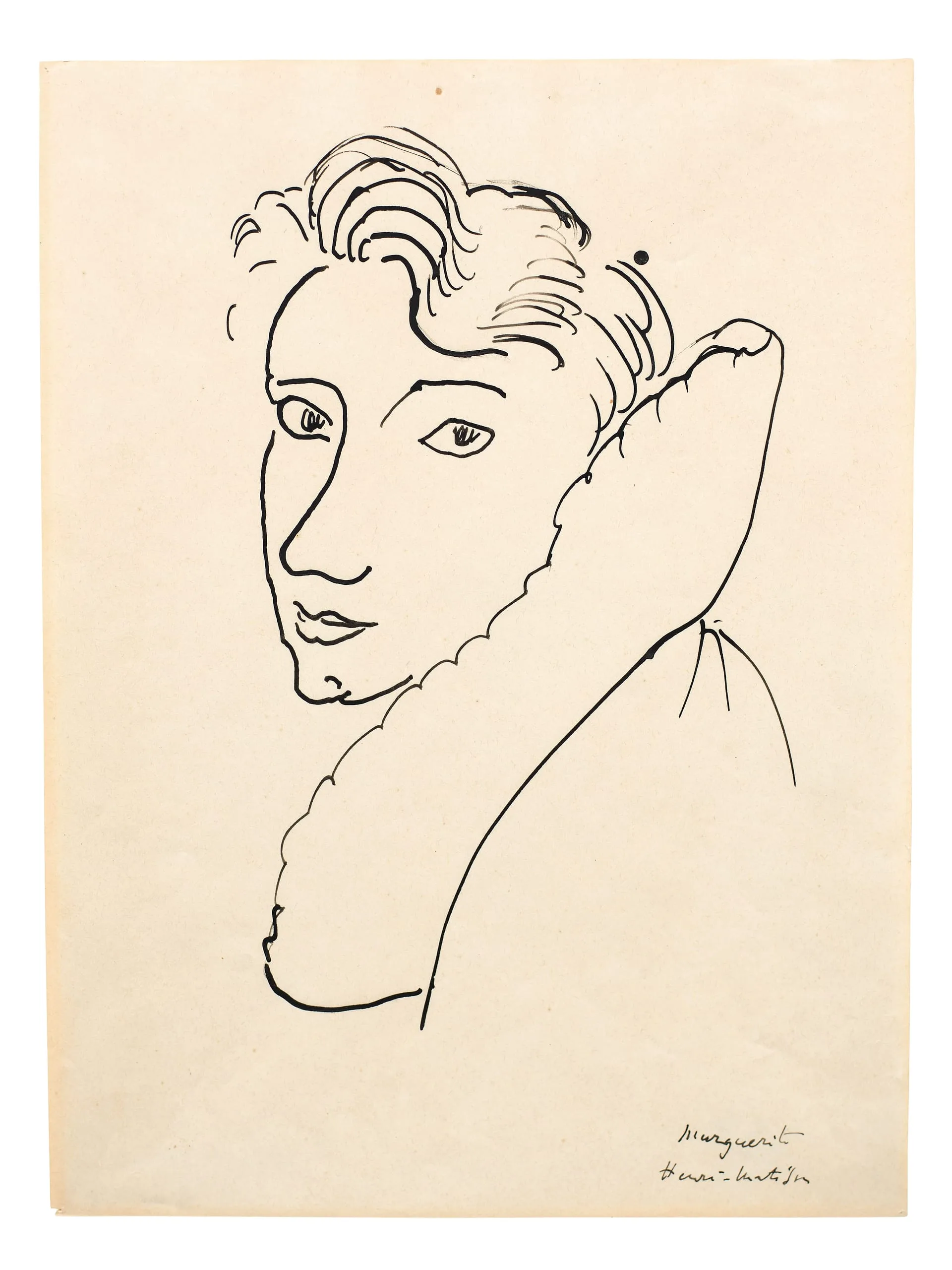
Henri Matisse made his most significant mark on the history of art through his use of color, but line was also paramount in his practice. His investigations into the possibilities of line appear even in his earliest, most colorfully expressive works for which he is best known and which garnered him attention as the leader of the Fauves (“wild beasts”). As he wrote, “My line drawing is the purest and most direct translation of my emotion. Simplification of means allows that” (Matisse 1939: 81).
This ink-on-paper portrait from the Perenchio collection can be seen as a clarification of the artist’s formal interests as well as an exercise in drawing itself. It depicts his daughter, Marguerite (1894−1982), turned toward us and captured in profile with a magnificent collar reminiscent of a portrait by Rembrandt. Light brushes of ink are interspersed with thicker strokes that neatly form impasto, with the variation of thick and thin, dry and wet, creating a sense of volume.
The sensitive rendition is one of dozens Matisse executed of his favorite child. Marguerite was the artist’s most consistent model from his early years through the postwar period, not only because of her accessibility but also because of his deep identification with her (Klein 2001: 94). As diminutive and intimate as this portrait is, it is a powerful reminder of the fundamentals of Matisse’s work. “For me,” he stated, “drawing is a painting made with reduced means” (Matisse 1951: 141). The simplicity of this line drawing belies Matisse’s considered approach to its composition.
Leah Lehmbeck and Claudine Dixon
2016/2024
Bibliography
Klein 2001. John Klein. Matisse Portraits. New Haven: Yale University Press, 2001.
Matisse 1939. Henri Matisse. “Notes of a Painter on His Drawing” (1939). In Matisse on Art, ed. Jack D. Flam, 80−82. New York: E. P. Dutton, 1978.
Matisse 1951. Henri Matisse. “Interview with Charbonnier, 1951.” In Matisse on Art, ed. Jack D. Flam, 138−41. New York: E. P. Dutton, 1978.