Picasso’s artistic phases have often been linked to the women in his life, as both muses and collaborators. He met Marie-Thérèse Walter, a young blonde French-Scandinavian, sometime between 1925 and 1927. Because he was already married (to Ballets Russes dancer Olga Khokhlova), and because Walter was underage, Picasso’s first painterly references to her were subtle, consisting of initials, symbols, and ghostly silhouettes. In 1931, these gave way to bold expressions of her physicality and a signature palette of yellow and violet. Walter appeared in his works throughout the decade, even as the passion of their relationship subsided.
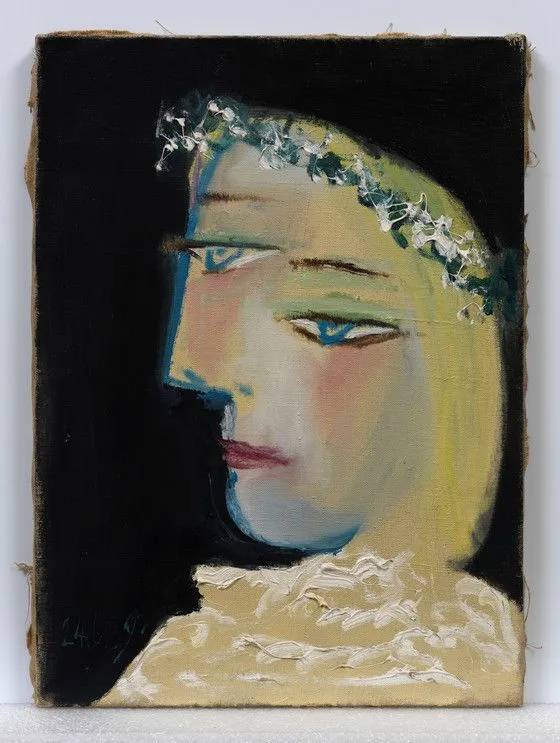
The artist saw in Walter’s beauty a transcendent classicism. From early on, she is depicted with a wreath of flowers, often as a classical muse. In LACMA’s painting, she materializes through a range of textures, from unfinished canvas to thick impasto. Shown in elegant Renaissance profile, her lips are closed, her gaze pensive. There is no hint of free-spirited sexuality in this portrait. The wreath is rendered with buttery daubs of paint whose delicate tendrils, created from the progression of the brush from point to point, are still intact. The execution gives the garland an eerie, insectlike quality. Her costume is suggested with a few strokes of impasto that couples brilliantly with the raw canvas, left exposed from her chin to her chest. The painting’s most striking feature is the utterly flat, impenetrably black background.
Although Woman Crowned with Flowers was created in 1939, it resembles the quiet studies of a decade earlier. But its melancholy tone, and that of three variants of a garlanded Walter made during the late 1930s, perhaps reflects the desolation and despair following Franco’s Hitler-backed destruction of Spain, memorialized in Picasso’s Guernica in 1937 (Museo Nacional Centro de Arte Reina Sofía, Madrid).
2024