LACMA

ShopMembershipMyLACMATickets
LACMA
Los Angeles County Museum of Art
5905 Wilshire Blvd.
Los Angeles, CA 90036
info@lacma.org
(323) 857-6000
Sign up to receive emails
Subscribe
© Museum Associates 2026
  • About LACMA
  • Jobs
  • Building LACMA
  • Host An Event
  • Unframed
  • Press
  • FAQs
  • Log in to MyLACMA
  • Privacy Policy
© Museum Associates 2026
Collections

Jasper Johns
Light Bulbmodelled and cast 1960

On view:
Geffen Galleries
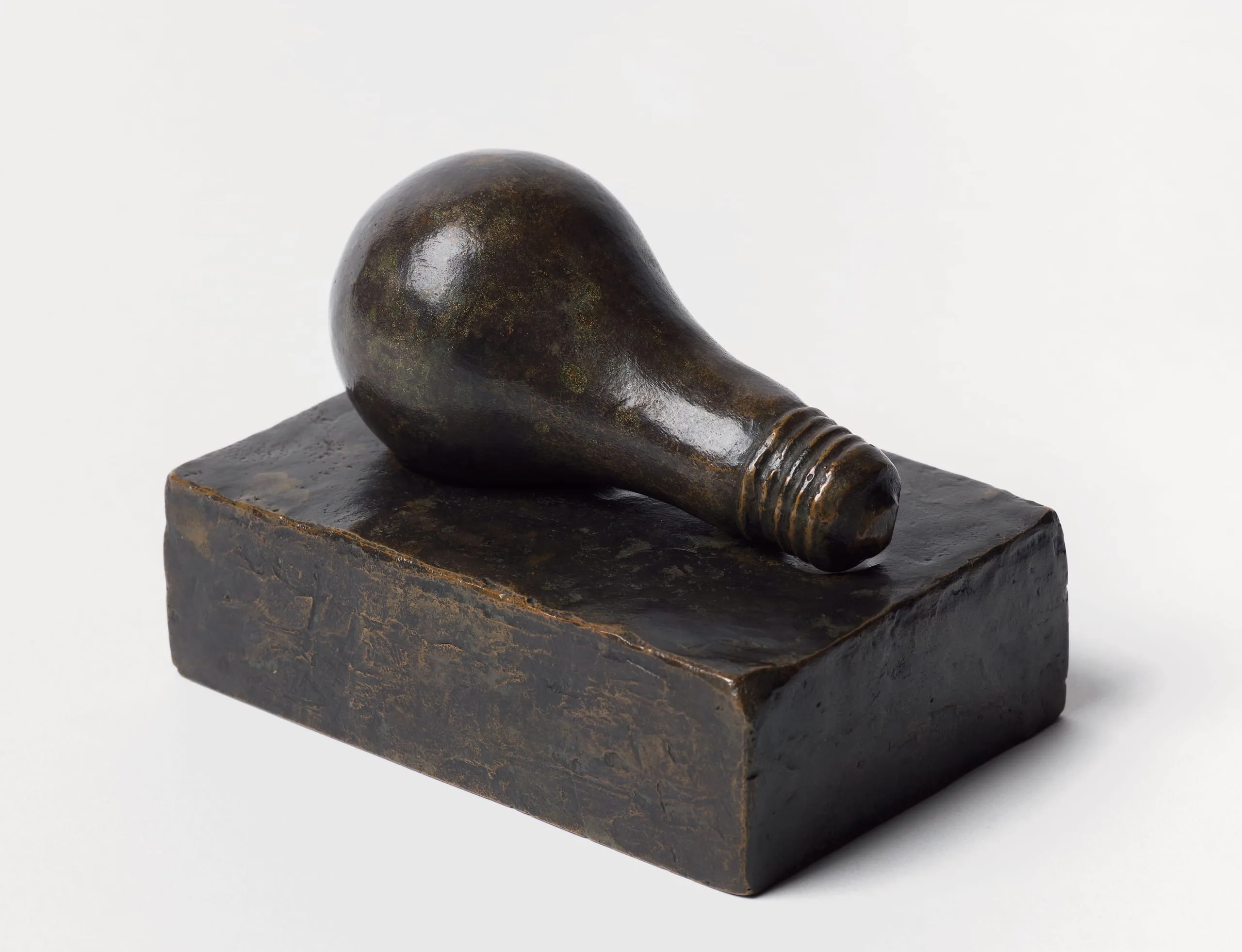
Small bronze sculpture of a lightbulb lying on its side atop a rectangular block, both with a dark brown and olive-green patina
Artist or Maker
Jasper Johns
United States, Georgia, Augusta, born 1930
Title
Light Bulb
Culture
American
Date Made
modelled and cast 1960
Medium
Bronze
Dimensions
Light bulb: 5 13/16 × 1 9/16 × 3 7/8 in. (14.7 × 4 × 9.8 cm) Base: 1 5/8 × 5 3/4 × 3 7/8 in. (4.13 × 14.61 × 9.84 cm)
Credit Line
Gift of A. Jerrold Perenchio
Accession Number
M.2025.64.23
Classification
Sculpture
Collecting Area
European Painting and Sculpture
Curatorial Notes

Jasper Johns committed fully to painting in 1954. By the end of that pivotal year, he had destroyed all of the work he’d made to that point and begun the iconic paintings of everyday objects and emblems that came to define his career. He made his first American flag painting in 1954, followed by emphatically flat images of targets, numbers, maps, and words. From 1958 to 1961, he produced a series of sculptures that nod to Duchampian readymades—light bulbs, flashlights, coffee cans, ale cans, sardonic representations of “critics”—but are, in fact, completely built up through artistic processes and materials. For these works, he first used sculp-metal—a commercial mix of paint and a clay(ish) substance that has the consistency of toothpaste and can be burnished to a shiny finish, like metal—and then employed the more traditional sculptural material of cast bronze.

Throughout his career, Johns has iterated and reiterated his repertoire of motifs across mediums. The first appearance of the light bulb occurs in 1957 in a line drawing, in which the object hangs from a string. The following year, he brought the form into three dimensions. LACMA’s Light Bulb is one of a small edition of four bronzes cast in 1960. Its medium connects it to the tradition of monumental sculpture, but the bulb’s familiarity and actual size undermine this association. Because the work is an instantly recognizable object, it also inhabits a kind of invisibility. With that, Johns very deliberately prods at notions of high and low art and clouds the already ambiguous nature of realism.

The finish of the bulb itself is smooth and nearly gestureless, certainly a reference to the Duchampian readymade. But the dimpled and uneven texture of the base is a calculated reminder that Light Bulb is, in fact, a handmade work of art. This clever flip—granting the base a greater connection to the artist than the actual object that sits upon it—is another way in which Johns upends perception. The light bulb is, after all, an everyday object that assists in seeing, and Johns’s continual return to this trope underscores his persistent interest in examining the fundamental aspects of how one sees.

2024

Provenance

[Leo Castelli Gallery, New York]. Robert C. Scull (1915–1986), New York (sale, New York, Sotheby Parke Bernet, 18 October 1973, lot 17).(2) Peter M. Brant (b. 1947), Greenwich, CT (sale, New York, Sotheby Parke Bernet, 18 May 1978, lot 218).(3) Frederick (1912–1994) and Marcia Simon (1918–1991) Weisman Family Collection (sale, New York, Sotheby Parke Bernet, (4) November 1982, lot 80, to);(4) [Coe Kerr Gallery Inc., New York, purchased for and transferred 10 November 1982 to]; A. J. Perenchio (1930–2017), Los Angeles, gifted 2025 to; Los Angeles County Museum of Art

Footnotes

(2) Robert C. Scull was born to Russian immigrant parents in Manhattan originally named Sokolnikoff, which was shortened to Scull. He inherited a share of his father-in-law’s taxi company, which Scull expanded into a prosperous business. Scull and his first wife, Ethel Redner, became major collectors of contemporary art in the 1960s, aided by dealers such as Leo Castelli and Richard Bellamy. The Sculls were rebuked by the very artists they collected for collecting art at low costs but selling at record-breaking prices at their 1973 Sotheby’s sale. The sale of fifty works from the Scull collection is captured in E. J. Vaughn’s documentary, America’s Pop Collector: Robert C. Scull—Contemporary Art at Auction.

(3) Peter M. Brant began collecting early, buying a few Warhols and a Franz Kline with money he made from investments while still an undergraduate student. In the early 1970s, after joining his father’s newsprint company, Brant-Allen Industries, Brant began collecting Warhols on a large scale, prompting the artist to meet him. Brant formed the Brant Foundation, located in Greenwich, CT, to maintain and display his collection.

(4) Frederick Weisman and Marcia Simon married in 1938, and Weisman began working with Marcia’s brother, the collector Norton Simon, at Val-Vita, Simon’s food-packing company. The couple began collecting in the late 1940s, and their collection ultimately numbered about one thousand pieces. Frederick was a longtime LACMA trustee, and Marcia was a guiding force behind the Museum of Contemporary Art (MOCA) in Los Angeles. The Weismans divorced in 1981 and split their collection.
Selected Bibliography
  • Lehmbeck, Leah, ed. Impressionist and Modern Art: The A. Jerrold Perenchio Collection. Los Angeles: Los Angeles County Museum of Art; Munich: DelMonico Books/Prestel, 2016.
Copyright
art © Jasper Johns / licensed by VAGA, New York, photo © Fredrik Nilsen

Related Unframed

Related Unframed

A Visual Dive into Buddha for Beginners
  • August 11, 2020
  • Trang Spero
Opening This Weekend: Outliers and American Vanguard Art
  • November 14, 2018
  • Rita Gonzalez
The Story of Urban Light
  • February 6, 2018
  • Editors
The Power of Charles White
  • July 21, 2015
  • Claudine Dixon
Silver Screens Turned into Art
  • October 31, 2013