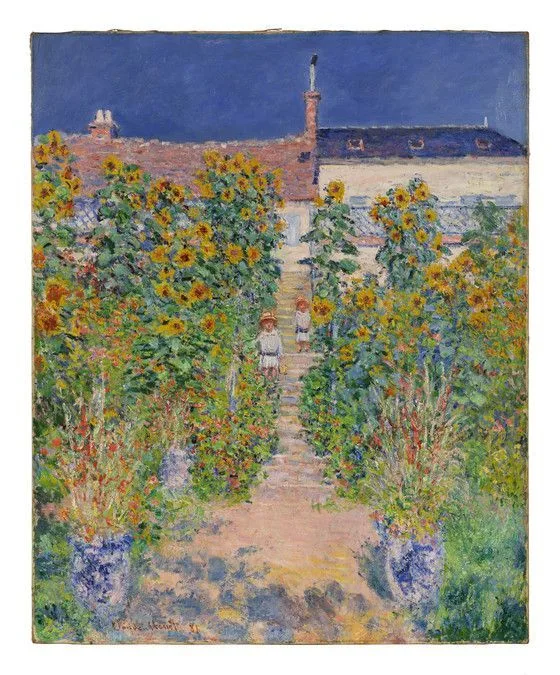
The artist, sold 9 February 1882 to; [Galerie Durand-Ruel, Paris]. Paul Durand-Ruel, Paris, sold 25 August 1891 to; [Galerie Durand-Ruel, Paris, sold 4 January 1893 to]; James F. Sutton (1844–1915), New York (sale, New York, American Art Association, 26 April 1895, lot 121, to);(1) [Durand-Ruel Galleries, New York, sold May 1895 to]; [Galerie Durand-Ruel, Paris, sold 16 September 1905 to]; [Paul Cassirer (1871–1926), Berlin, sold 7 November 1907 to]; [Galerie Durand-Ruel, Paris, sold 4 October 1916 to]; Pierre Dubied, Neuchâtel, Switzerland. [Paul Cassirer (1871–1926), Berlin, sold 1919 to]; [Christensen & Jörck, Copenhagen].(2) Oskar Federer (1884–1968), Ostrava and Prague, Czechoslovakia, from at least June 1938, confiscated late 1940 or early 1941 by;(3) Einsatzstab Reichsleiter Rosenberg (ERR), Paris (ERR card Unb. 348), removed from Banque Rothschild Frères;(4) Reichsmarschall Hermann Göring (1893–1946), by 9 July 1941 used for trade with;(5) [Gustav Rochlitz (1889–1972), Meersburg-Mühlhofen, Germany, repatriated by Allied Forces to France in March 1946];(6,7) Mr. and Mrs.Oskar Federer (1884–1968), Montreal. [Richard L. Feigen & Co., New York, sold 15 October 1968 to]; Charles W. Engelhard (1917–1971), bequeathed to; Jane Engelhard (née Marie Antoinette Jeanne Reiss, 1917–2004) (sale, New York, Christie’s, 13 November 1996, lot 13, to);(8) A. J. Perenchio (1930– 2017), Los Angeles, gifted 2025 to; Los Angeles County Museum of Art
Footnotes
(1) James F. Sutton was a founding member of the American Art Association and married Florence Macy, daughter of R. H. Macy, on 16 November 1876. According to Durand-Ruel the picture was purchased from Mr. Durand-Ruel on 25 August 1891 for 2000 Francs and sold on 4 January 1893 to Sutton for 6000 Francs, with the stock number 1255. It was then bought back from his estate sale by Durand-Ruel, New York, with the stock number 1411 and sold to Durand-Ruel Paris in May 1895 with the stock number 3324. The same stock number was used for its sale to Dubied in 1916 (document prepared by Flavie and Paul-Louis Durand-Ruel for Leah Lehmbeck, 8 December 2015).
(2) The Danish Ministry of Commerce describes “Christensen & Jörck, Copenhagen” as a broker and banking firm active around 1917 through 1922, operated by Georg Alfred Christensen and Poul Christian Valdemar Jörck.
(3) Oskar Federer stated that some of his paintings were brought out of Czechoslovakia in “June 1938 to Amsterdam for the Exhibition of French Art at the Stedelijk Museum. One of these pictures, ‘Jardin de Giverny’ by Claude Monet, signed and dated, 1881, 101–82 cm, was sent to Paris, where I was staying. I left Paris in August 1939 for London, but this picture remained in Paris and was sent before the invasion by the Germans, together with art treasures of the Rothschild family, to Nevers in France. I have been informed by Baron Guy de Rothschild, that this picture has been stolen by the Germans and that there was no possibility of the employees of the Banque Rothschild Frères preventing its theft.” Quote from O. Federer letter to the British Committee for the Preservation & Restitution of Works of Art, London, 31 May 1945, copy in Federer’s file at the Ministère des Affaires étrangères, Département des Archives, La Courneuve, Paris, Cote 209SUP, Carton 51, CRA Dossier #46.489.1513. Federer was the Director of the Vítkovice Mining and Metallurgic company, the largest steel manufacturer in Czechoslovakia in the 1930s. Federer was also a distinguished collector of French Impressionists, and nineteenth– twentieth century German, Austrian, and Czech art in prewar Czechoslovakia. Forced to flee the country in 1939, Federer settled in Montreal, Canada, in August 1940 with the assistance of the British Foreign Office. Much of his collection was confiscated in Czechoslovakia, along with at least this one painting in Paris.
(4) ERR Photograph for Monet painting Unb. 348, BArch B323/297; B323/72, where Federer’s Monet appears as part of a longer list dated 10.5.44/DvI/Spa (pp. “95–101”) of items from the Jeu de Paume marked “HG.” intended for Hermann Göring, Bundesarchiv, Koblenz. Federer and the Monet also appear on Devisenschutzkommando List dated 5 May 1941. Original German copies appear in ERR Correspondence (May 1941–June 1941), pp.129-h–132-h, Records Concerning the Central Collecting Points (“Ardelia Hall Collection”): Munich Central Collecting Point, 1945–1951, Record Group 260, M1946; National Archives and Records Administration, College Park, MD.
(5) The Monet appears on Göring’s special list of artwork intended for trade. Sonderstab Bildende Kunst Arbeitsgruppe Louvre, F./St. dated 9 April 1943, no. 38, Consolidated Interrogation Report no.2: The Goering Collection, Attachment 5, Records of the American Commission for the Protection and Salvage of Artistic and Historic Monuments in War Areas, 1943–1946, Record Group 239, M1944; National Archives and Records Administration, College Park, MD.
(6) Rochlitz was a German art dealer who traded to the ERR on Göring’s behalf eighteen artworks, including the Monet, for Titian’s Portrait of Lavinia. The exchange dated 9 July 1941–10 is detailed in item 11, Restitution Research Records, ERR: Göring Art Exchanges (1941), Records Concerning the Central Collecting Points (“Ardelia Hall Collection”): Munich Central Collecting Point, 1945–1951, Record Group 260, M1946; Consolidated Interrogation Reports no. 1, Activity of The Einsatzstab Rosenberg In France, OSS Art Looting Investigation Unit Reports, 1945–46, Record Group 239, M1782; National Archives and Records Administration, College Park, MD. Rochlitz’s dispersal of the paintings is described in Gustav Rochlitz, Detailed Interrogation Report (DIR) no. 4, Ardelia Hall Collection, NARA.
(7) Restituted to Oskar Federer by the French Commission de Récupération artistique (Commission for Art Recovery) via Federer’s representative E. Oplatek. Ministère des Affaires étrangères, Département des Archives, La Courneuve, Paris (Cote 209SUP, Carton 51, CRA Dossier #46.489.1513, “M. [Oskar] Federer, London.”).
(8) Charles W. Engelhard was president of Engelhard Minerals and Chemicals, founded by his father, and specialized in the precious metals industry. Purportedly he served as the inspiration for the James Bond novel Goldfinger, written by his friend Ian Fleming. In addition to this Monet, Engelhard owned Monet’s Water Lilies, cat. 34.