LACMA

ShopMembershipMyLACMATickets
LACMA
Los Angeles County Museum of Art
5905 Wilshire Blvd.
Los Angeles, CA 90036
info@lacma.org
(323) 857-6000
Sign up to receive emails
Subscribe
© Museum Associates 2026
  • About LACMA
  • Jobs
  • Building LACMA
  • Host An Event
  • Unframed
  • Press
  • FAQs
  • Log in to MyLACMA
  • Privacy Policy
© Museum Associates 2026
Collections

Paul Cézanne
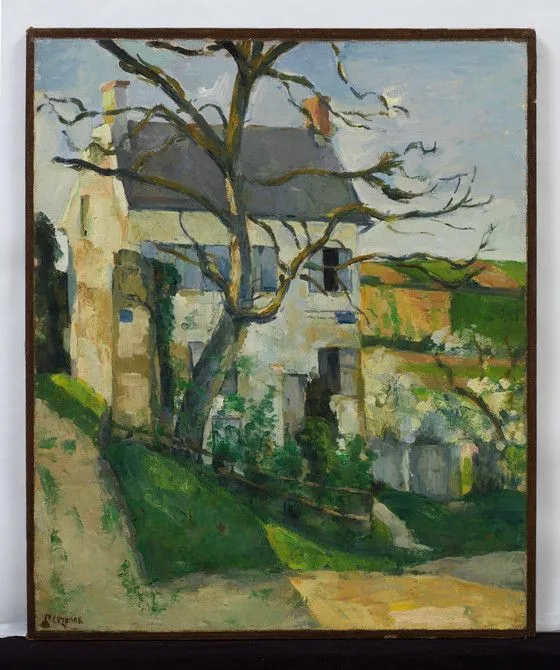
The Rondest House, l’Hermitage, Pontoisecirca 1874

On view:
Geffen Galleries
Vertical oil painting of a stone farmhouse with a steep gray roof, framed by a large bare tree, with a grassy slope and sandy path in the foreground, painted in loose brushwork
Artist or Maker
Paul Cézanne
France, 1839-1906
Title
The Rondest House, l’Hermitage, Pontoise
Culture
French
Date Made
circa 1874
Medium
Oil on canvas
Dimensions
Canvas: 25 9/16 × 21 1/4 in. (65 × 54 cm)
Credit Line
Gift of A. Jerrold Perenchio
Accession Number
M.2025.64.18
Classification
Paintings
Collecting Area
European Painting and Sculpture
Curatorial Notes

The art of Paul Cézanne tends to be described as the bridge between the Impressionist and Post-Impressionist experiments of the late nineteenth century and the Cubist, Fauvist, and ultimately abstract experiments of the early twentieth. Linking Manet to Picasso through Cézanne seems a convenient line for twentieth-century formalist scholars, and the connection was validated even during Cézanne’s own lifetime. Pissarro, Renoir, Monet, Degas, Caillebotte, Signac, Gauguin, and Matisse all owned his paintings before his death, drawing from them various aspects that resonated with each of their distinct artistic goals.

Cézanne’s own self-declared artistic parentage reinforces a part of this formalist lineage, as he worked alongside Pissarro during the years 1872–74 and again in 1877 in and around Pontoise. The Rondest House, l’Hermitage, Pontoise was likely painted during one of these joint outdoor sessions, as the motif served Pissarro on several occasions during 1874 (M.2005.70.117). It was also during these few years that Cézanne made definitive advancements toward his own unique aesthetic. Both aspects—Pissarro’s influence and Cézanne’s break with his dark-paletted past—are fully realized in this image.

There are two elements in this painting that make it exceptional in Cézanne’s oeuvre to this point: the lightened palette and the rigid make-up of the composition. The painter from the south was finally incorporating atmospheric light into his pictures and embracing a subtle vibrancy seen in the lavenders, greens, and sand tones deployed throughout the canvas. Cézanne’s challenge, however, was to maintain an attention to these effects without sacrificing the structure of the painting—a critical part of his work. The balance he achieves is striking: the highlights and shadows are rendered not in the dappled touches favored by Renoir, Monet, or even by his mentor, but instead are forcefully deployed with a palette knife in strict horizontals, verticals, and diagonals. Cézanne selects a viewpoint that is elevated and off-center. His aggressive paint merges house with tree and road with grass, illustrating his oft-quoted wish to “make of Impressionism something solid and enduring, like the art of museums.”

2024

Provenance

[Ambroise Vollard (1839–1906), Paris, by late 19th century]. Ivan Ivanovich Shchukin (1869–1908), Moscow and Paris, from at least October 1899 (sale, Paris, Hôtel Drouot, 24 March 1900, lot 4).(1) Josse and Gaston Bernheim-Jeune, Paris, from at least 1919 to 1930;(2) Gaston Bernheim de Villers, Paris, from 1930, still in 1949. [Sam Salz, New York, by c. 1949–50, probably sold about January 1951 to]; William (1903–1969) and Edith Mayer (1905–1988) Goetz, Los Angeles (sale, London, Sotheby’s, 14 October 1970, lot 4, to);(3) [A. de Vidal, possibly for];(4) Mario de Botton (1909–1992), London (sale, New York, Christie’s, 13 November 1984, lot 129, to); A. J. Perenchio (1930–2017), Los Angeles, gifted 2025 to; Los Angeles County Museum of Art

Footnotes

(1) The Commissaire-priseur G. Duchesne’s Minutes and Procèsverbal for this sale lists Shchukin as the seller and provides information on his financial difficulties. Scholar, critic, and art collector, Shchukin led an overly extravagant lifestyle and squandered his fortune. His lack of support from his family, particularly from his brother Sergei (1854–1936), a well-known collector of Henri Matisse and an early patron of modern art, forced Ivan to place his collection on the market. In so doing he discovered that a number of his Spanish paintings (El Greco and Goya, primarily) were forgeries. Desperate and unable to pay his bills, Ivan killed himself on 2 January 1908.

(2) According to Jayne Warman, “In 1930 Josse and Gaston divided their collection—Gaston kept this canvas (this information from a letter dated March 25, 1981 to John Rewald from Gilbert Gruet, who worked for many years at Bernheim-Jeune)” (email to Patricia Teter-Schneider, 28 July 2015). According to Bernheim-Jeune & Cie, the painting was in the personal collection of Josse and Gaston Bernheim-Jeune, and consequently was not logged in the stock of the gallery, and therefore they are unable to provide further information regarding the picture (letter from Guy-Patrice Dauberville to Leah Lehmbeck, 16 December 2015).

(3) Film producer William Goetz and his wife Edith, the daughter of the film mogul Louis B. Mayer, were part of Hollywood’s heyday, and by the 1940s they had started amassing what would become one of the finest West Coast collections of Impressionist and modern art. In addition to this Cézanne, the Goetzes owned Bonnard’s After the Meal, cat. 2.

(4) Sotheby’s price and buyer sheet for the 14 October 1970 Goetz sale lists “A. de Vidal” as the buyer for lot 4, however the buyer has been verified by Sotheby’s as Mario de Botton (email to Patricia Teter-Schneider, 27 July 2015). A. de Vidal also purchased lots 7 by Dufy and 14 by Renoir, however it is uncertain if the other lots were also intended for Mario de Botton.
Selected Bibliography
  • Lehmbeck, Leah, ed. Impressionist and Modern Art: The A. Jerrold Perenchio Collection. Los Angeles: Los Angeles County Museum of Art; Munich: DelMonico Books/Prestel, 2016.