LACMA

ShopMembershipMyLACMATickets
LACMA
Los Angeles County Museum of Art
5905 Wilshire Blvd.
Los Angeles, CA 90036
info@lacma.org
(323) 857-6000
Sign up to receive emails
Subscribe
© Museum Associates 2026
  • About LACMA
  • Jobs
  • Building LACMA
  • Host An Event
  • Unframed
  • Press
  • FAQs
  • Log in to MyLACMA
  • Privacy Policy
© Museum Associates 2026
Collections

Henri Fantin-Latour
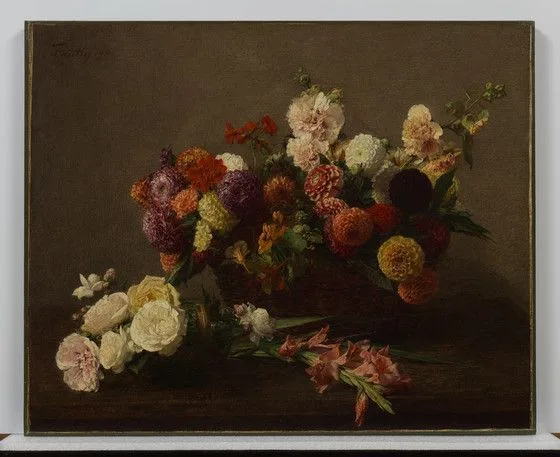
Dahlias1890

On view:
Geffen Galleries
Oil painting still life of mixed flowers — dahlias, roses, and marigolds in orange, pink, cream, and burgundy — spilling from a wicker basket onto a dark tabletop
Artist or Maker
Henri Fantin-Latour
France, Grenoble, 1836-1904
Title
Dahlias
Culture
French
Date Made
1890
Medium
Oil on canvas
Dimensions
Canvas: 26 × 32 in. (66.04 × 81.28 cm) Frame: 37 3/16 × 42 7/8 × 3 1/2 in. (94.46 × 108.9 × 8.89 cm)
Credit Line
Gift of A. Jerrold Perenchio
Accession Number
M.2025.64.17
Classification
Paintings
Collecting Area
European Painting and Sculpture
Curatorial Notes

Henri Fantin-Latour’s precocious start before the age of fifteen allowed for a career that spanned nearly fifty years, during which time the Grenoble-born, Paris-raised artist dedicated himself to painting subjects arranged in a studio. His still lifes, from which he gained most of his critical attention and certainly all of his financial success, grew largely out of a Victorian sensibility. James Abbott McNeill Whistler, whom he met in the late 1850s, invited Fantin on his first trip to England in 1859 after his discouraging rejection by the annual Paris Salon. The visit had a profound effect on him, as he found in England “a sensibleness in everything—no French nonsense.” This clarity is subsumed into his flower paintings, which he began to sell there in 1861. He was aided by his friend Edwin Edwards, the British printmaker, and later by Edwards’s wife Ruth, who worked as an agent on Fantin’s behalf. Fantin produced 500 flower paintings between 1864 and 1896, struggling to keep his subject new and fresh while satisfying the demands of his market.

Dahlias—also known as, or to be more precise, emphatically branded by Mrs. Edwards as These are the Flowers of Middle Summer—is an exemplary statement of Fantin’s sense of artistic balance. Striking a tone between artifice and verism, the beautifully executed array of dahlias, hollyhocks, nasturtiums, tea roses, and gladiolus showcases his absolute control of medium and compositional elements, from the perfectly placed diagonals to the exactitude of the lusciously rendered petals. There is a movement to the arrangement, driven by the variety of flowers, their inconsistent shapes and colors, and the negative spaces. Fantin’s pictures not only derived from English taste but may have influenced it: descriptions reflecting the choices he made in this very painting were published with photographs in the popular publication Flower Decoration in the House in England in 1907.

2024

Provenance

[Ruth Edwards (née Escombe, 1833–1916), London, probably 1890s].(1) George Woodiwiss, Esq. (1857–1906), Hazelwood House, Bath, England, c. 1898.(2) [P. & D. Colnaghi and Obach, London, c. 1911]. [F. & J. Tempelaere and Hector Brame, Paris, c. 1911].(3) [Sabourdin, Paris, c. 1911].(4) Newman, London, 20th century.(5) [Arthur Tooth and Sons, London, c. 1966]. William Russell Grace (1940–1999) and Constance Barber Mellon (1941–1983) Byers, in 1966 to c. 1969, or as late as 14 April 1983, to];(6) [Acquavella Galleries, sold 14 April 1983 to];(7) A. J. Perenchio (1930–2017), Los Angeles, gifted 2025 to; Los Angeles County Museum of Art

Footnotes

(1) Ruth Edwards was the wife of Fantin-Latour’s English dealer, Edwin Edwards (1823–1879), and continued their business relationship after Edwin’s death, in 1879, through 1897.

(2) Woodiwiss was a Justice of the Peace and Deputy Lieutenant, as well as Mayor of Bath, 1896–97.

3 Ferdinand and Julien Tempelaere were sons of the painting dealer Gustave Tempelaere (1840–1904); Hector Brame was Gustave’s brother-in-law; more details in letter from Fantin-Latour to Otto Scholderer, 31 October 1891, and footnotes: Deutsches Forum für Kunstgeschichte, Correspondance between Henri Fantin-Latour & Otto Scholderer (1858–1902): http://quellen-perspectivia.net/fr/fantin-scholderer/1891_04.

(4) Sabourdin is known to have owned at least four other Fantin-Latours, which he lent to the May–June 1906 Exposition de L’Oeuvre de Fantin-Latour, at the Palais de L’École Nationale des Beaux-Arts, Paris.

(5) In entry no. 144 for this painting, in the catalogue that accompanied the 1982 Galeries nationales du Grand Palais exhibition Fantin-Latour, the owner is listed as “Newmab, Londres.” However, Sylvie Brame, of Brame & Lorenceau, Paris, has corrected this and verified the owner as Newman (email to Leah Lehmbeck, 23 June 2015). This could possibly refer to M. Newman Ltd, est. 1870, who had galleries in London at 43a Duke Street, and 1 & 3 Ryder Street.

(6) Mr. and Mrs. W. Russell G. Byers are listed as lending the painting to the Acquavella Galleries Inc. exhibition Flowers by Fantin- Latour, New York, 2 November–3 December 1966, no. 8. The Byerses married and divorced twice; they first married in July 1962 and the date of their final divorce is c. 1969. Constance B. Mellon married J. Carter Brown in June 1971.

(7) According to notes in owner’s object file, this painting was purchased from (through?) Acquavella Galleries Inc., New York on 14 April 1983, following Constance Barber Mellon’s death on 2 January 1983, during the 1982–83 Fantin-Latour exhibition.
Selected Bibliography
  • Lehmbeck, Leah, ed. Impressionist and Modern Art: The A. Jerrold Perenchio Collection. Los Angeles: Los Angeles County Museum of Art; Munich: DelMonico Books/Prestel, 2016.
Copyright
photo © Fredrik Nilsen