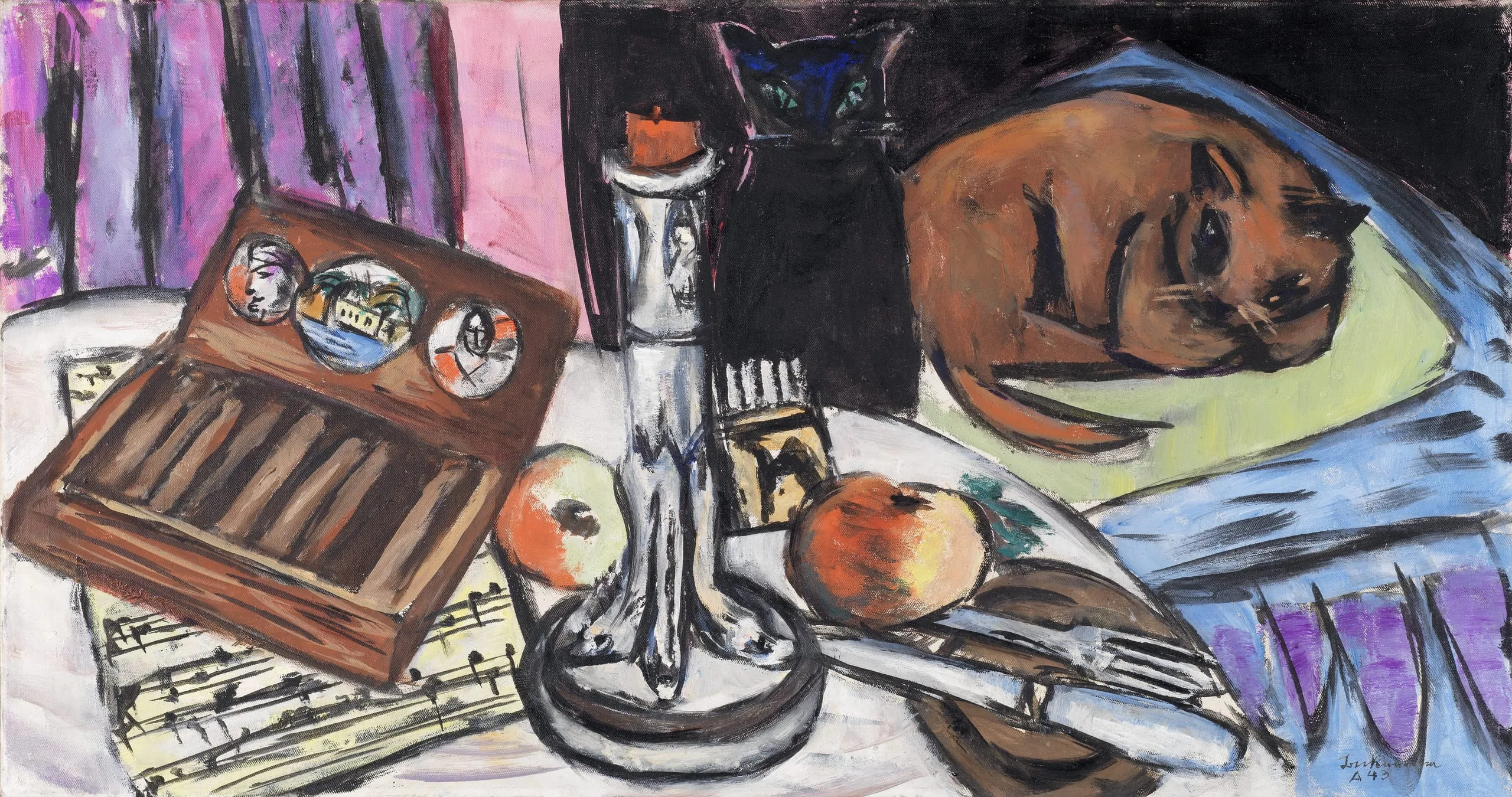
The night Max Beckmann finished painting Still Life with Silver Candlestick, he wrote in his diary: “Gray evening. Very sad.” The atmosphere of the painting reflects this mood with its compressed space, uneven contours, and detailing in black, as well as a pair of cats that stare menacingly at the viewer. The candlestick is burnt down and unlit, while some of the notes and measures on the sheet music appear to disintegrate.
Beckmann’s distorted perspective confers an irregular, bulbous shape to the table, and allows access to a very limited portion of his Amsterdam apartment. Likewise, the artist’s distribution and balancing of complementary colors—blue, orange, violet, and pale yellow—throughout the canvas both enliven the scene and instill a visual stalemate, contributing to its overall claustrophobic feel.
Beckmann painted this work while in exile in Amsterdam, after his dismissal as university professor in 1933 by the Nazi regime, and the inclusion of his work in the “Degenerate Art” [“Entartete Kunst”] exhibition in 1937. By 1943, the Netherlands had been under German occupation over two years, and Beckmann sold this painting to Hans Melchers, a Cologne-based art and book dealer who collaborated with the Nazis on assembling a collection from sequestered or stolen (mostly Old Master) artworks for a future Führermuseum in Linz (in present-day Austria). That same year, Still Life with Silver Candlestick was acquired by Melchers’ business partner Albert Schulze-Vellinghausen, who would retain it until his death in 1967, when it entered the art market.