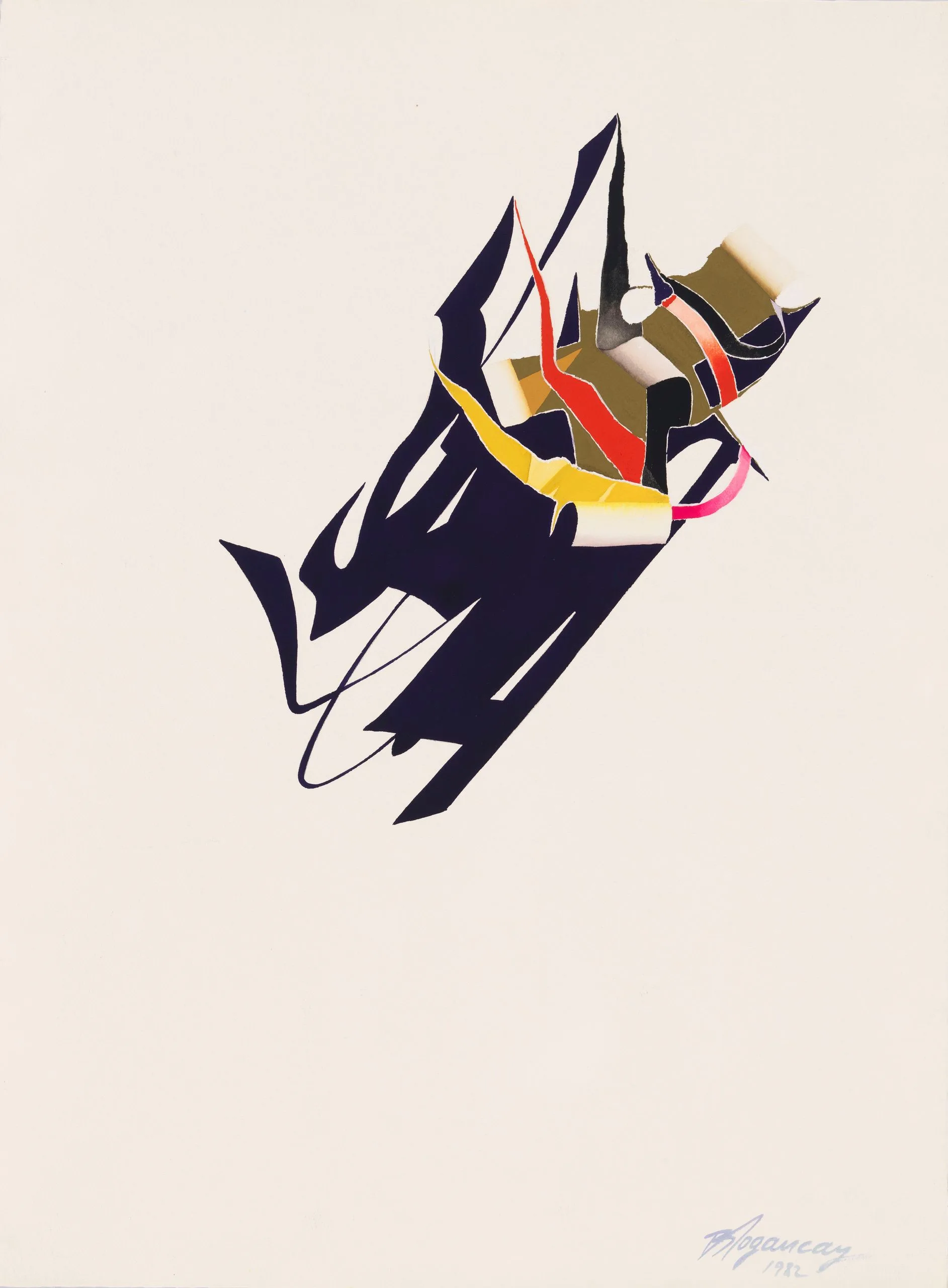
Burhan Doǧançay was one of Turkey’s foremost contemporary artists; he is also well known internationally, particularly for his Urban Walls series, begun in the 1960s. For this series, he traveled worldwide, documenting with his camera city walls covered with curled and mangled advertisements, posters, and graffiti, which he reconstructed into new narratives in his paintings and collages. Doǧançay built on his earlier work in this beautiful pair (see M.2015.160.2) of abstract compositions, in which brightly intense curvilinear forms seem to burst forth from flat, solid-colored backgrounds. Inspired by Islamic calligraphy, the graceful ribbonlike shapes take on a three-dimensional quality, especially as suggested by the implied shadows in the earlier of the two works. Both are from the aptly titled series Ribbons (1972–89).
Doǧançay studied law in Turkey and economics in France, but in 1963, while working as a diplomat in New York, he saw a torn orange poster spattered with mud, which he described as "the most beautiful abstract painting," thus inspiring his first and longest-running series, Urban Walls. Doǧançay’s work is in the collections of the Metropolitan Museum of Art and the Solomon R. Guggenheim Museum in New York and the British Museum in London, among many others.