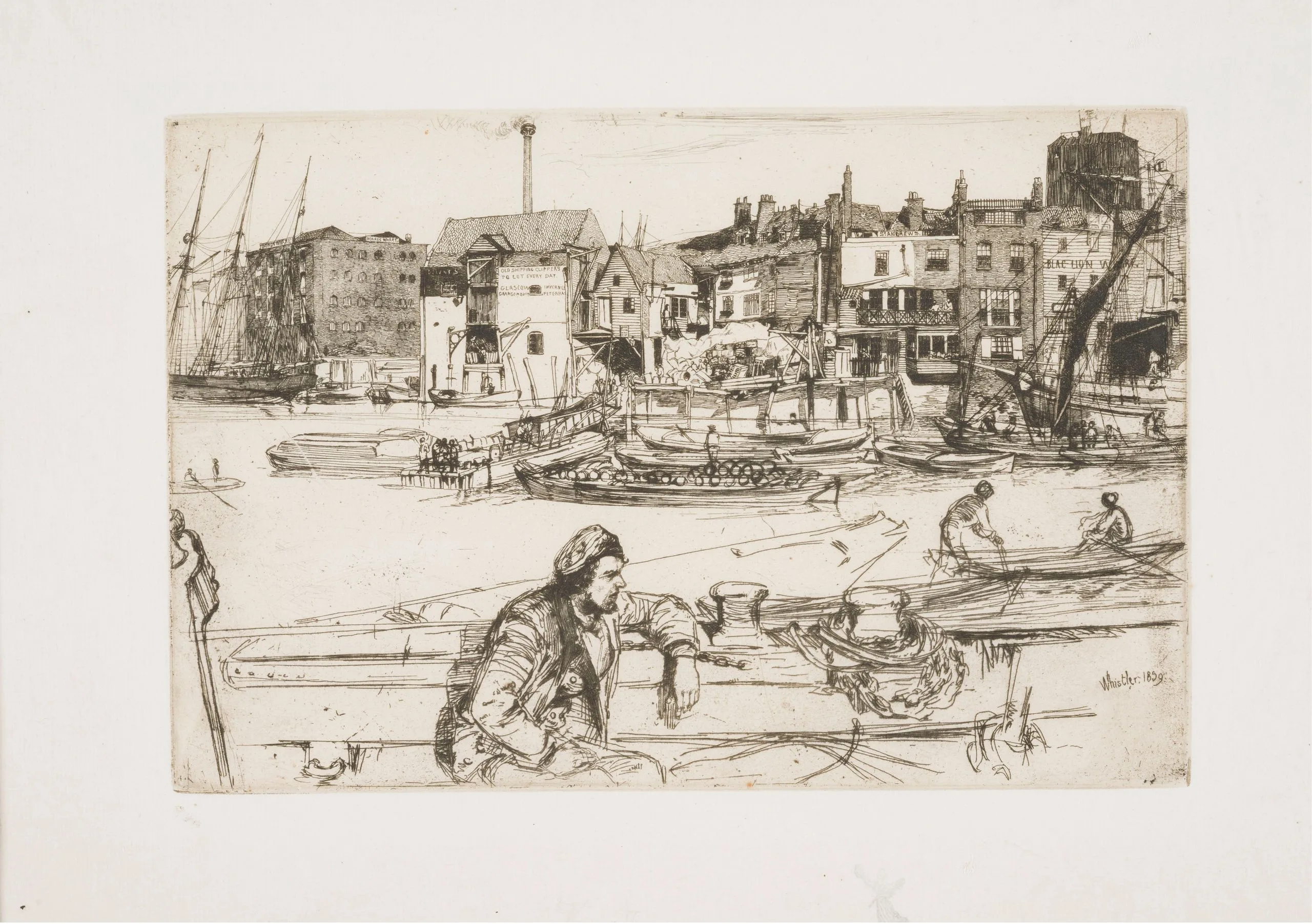
Thanks to the generosity of the late Julius and Anita Zelman, LACMA is one of the most important repositories of Whistler’s printed work. This etching was the first to enter the Zelmans’ collection. Dating from 1859, it was not widely distributed until 1871, when it was included in the Thames Set, a series of sixteen prints depicting various London neighborhoods. Here, warehouses line an industrial and commercial waterfront in the docklands southeast of the Tower Bridge. One building bears the sign BLAC [sic] LION WHARF, which serves as the print’s title. Whistler’s lines become progressively looser and sketchier from top to bottom of the sheet, from the variously patterned rooftops and facades to the lightly rendered figures and watercraft in the lower foreground. Heavily inked areas lead our eye around the composition, from the foreground man’s crop of black curly hair, upward and right to the ship’s rigging and the blank interior behind the warehouse door, up to the thickly lined structure above, across the contours of variously shadowed chimneys to the ship’s spars at left. The middle zone is punctuated with pools of black behind windows and bright white walls.
Black Lion Wharf is one of the few prints by the artist in which he drew and etched the image in reverse of the actual view, so that it was oriented correctly when it was printed. Whistler reproduced the image in his most famous painting, Arrangement in Grey and Black, No. 1, otherwise known as “Whistler’s Mother” (Musée d’Orsay, Paris).
Claudine Dixon
2024