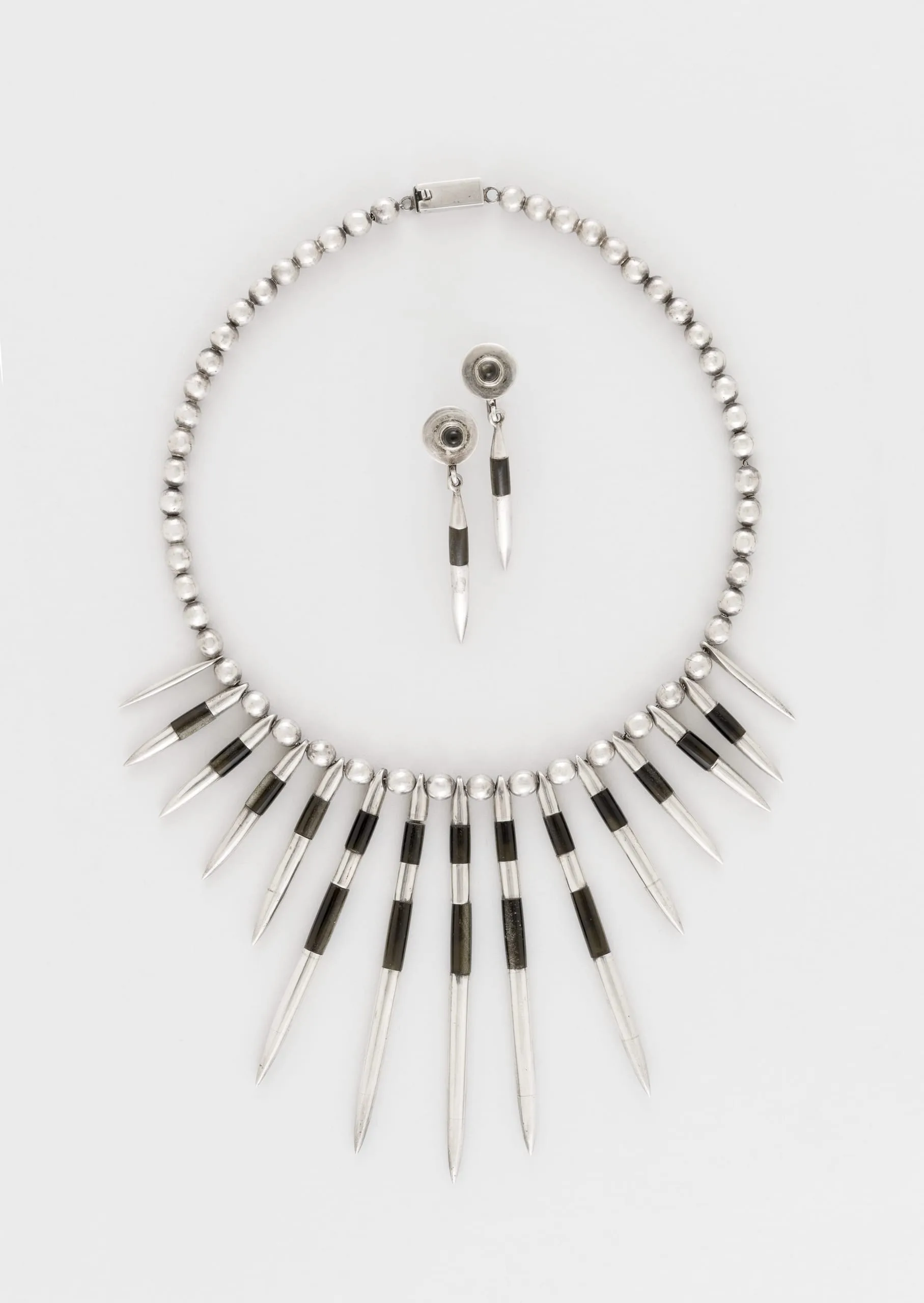
This needle necklace and matching earrings reference the tips of javelins, demonstrating William Spratling’s fascination with Alaskan art. In keeping with his predilection for contrasting light and dark materials, bands of obsidian interrupt the smooth silver surfaces of the hanging needles in this sophisticated set.
An architect from New Orleans, Spratling established his first workshop in Taxco, Mexico, in 1931, working alongside a local master silversmith and several young apprentices. A brilliant marketing strategist, Spratling set out to reinvigorate Taxco’s economy by employing local artisans, catalyzing a renaissance in the Mexican silver industry. Insistence on handiwork and experimentation contributed to a thriving local industry. Designers and craftspeople drew on and creatively reinterpreted a variety of sources, including Mesoamerican art, Arts and Crafts, Art Deco, and modernist motifs.
Following his successes in Mexico, Spratling presented a plan to the U.S. Indian Arts and Crafts Board to launch a similar initiative in Alaska. He arrived in August 1945 at the invitation of his friend, Ernest Gruening (1887–1974), the territory’s governor. In 1949, seven Alaskan World War II veterans arrived in Taxco to train at Spratling’s workshop. Spratling created 200 prototypes that could be reproduced by Native artisans for the growing tourist market in Alaska (see M.2013.5.1). Although the project was ultimately abandoned due to lack of support from governmental agencies, many of Spratling’s subsequent designs demonstrate the impact of the Alaskan models.
Ilona Katzew and Rachel Kaplan
2024