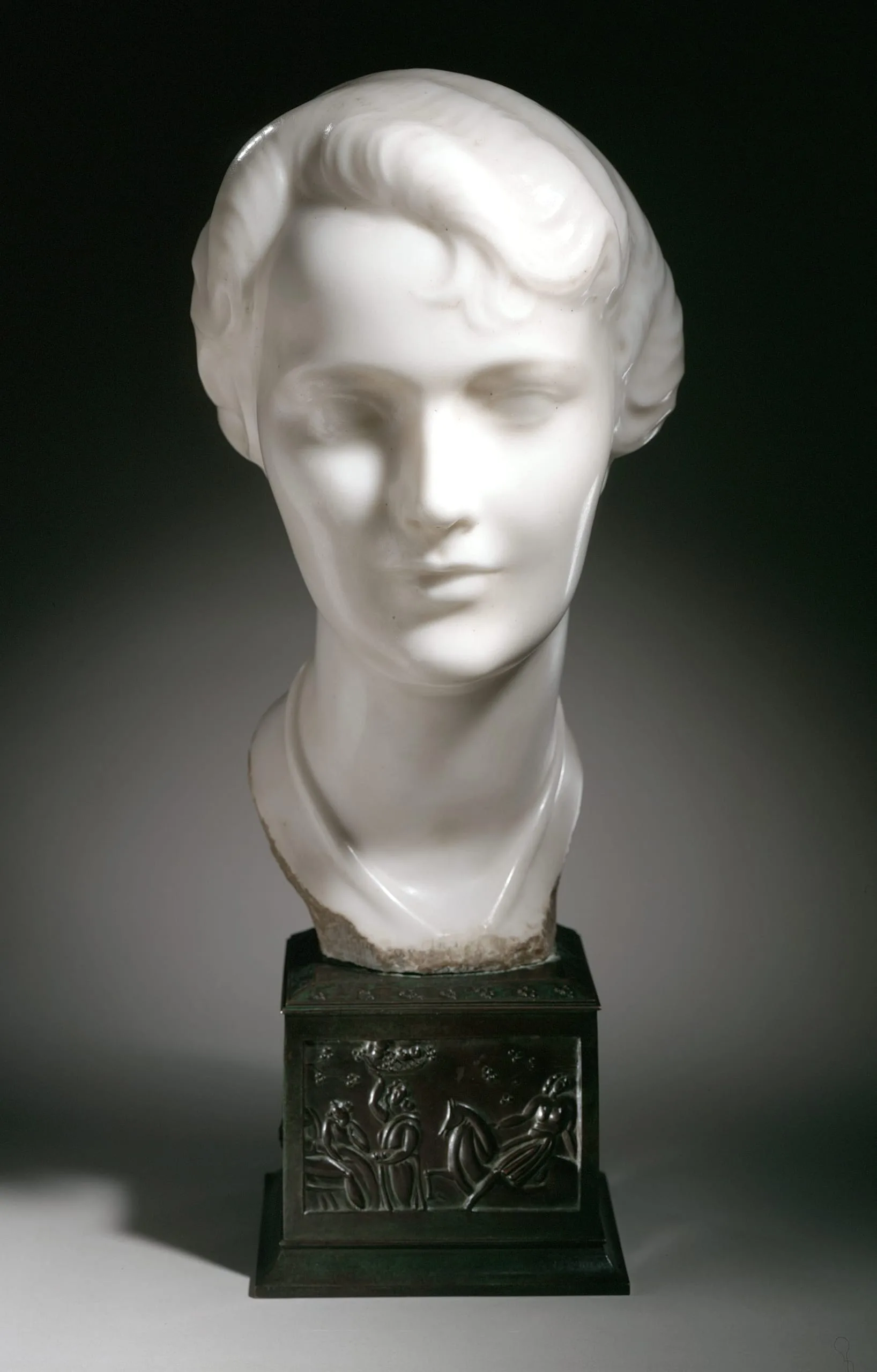
Nadelman’s introduction to New York was largely through Martin Birnbaum, a junior partner at the firm of Scott & Fowles, the artist’s dealers from 1915 to 1925, who organized two successful exhibitions of his work in 1917 and 1925. In about 1916 Nadelman carved a marble bust of the firm’s senior partner, Steven, son Scott (Joslyn Art Museum, Omaha). In 1915 Nadelman began studies for Portrait of a Little Girl, 1916 (Metropolitan Museum of Art, New York), a three-quarter-length marble sculpture of Scott’s daughter. Nadelman completed portraits of the family with this head of Mrs. Stevenson Scott, Marie, carved in 1919.
Seldom attempted before by Nadelman, portraiture became a significant part of his output during his New York period, coming to about two dozen examples. Most are in white marble and similar to Marie Scott in their balance of accurate representation and stylization. Nadelman sought pure forms within the specific, slightly abstracting and softening the portrait. In 1910 Nadelman explained, "I employ no other line than the curve, which possesses freshness and force. I compose these curves so as to bring them in accord or opposition to one another. In that way I obtain the life form, i.e. harmony" ("Photo-Secession Notes," Camera Work no. 32 [October 1910]: 41). One finds in Marie Scott this balanced, rhythmic, flowing movement of simplified, swelling volumes. This fluid quality is enhanced by Nadelman’s rejection of the conventional opaque marble surface, which gives a hard, firm appearance. He polished his marbles to the point that they have a soft, waxlike surface. This allowed planes to merge imperceptibly, while also giving the sculpture an indefiniteness that enhances its ideal quality.