LACMA

ShopMembershipMyLACMATickets
LACMA
Los Angeles County Museum of Art
5905 Wilshire Blvd.
Los Angeles, CA 90036
info@lacma.org
(323) 857-6000
Sign up to receive emails
Subscribe
© Museum Associates 2025

Museum Hours

Monday

11 am–6 pm

Tuesday

11 am–6 pm

Wednesday

Closed

Thursday

11 am–6 pm

Friday

11 am–8 pm

Saturday

10 am–7 pm

Sunday

10 am–7 pm


  • About LACMA
  • Jobs
  • Building LACMA
  • Host An Event
  • Unframed
  • Press
  • FAQs
  • Log in to MyLACMA
  • Privacy Policy
© Museum Associates 2025
Collections

Hassan Hajjaj
Gang of Kesh Part 22000

Not on view
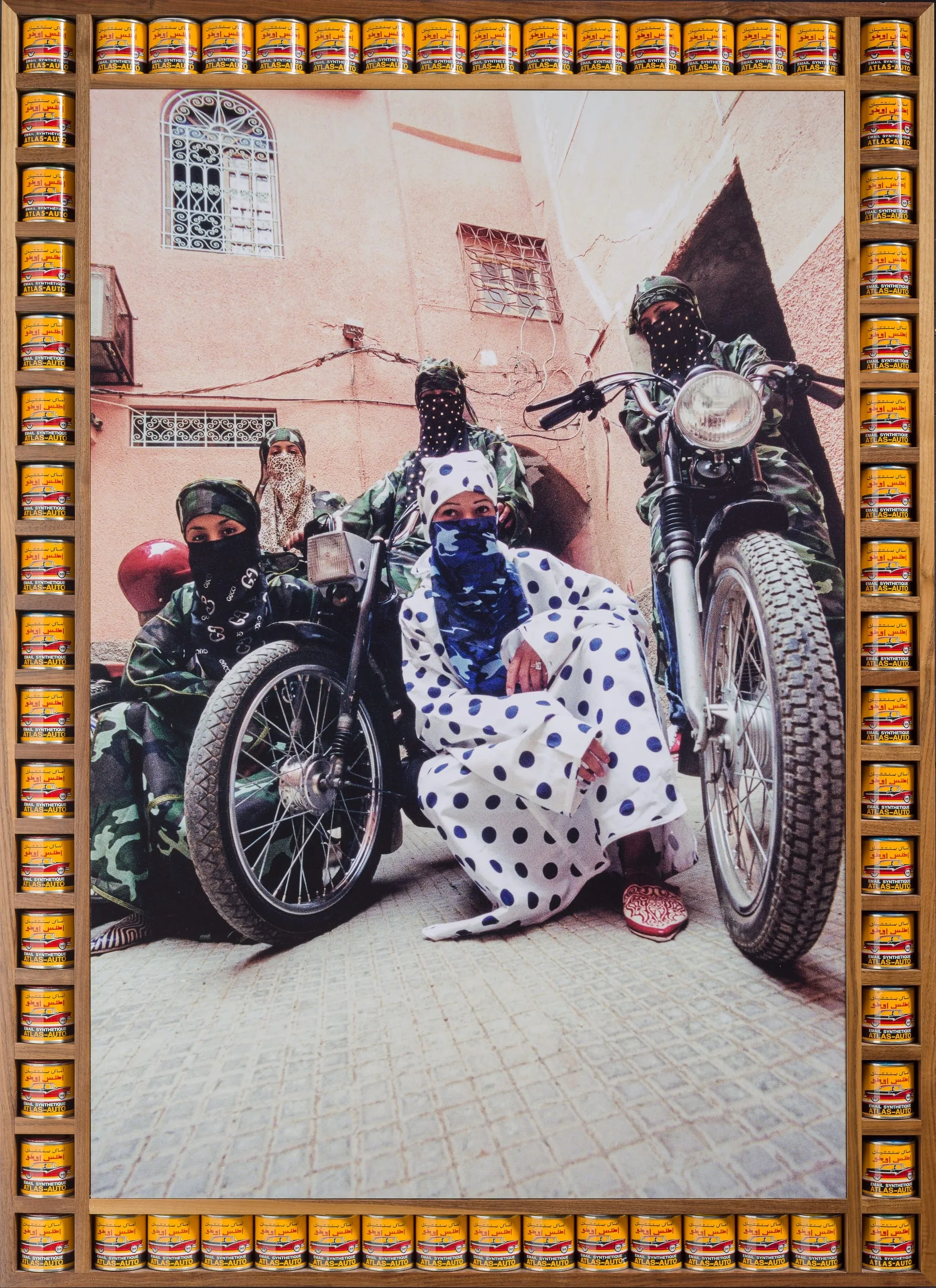
Color photograph of four masked figures in camouflage and polka-dot robes posing with motorcycles on a street, framed with rows of small yellow-labeled cans
Artist or Maker
Hassan Hajjaj
Morocco, Larache, born 1961, active London, United Kingdom and Marrakesh, Morocco
Title
Gang of Kesh Part 2
Place Made
Morocco
Date Made
2000
Medium
Chromogenic print with wood frame and car-paint tins
Dimensions
Image: 44 × 30 in. (111.8 × 76.2 cm) Frame: 51 1/8 × 37 in. (129.8 × 94 cm)
Credit Line
Gift of the artist
Accession Number
M.2014.176
Classification
Photographs
Collecting Area
Art of the Middle East: Contemporary
Curatorial Notes

Inspired by the "henna girls" of Marrakesh, Gang of Kesh (from the series Kesh Angels) features subjects
dressed in an alternate reality of haute couture. They wear the traditional djellaba, head scarf, and veil, but
the garments are made entirely of modern fabrics with bold prints such as bright polka dots, camouflage
designs, or leopard spots. The young women are shown with their motorbikes, seemingly playing against
Western stereotypes of hijab attire and especially the veil as an instrument of disempowerment. These
"biker chicks" are clearly in full command of the powerful vehicles they ride.


Hassan Hajjaj was born in Larache, a small harbor town in northern Morocco. He moved to London as a
teenager, and now divides his time between that city and Marrakesh. Best known as a photographer,
Hajjaj depicts a globalized society where the margins of cultural identity—whether African, Arab, or
European—are continuously shifting and blurred. Here, as in many of his photographs, Hajjaj creates
frames incorporating Coke or Fanta cans or various other packaged goods often labelled in Arabic.
Selected Bibliography
  • Komaroff, Linda. Islamic Art Now: Contemporary Art of the Middle East. Los Angeles: Los Angeles County Museum of Art, 2015.