LACMA

ShopMembershipMyLACMATickets
LACMA
Los Angeles County Museum of Art
5905 Wilshire Blvd.
Los Angeles, CA 90036
info@lacma.org
(323) 857-6000
Sign up to receive emails
Subscribe
© Museum Associates 2025

Museum Hours

Monday

11 am–6 pm

Tuesday

11 am–6 pm

Wednesday

Closed

Thursday

11 am–6 pm

Friday

11 am–8 pm

Saturday

10 am–7 pm

Sunday

10 am–7 pm


  • About LACMA
  • Jobs
  • Building LACMA
  • Host An Event
  • Unframed
  • Press
  • FAQs
  • Log in to MyLACMA
  • Privacy Policy
© Museum Associates 2025
Collections

William Spratling
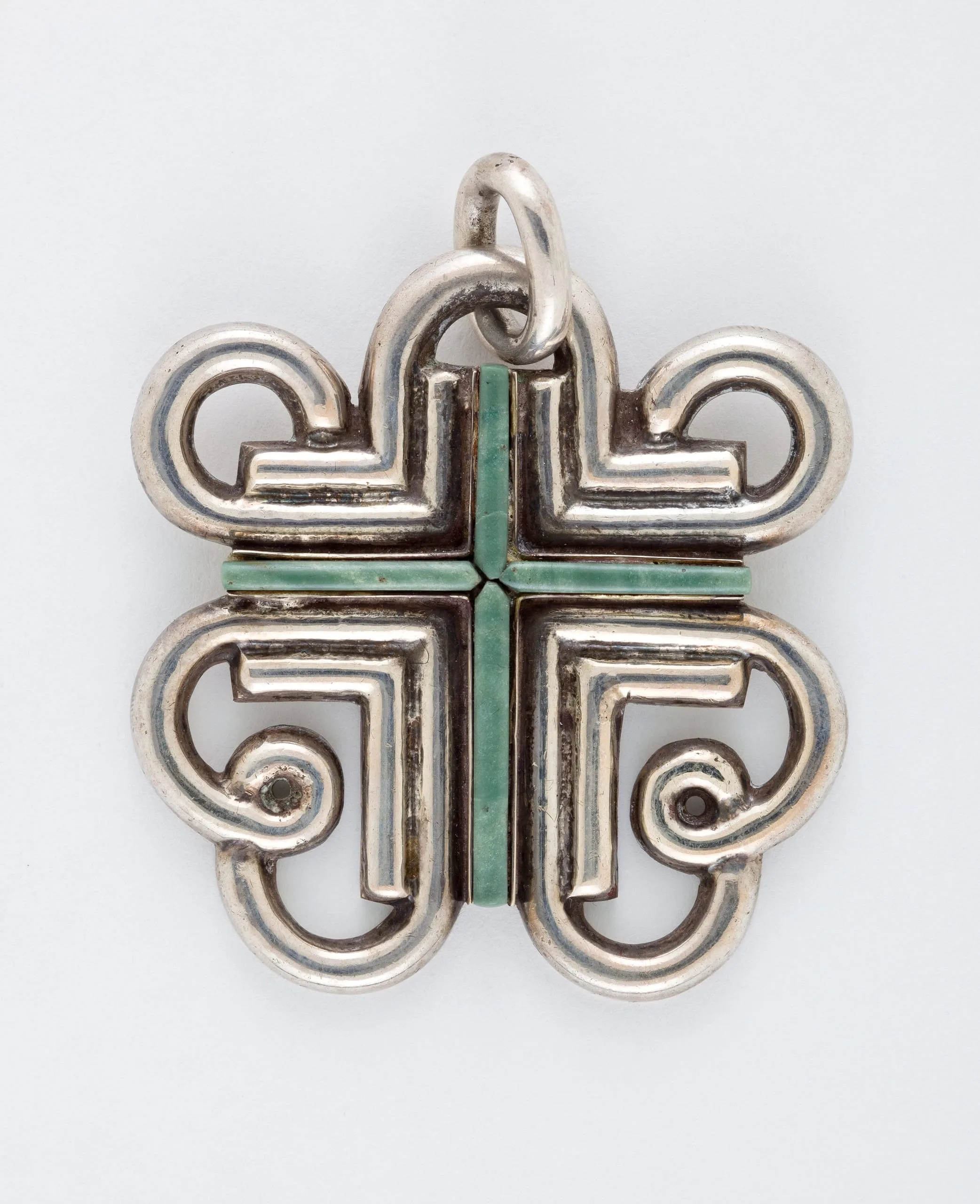
Cross Pendant (Colgajo en forma de cruz)circa 1956-1962

Not on view
Silver pendant with openwork maze-like spiral design in four heart-shaped lobes, centered with a cross inlaid with green stone, suspended from a round jump ring
Artist or Maker
William Spratling
United States, active Mexico, 1900-1967
Title
Cross Pendant (Colgajo en forma de cruz)
Date Made
circa 1956-1962
Medium
Silver, jade
Dimensions
2 5/16 × 2 1/4 × 1/2 in. (5.87 × 5.72 × 1.27 cm)
Credit Line
Gift of Penny Morrill, Susan McCloskey, and Mary Jane Fletcher in memory of John and Chiltipin Sutherland and Dorothy Sutherland Chittim
Accession Number
M.2014.212.1
Classification
Jewelry and Adornments
Collecting Area
Latin American Art
Curatorial Notes

William Spratling was a leading figure in the resurgence of the Mexican silver industry in the twentieth century. This cross, which combines silver and jade, is representative of Spratling’s interest in alternating different materials and colors. The cross conjures Mexico’s colonial past (see also M.2014.161.3 and M.2014.212.2), while the use of jade reveals his fascination with Mesoamerican art.

An architect from New Orleans, Spratling established his first workshop in Taxco, Mexico, in 1931, working alongside a local master silversmith and several young apprentices. A brilliant marketing strategist, Spratling set out to reinvigorate Taxco’s economy by employing local artisans, catalyzing a renaissance in the Mexican silver industry. Insistence on handiwork and experimentation contributed to a thriving local industry. Designers and craftspeople drew on and creatively reinterpreted a variety of sources, including Mesoamerican art, Arts and Crafts, Art Deco, and modernist motifs.

Ilona Katzew

2014