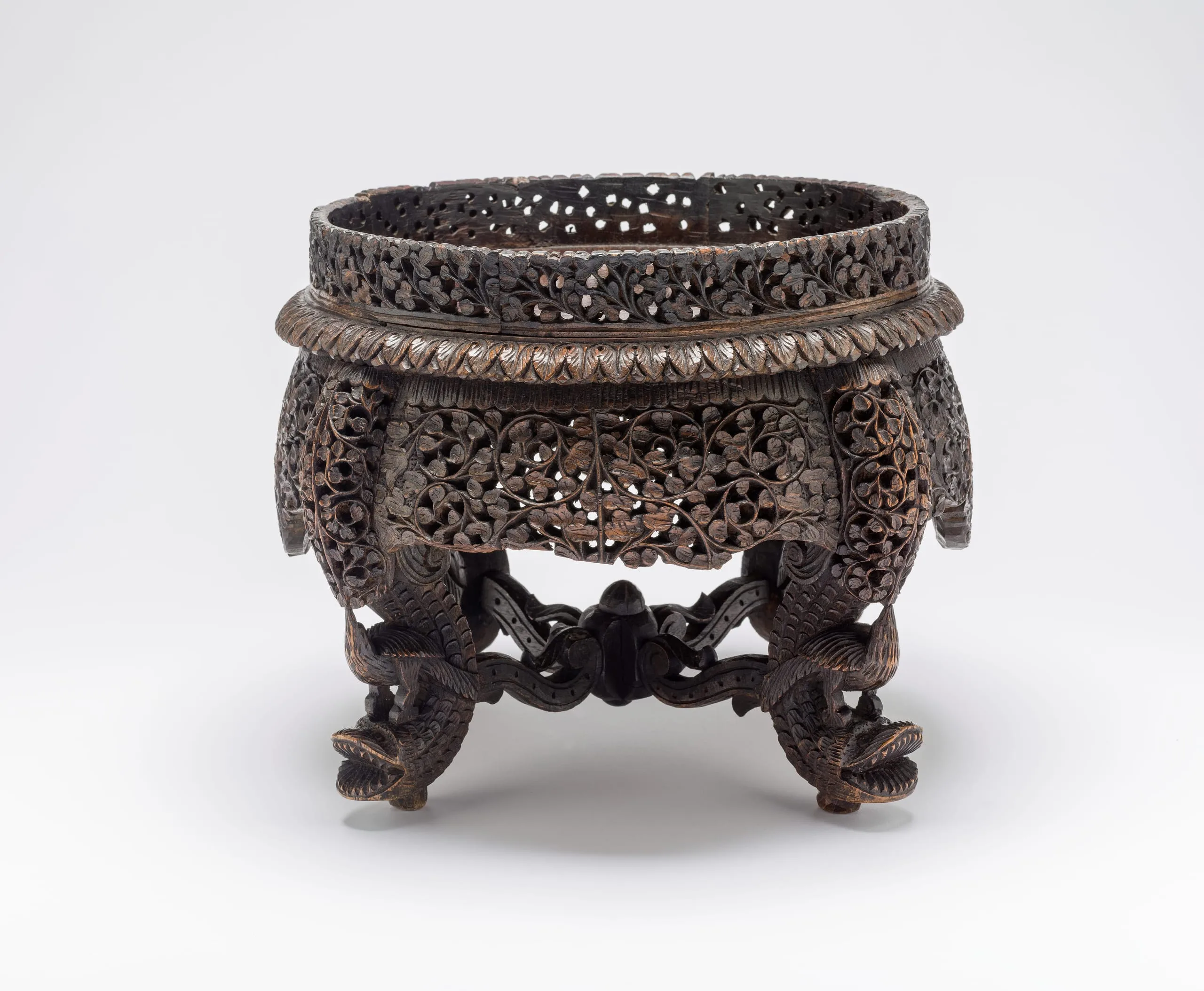
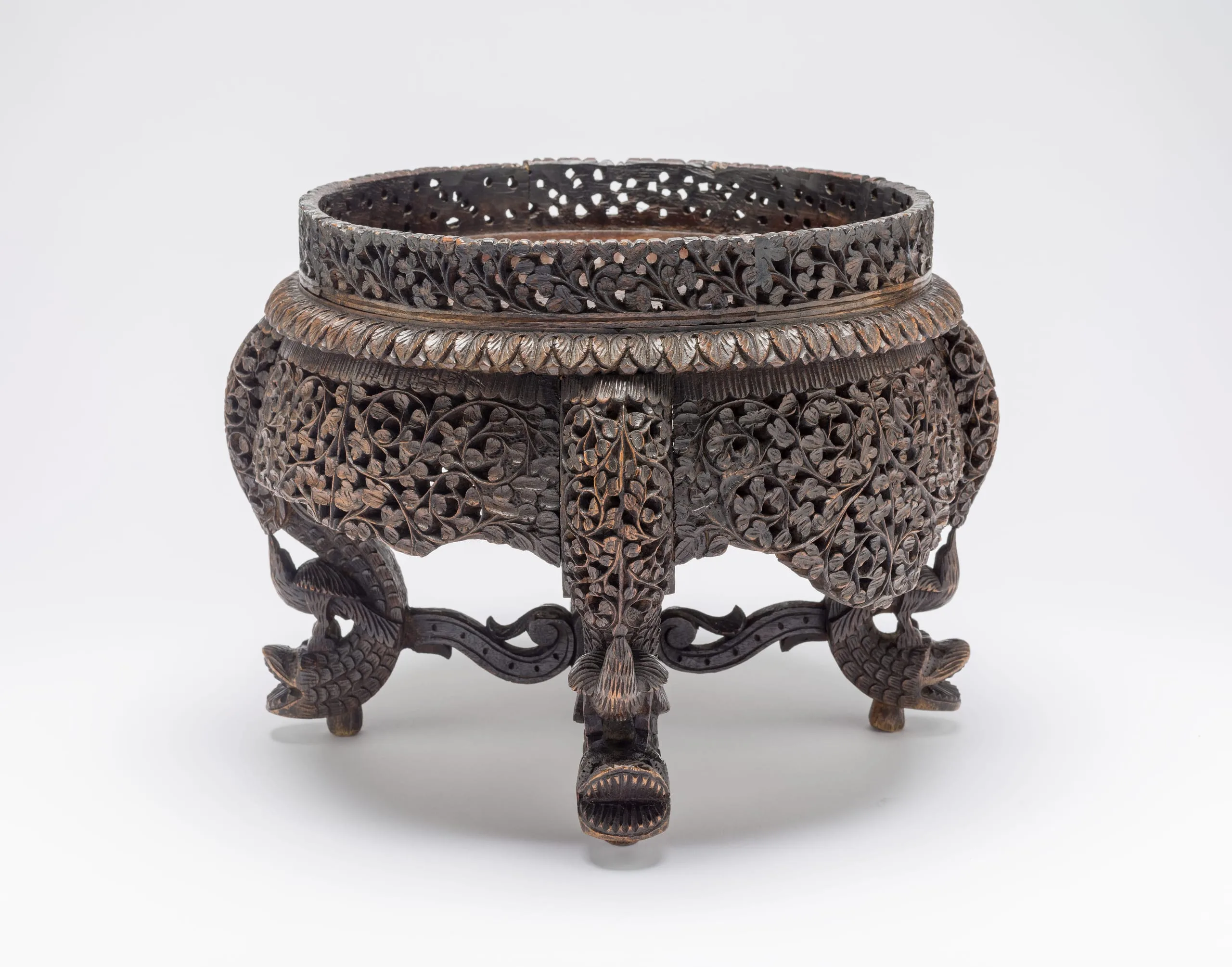
Known as Bombay blackwood because it was produced in a region of present-day Mumbai when it was part of the Bombay Presidency during British colonial rule, this distinctive flamboyant style of woodworking was made of blackwood (Dalbergia latifolia) imported to Bombay from the Malabar Coast in Kerala. During its heyday in the second half of the 19th century, when it was sold in significant numbers both in India and internationally, a wide repertoire of diverse types of tables, stands, cabinets, chairs, and even entire suites of furniture were fashioned. Regardless of function, Bombay blackwood featured openwork surfaces with lush botanical motifs and solid supporting and projecting elements with bold forms drawn from nature and fantasy that were expressed in an exuberant ornamental mode likely inspired by the Victorian Rococo Revival style of 1845-70 and Gujarati architectural vernaculars.
This low stand, perhaps meant to support a potted plant, has a recessed top with a pierced foliate collar. A band of pendent acanthus leaves encircles the shoulders, beneath which are a band of lappets and a large overhanging fringe of openwork foliage. The stand is supported by four opposing feet connected with floral brackets and a bud-shaped junction. The demonstrative feet are in the form of four stylized eels or serpents, each with an open mouth displaying sharp teeth and a scaled body undulating upward. A bird stands on each head with its neck craned to peck at the drooping vegetation.