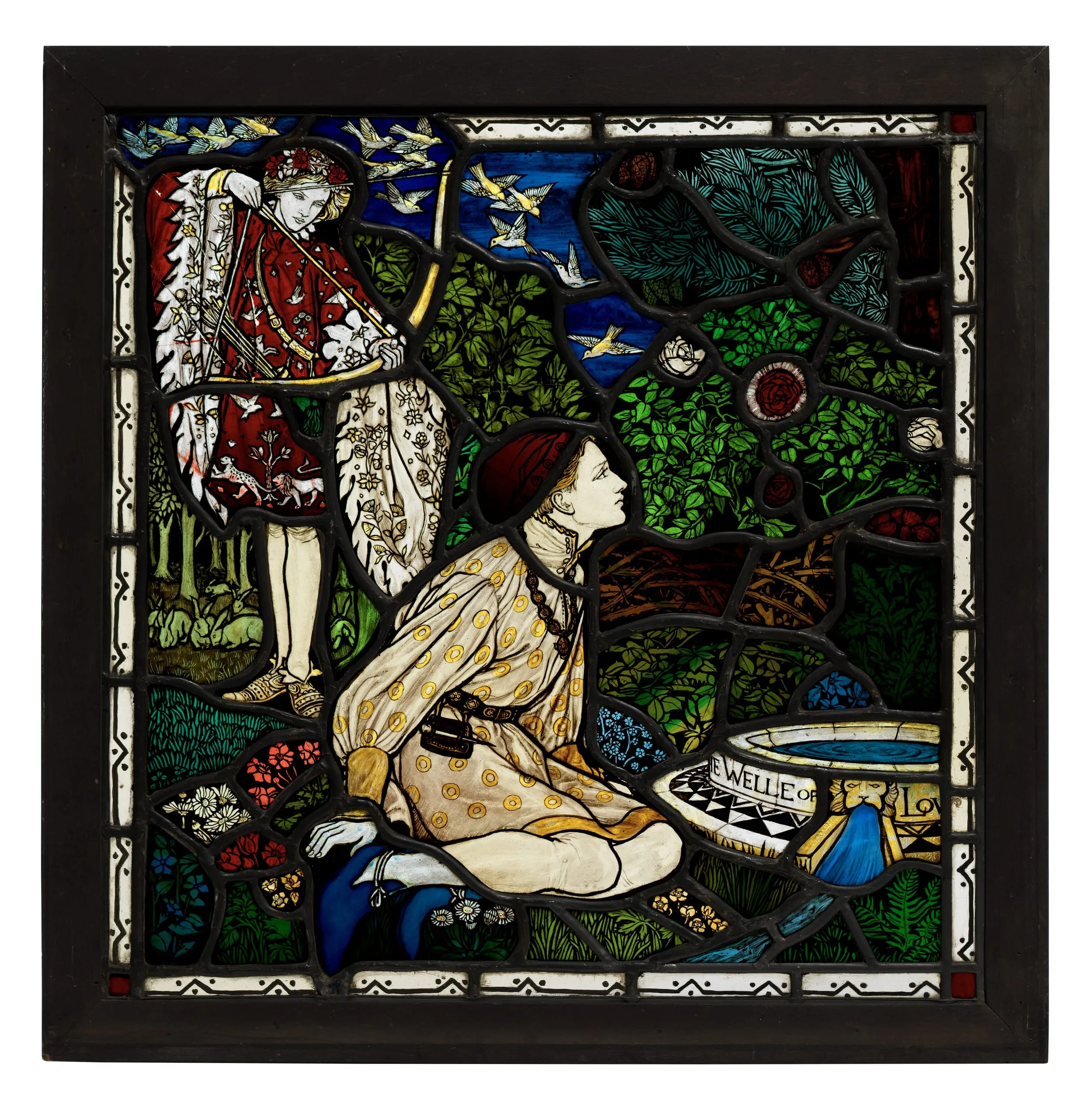
The Birmingham Municipal School of Art (BMSA) was the epicenter of the city’s vibrant Arts and Crafts movement. In 1885, it became the first purpose-built art school in Britain and quickly expanded design education to include actual making. Margaret Agnes Rope enrolled at BMSA in January 1900 and continued there until 1909. She studied enameling, metalwork, and lettering initially but soon took up stained glass. The Welle of Love panel was likely done as a student project. With its saturated jewel tones, the striking panel demonstrates Rope’s mastery of design and glass painting. Unlike the division of labor characteristic of traditional stained-glass production, Rope and other BMSA students not only designed and painted panels but selected and cut the glass and leaded the final pieces.
Rope’s emphasis on the natural landscape in her depiction of a scene from Chaucer’s Romaunt of the Rose is in keeping with Arts and Crafts principles. References to Chaucer were themselves integral to the Medieval Revival aesthetic championed by William Morris and Edward Burne-Jones, both leading figures in the movement. The latter was responsible for designing Morris & Co.’s stained glass between 1874 and 1898, including the windows at Birmingham Cathedral, which students at BMSA could easily visit.
The Welle of Love panel is illustrated in the 1909 Studio Year-book of Decorative Art, selected by Rope for her brief entry in the publication. In that same year, she left BMSA and almost immediately started work on her best known commission, a series of seven windows for Shrewsbury Cathedral, completed over three decades. Around 1911, she took a studio at Lowndes & Drury in London, where all of her windows were made until 1922. In 1923, Rope entered the Carmelite monastery at Woodbridge, Suffolk, but continued to make stained glass there, cutting, painting, and assembling panels and sending painted glass out for firing at Lowndes & Drury.
Abbey Chamberlain Brach
2014