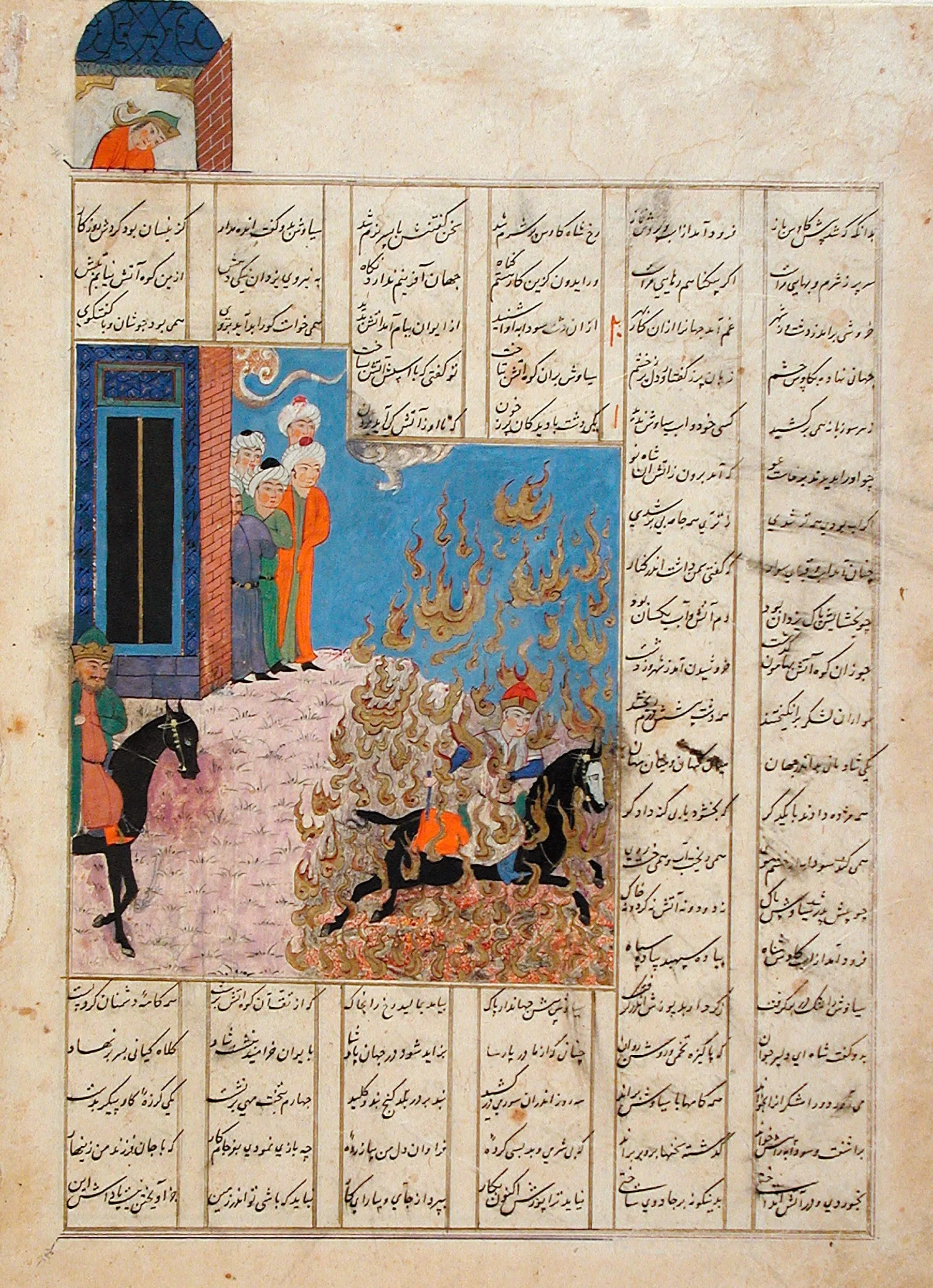
The Shahnama (Book of Kings), the Iranian national epic, was composed by Firdawsi and completed around 1010. It chronicles in verse the legendary and historical kings and heroes of the Persian Empire up to the Arab Muslim conquest in the seventh century. Celebrated for its literary prestige and depiction of sovereign ideals, it was widely circulated and admired in the Persian-literate world, including the Muslim courts of South Asia. Indian copies first appeared in the fourteenth century, with production expanding in the fifteenth century. Shiraz, in southern Iran, played a key role in exporting artists and manuscripts to South Asia, driven by its commercial manuscript tradition and the search for new patronage after the dissolution of its own royal atelier in 1435.
This folio illustrates one of the Shahnama’s most dramatic episodes: Siyavush’s fire ordeal. Falsely accused by his stepmother Sudabeh, Siyavush was ordered by his father, King Kay Kaus, to prove his innocence by riding through fire. The painting captures the tense moment as Siyavush enters the flames and emerges unscathed—a divine testament to his purity. A hallmark of Shiraz manuscripts, the stepped text layout in this folio creates an engaging composition by enhancing the interplay between word and image, guiding the reader through the unfolding drama. Though linked to the Shiraz style of painting with its high horizon and scalloped cloud band, the clustering of the courtiers and the bright orange pigment suggest an Indian provenance. This folio is one of four from the same dispersed Shahnama manuscript (see also 57.17.3, .4, 10).
2025