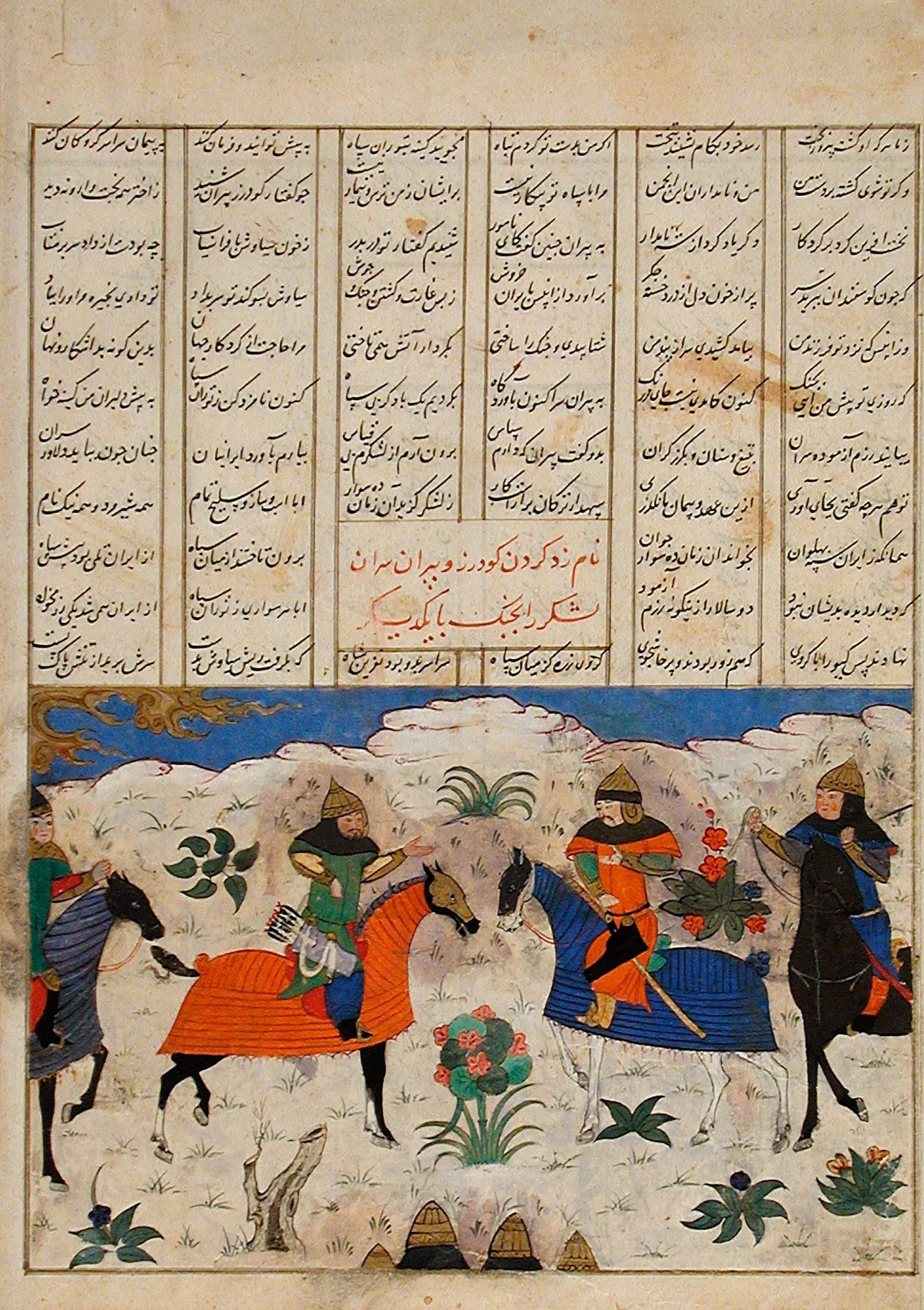
The Shahnama (Book of Kings), the Iranian national epic, was composed by Firdawsi and completed around 1010. It chronicles in verse the legendary and historical kings and heroes of the Persian Empire up to the Arab Muslim conquest in the seventh century. Illustrated manuscripts of the great poem were widely circulated as well as produced throughout the Persian-literate world, including South Asia, where it was admired at the Muslim courts for its grandeur and association with Persian kingship traditions. Indian copies of the Shahnama first appeared in the fourteenth century, increasing in production during the fifteenth century. It is generally accepted that Shiraz was one of the key regions from which artists and manuscripts were exported to South Asia.
This folio is one of four in LACMA’s collection from the same dispersed manuscript of the Shahnama (see also 57.17.4, .7, .10). It depicts one of the text’s finest stories, Davāzdah Rukh (The Twelve Worriers), celebrated for its compelling plot, dramatic descriptions, and insight into human nature. It recounts a series of single combats between Iranian and Turanian heroes along their shared border. Led by Goudarz, the Iranian heroes consistently triumph over their Turanian counterparts, commanded by Piran Viseh. The generic scene of mounted warriors shown here is closely allied to the Shiraz style of painting with its high horizon, scalloped cloud bands, and mountainous landscape with clusters of flowering plants. However, the row of helmeted heads observing in the foreground and the use of bright orange pigment belie an Iranian provenance.