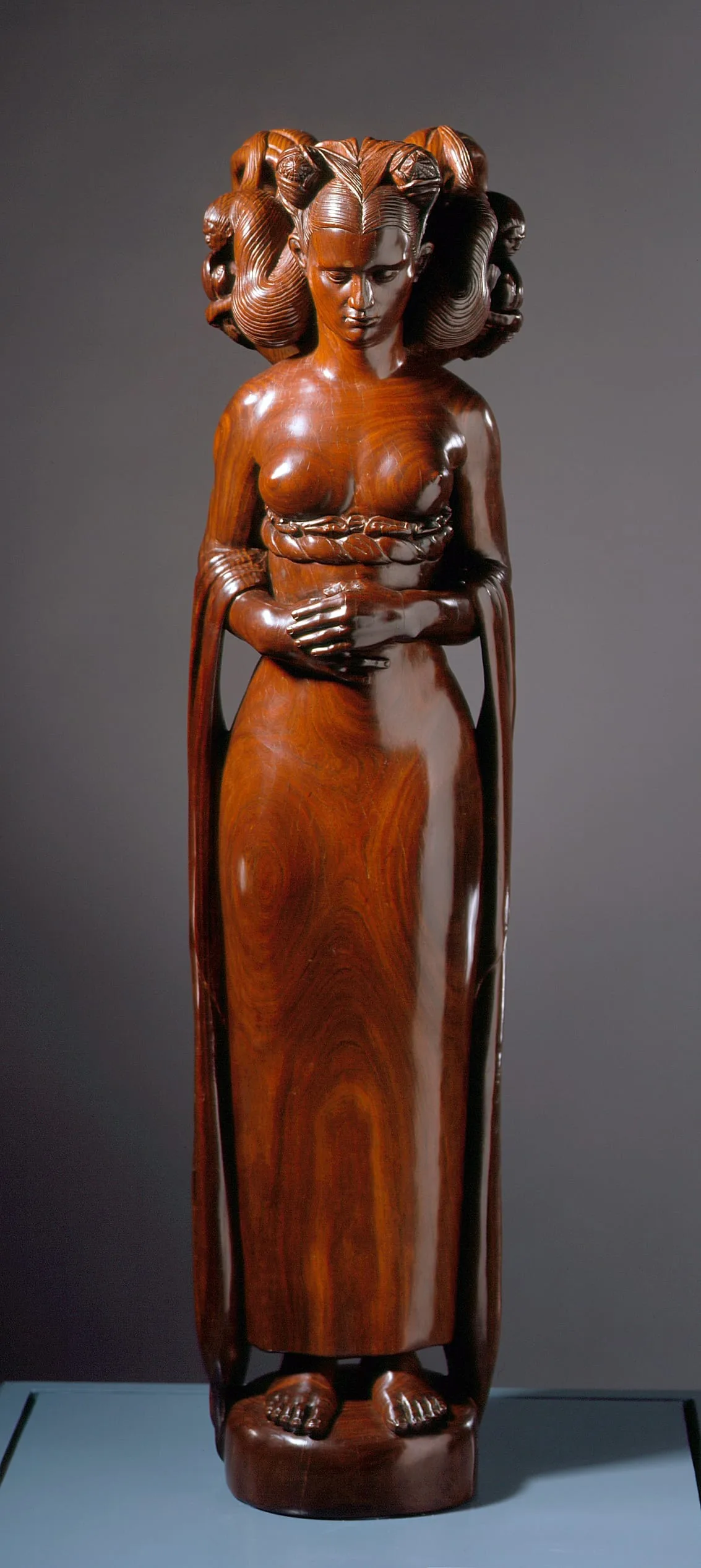
Hord was an amateur archaeologist and was fascinated with the indigenous culture of the Southwest. In his art he attempted to represent in human form the forces of nature that the Native Americans believed controlled their lives, such as corn, their basic food staple, which they deified. Hord carved Young Maize, 1931 (San Diego Museum of Art), as a powerful young man symbolizing the sturdy stalk of a new plant. In The Corn Goddess Hord presents a strong, voluptuous figure to suggest the fecundity of the earth. The waves of her elaborate hair arrangement form a soft bed from which two ears of corn emerge, and two small figures representing sprouting corn grow upwards on stalks from her back. This swirling arrangement of hair, an essential, symbolic element, is present in many of Hord’s carvings of the early 1940s, as are figures depicted with the broad, fiat facial features of the Native American.
Hord preferred the harder types of stone and wood for his sculpture. During World War II he could not obtain rosewood, so he used lignum vitae, which takes a beautiful polish, and he used it for Corn Goddess. Hord worked on his wood objects himself, without the aid of his assistant, Homer Dana, and this piece required three months to complete. Although he had been taught to leave the chisel marks showing, in the early 1930s Hord began the practice for which he became famous: polishing a piece to a high gloss to expose the wood’s grain.