Beginning in the early 19th century in Murshidabad, images of festivals, ceremonies, occupations, and transportation modes were painted on mica. Known colloquially as talc paintings, mica was used by artists for making tracings as models (namuna) of their ancestral paintings. Mica was mined in the Chota Nagpur Plateau in eastern India. The mica crystals could be cleaved into thin elastic plates, which were suitable as a ground for illustrations and for making lanterns (see M.85.180). By the middle of the 19th century, mica painting spread to Patna, Bihar; Benares (Varanasi), Uttar Pradesh; and Trichinopoly (Tiruchirappalli), Puddukkottai, and Srirangam, Tamil Nadu. Each venue produced mica paintings in their own regional styles of standard and idiosyncratic subjects, including natural history studies done in Trichinopoly. Hundreds of mica paintings were collected by British patrons and visitors, many of which were sent home as gifts. By the end of the 19th century, the artform had been largely supplanted by photography.
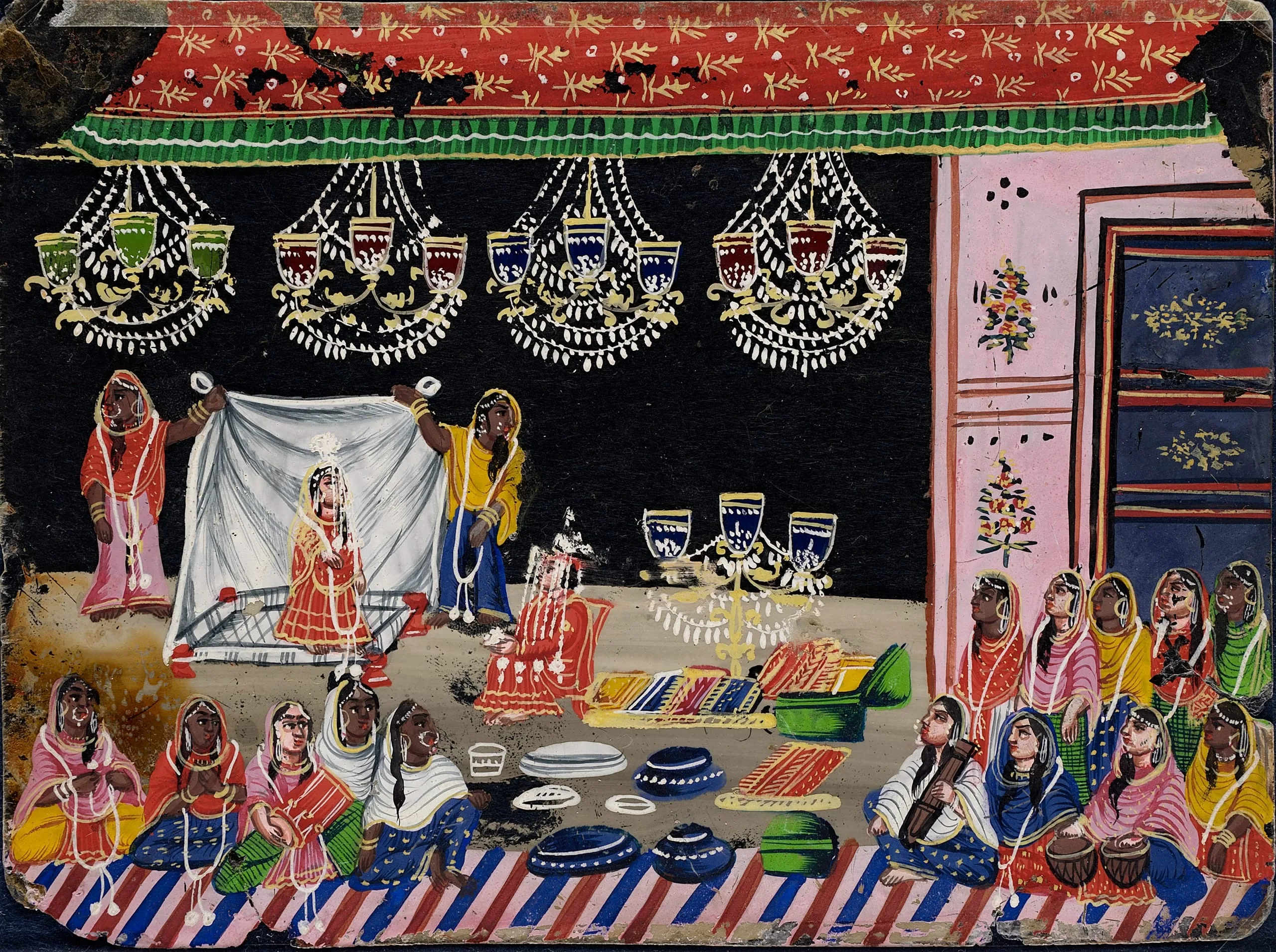
This painting depicts part of a Hindu wedding ceremony taking place at night in the bride’s family house with only her female relatives present. The bride-to-be is standing on a platform behind a canopy held by maidservants. The bridegroom is seated before her wearing floral garlands, formal garments, and holding a bouquet of flowers. Behind him is a sacred lamp and gifts of textiles. Entertainment is provided by an all-female group of musicians and singers.