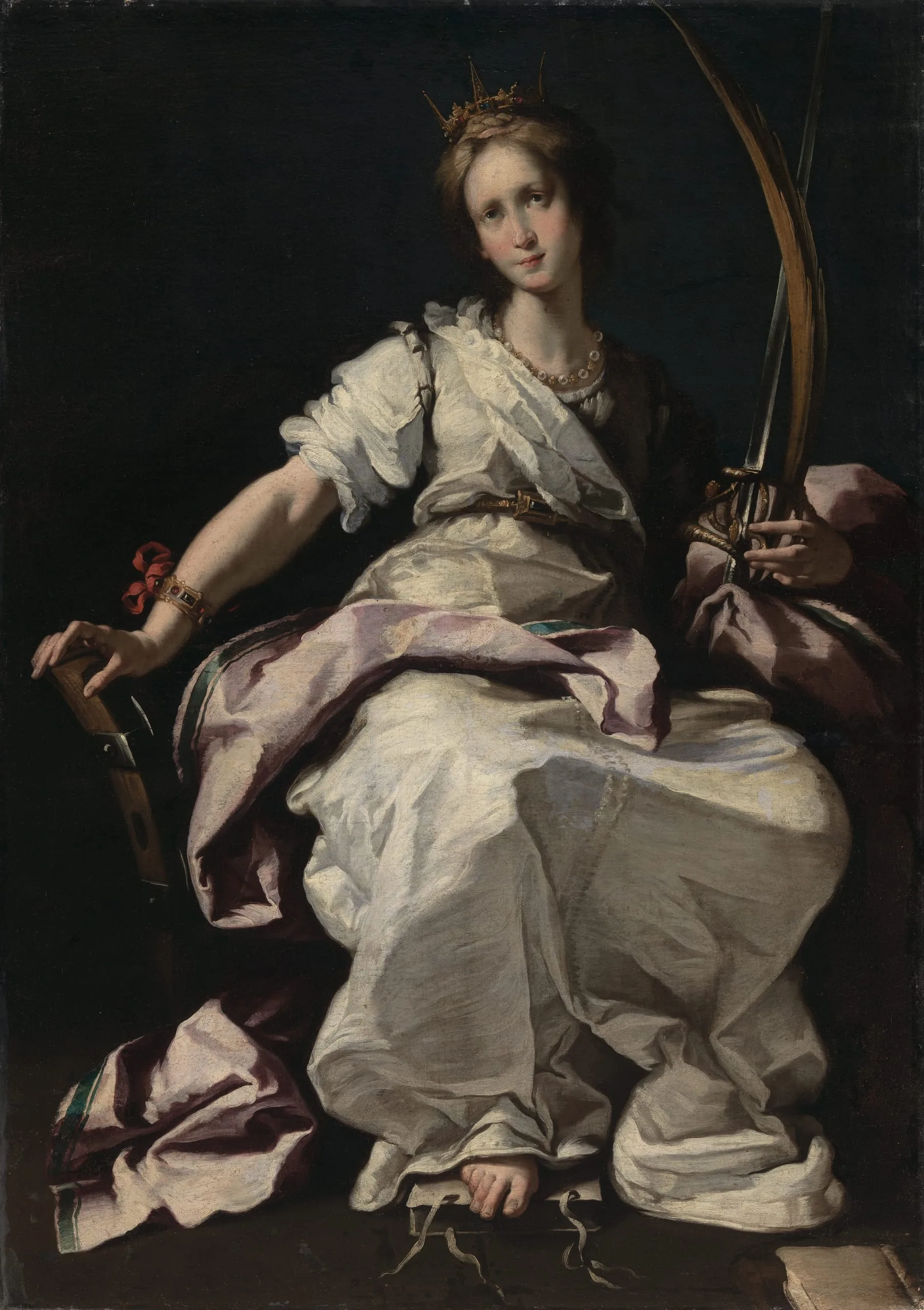
A few years prior to painting this idealized, life-size representation of Saint Catherine, Bernardo Strozzi lived as a cloistered Capuchin monk in Genoa, the largest Italian seaport on the Mediterranean coast, renowned for its trade in artworks and goods. The Republic, governed by doges, was fundamentally an oligarchy ruled by a small group of merchant families. Strozzi’s Saint Catherine was likely commissioned by a member of the powerful House of Doria, a family whose ranks included several doges of Genoa and cardinals of the Catholic church. Yet his depiction of Saint Catherine, holding the emblems of her martyrdom—the executioner’s sword and the wheel—diverges from his usual focus on piety, which adhered to the Council of Trent’s directives to emphasize the propaganda value of personifying sacred mysteries through the suffering and triumph of martyrs. Here, Catherine is seated in a manner that presents her to the viewer from below, with Strozzi meticulously detailing her elongated oval head, theatrical upward gaze, and pale-pink and indigo garment set against a sharply contrasting dark backdrop. The books at her feet allude to her status as the patron saint of scholars. Rather than serving purely devotional purposes, the painting was likely intended for a library or study within the Doria family’s estate.
In 1944, this painting was looted from Charles Loeser’s collection at the Villa Gattaia during the Nazi occupation of Florence. Considered lost for many years, it resurfaced when a pair of Italian dealers attempted to auction it in 2009, leading to its recognition as Nazi plunder. Philippa Calnan, Loeser’s granddaughter and the sole heir of the painting, spent five years fighting for its restitution. The Italian courts ultimately overturned previous rulings that had prevented its export from Italy. In a generous gesture, Calnan has since gifted the painting to LACMA in memory of her grandfather.
2024