- Title
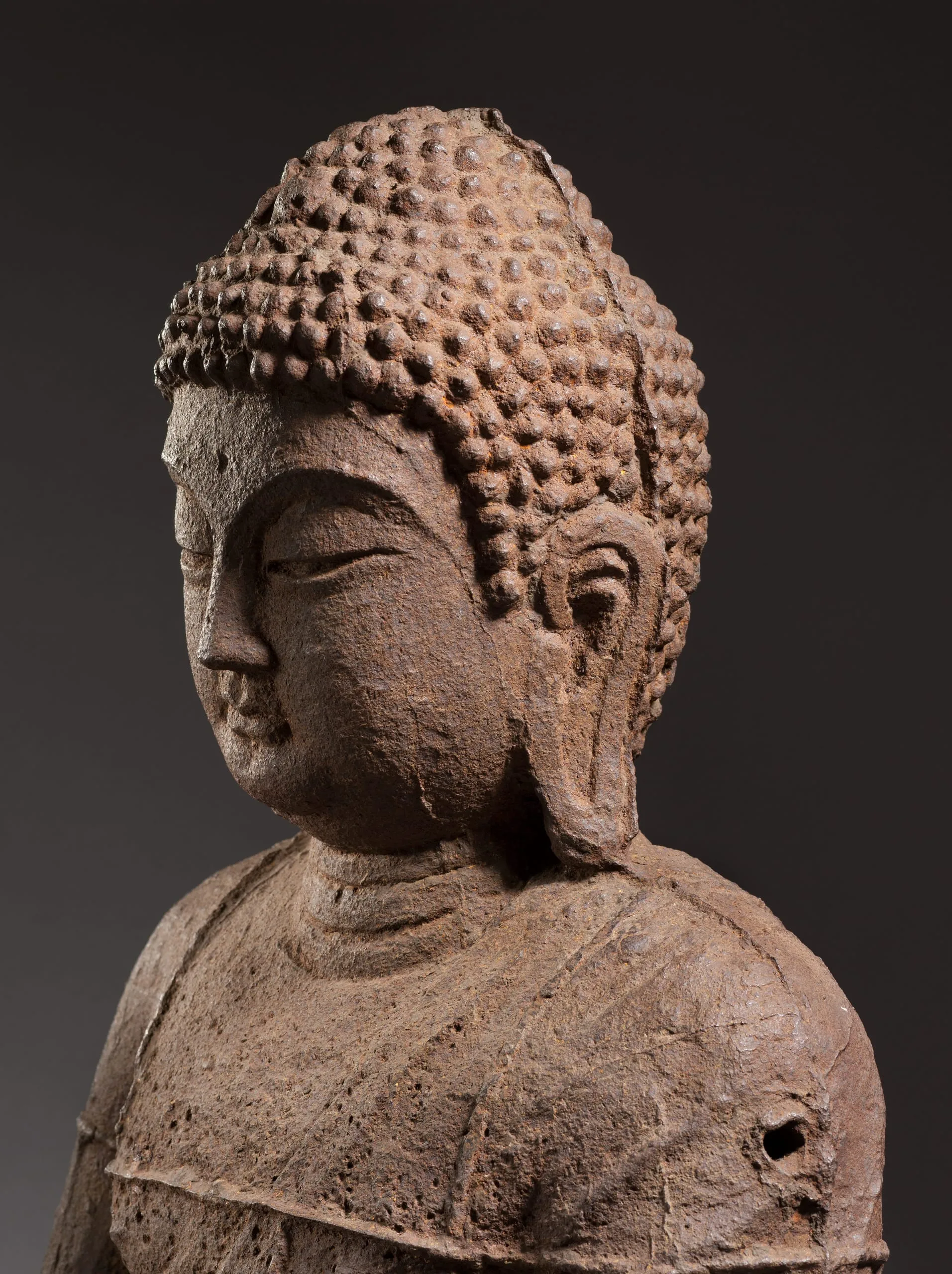
- Seated Buddha
- Date Made
- Goryeo dynasty (918-1392), 10th century
- Medium
- Cast iron
- Dimensions
- 25 1/4 × 20 × 15 in. (64.14 × 50.8 × 38.1 cm)
- Accession Number
- M.2013.44
- Curatorial Notes
Buddhism arrived in Korea with monks from India and China in the fourth century CE. The foreign religion, which taught a means to transcend life’s inevitable suffering and the cycle of death and rebirth, quickly took hold and was soon supported by members of the royal courts of the Three Kingdoms period (4th7th centuries). Later, during the Unified Silla (668–935) and Goryeo (918–1392) dynasties, Buddhism enjoyed widespread patronage and flourished throughout the Korean peninsula. The Goryeo dynasty witnessed enthusiastic aristocratic and governmental support for the religion.
Depicting the historical Buddha Shakyamuni’s enlightenment at Bodh Gaya, in the modern state of Bihar in India, this iron sculpture projects a profound sense of meditative calm. Having fended off an attack by the forces of the demon Mara, the Buddha, at the moment of his enlightenment, touched the earth with his right hand, thereby calling on the earth to witness his achievement. This sacred gesture is known in Sanskrit as bhumisparsha mudra, or the earth-touching gesture. Cast iron was widely used in Korea for Buddhist sculpture from the eighth century onward.
Stephen Little
2013
- Selected Bibliography
- Goodall, Hollis, and Robert T. Singer. "Art of Asia Acquired by North American Museums, 2012-2013: Los Angeles County Museum of Art." Archives of Asian Art 64, no.2 (2014): 236-244.
- Woodward, R.M. Buddhism: A Journey Through Art. Northampton, MA: Roli Books, 2024.