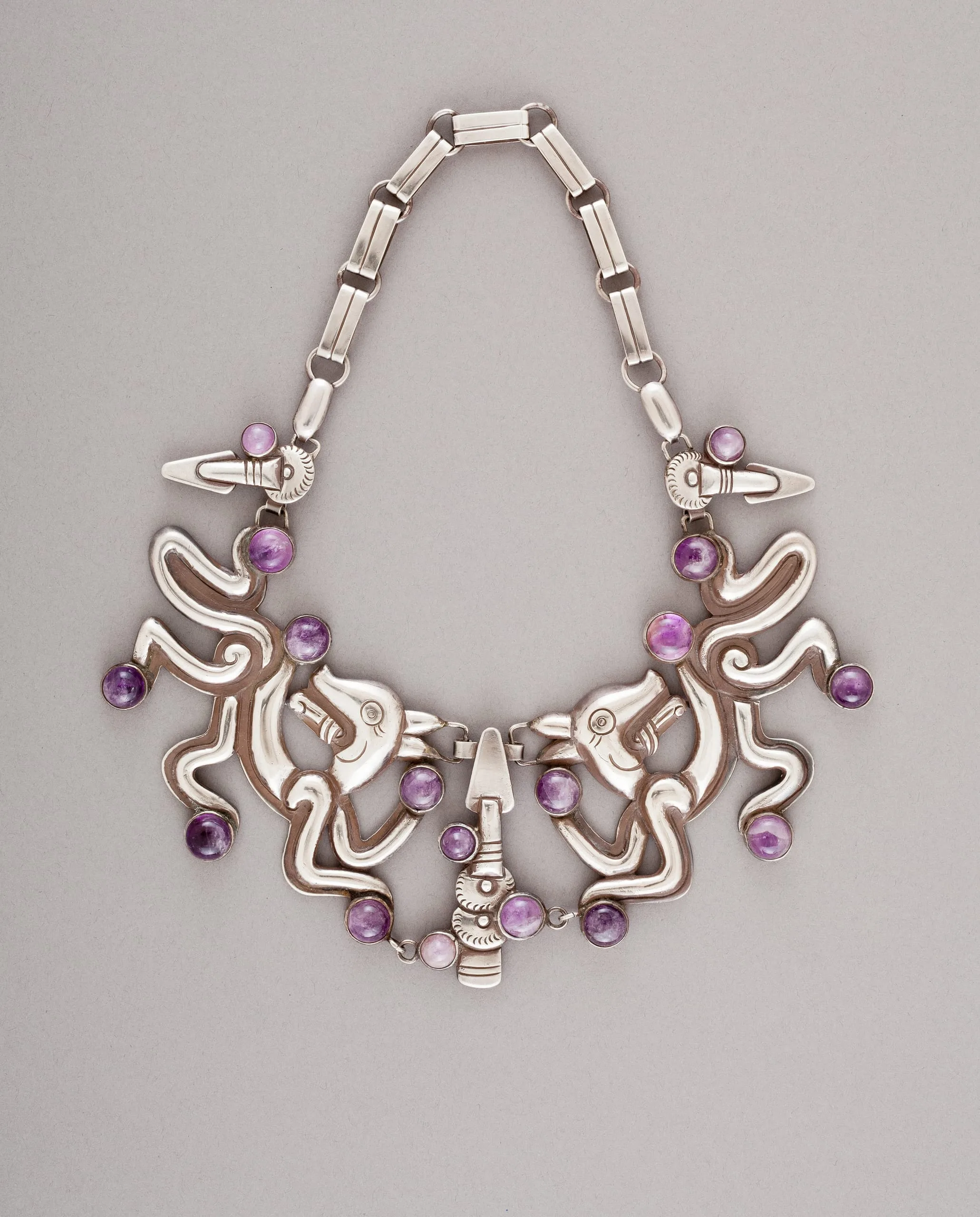
This necklace, featuring two quadrupeds in mirror image, is one of William Spratling’s most important silver designs and is emblematic of his interest in Mesoamerican art. The swirling lines of the animals produce a sense of movement, while the combination of silver and amethyst creates a striking effect. The animal form here and in the related brooch (M.2012.189.4) has generally been identified as a jaguar by Spratling aficionados and collectors, yet in his wholesale catalogues Spratling referred to the motif as a tigre (tiger). Adding to the confusion, in his 1953 book Designs of Ancient Mexico, the artist and scholar Jorge Enciso (1879–1969) published a clay stamp from Spratling’s personal collection (perhaps a model for this design) and classified it as a dog. More recently, scholar and silver expert Penny Morrill identified as a possible source a polychrome ceramic vessel from Cholula featuring a deer (now in the Museo Nacional de Antropología, Mexico City). A plate in LACMA’s collection (M.2010.115.168) offers another suggestive comparison: on the outer edges of the plate, two deer crane their necks backward with their tongues hanging out. Regardless of the particular animal represented, this necklace exemplifies Spratling’s creative reinterpretations of Mesoamerican art in his modern designs.
Trained as an architect, Spratling moved from New Orleans to Taxco, Mexico, where he established his first silver workshop in 1931. Working alongside master silversmiths and local apprentices, in 1935 he opened his famed Taller de Las Delicias, which attracted a cohort of international artists, intellectuals, and Hollywood celebrities. Spratling’s emphasis on craftsmanship and his experimentation with different sources, including Mesoamerican art, Art Deco, and modernism, contributed to his great success and helped revitalize the Mexican silver industry.
Rachel Kaplan
2025