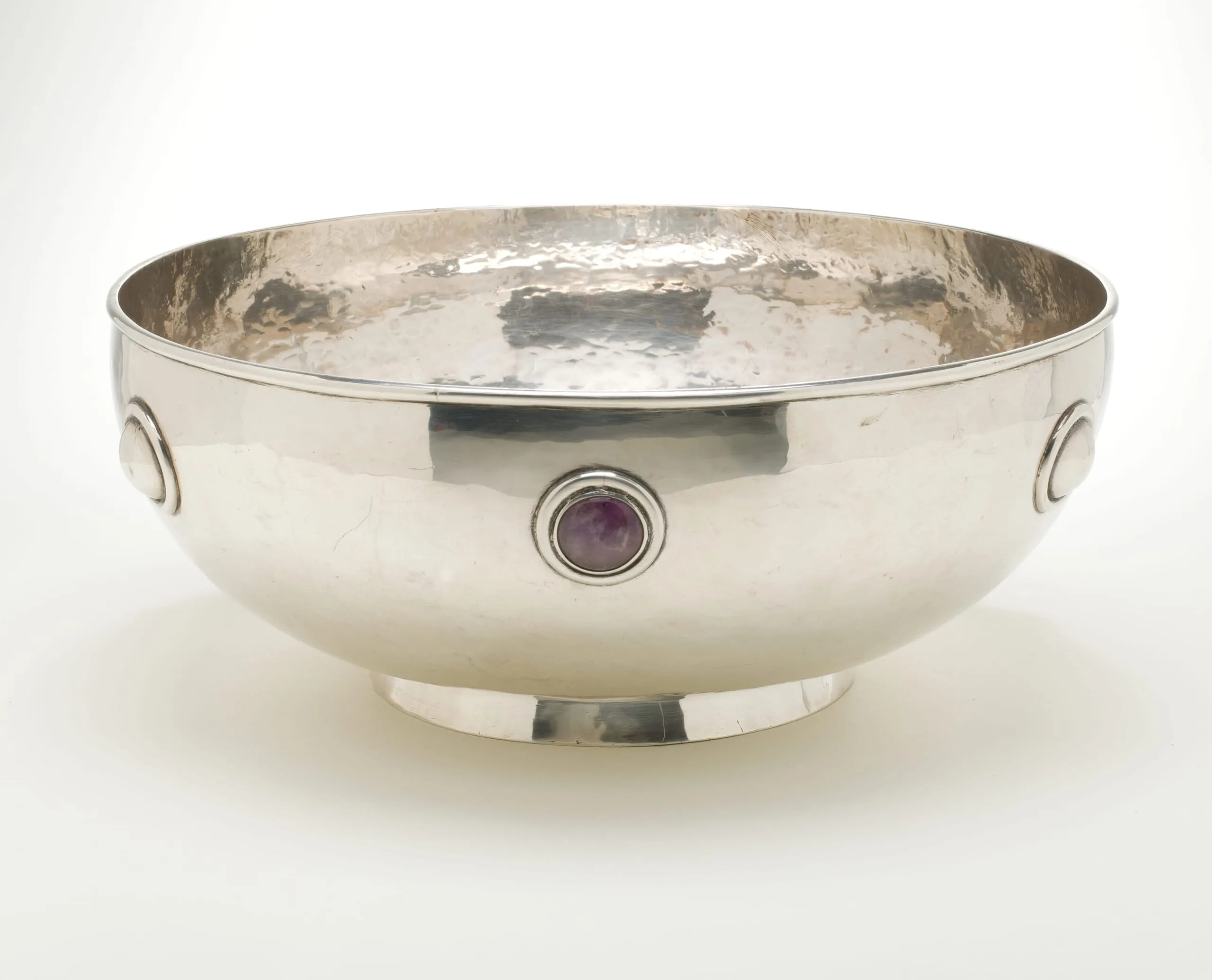
This fine punch bowl was originally commissioned from William Spratling by Manuel Ávila Camacho, president of Mexico from 1940 to 1946, as a gift for his wife. However, in the end, the Camachos rejected the design, which they deemed too plain as it lacked the colonial and Mesoamerican ornamentation typical of Spratling’s silverwork. Instead, the bowl showcases Spratling’s enhancement of his elaborate handwrought designs with beautiful local stones, in this case amethyst cabochons. While the exterior has been smoothed to highlight silver’s reflective qualities, the inside retains hand-hammered marks, emphasizing the highly skilled craftsmanship of the piece.
Trained as an architect, Spratling moved from New Orleans to Taxco, Mexico, where he established his first silver workshop in 1931. Working alongside master silversmiths and local apprentices, in 1935 he opened his famed Taller de Las Delicias, which attracted a cohort of international artists, intellectuals, and Hollywood celebrities. Spratling’s emphasis on craftsmanship and his experimentation with different sources, including Mesoamerican art, Art Deco, and modernism, contributed to his great success and helped revitalize the Mexican silver industry.
Rachel Kaplan
2025