LACMA

ShopMembershipMyLACMATickets
LACMA
Los Angeles County Museum of Art
5905 Wilshire Blvd.
Los Angeles, CA 90036
info@lacma.org
(323) 857-6000
Sign up to receive emails
Subscribe
© Museum Associates 2026
  • About LACMA
  • Jobs
  • Building LACMA
  • Host An Event
  • Unframed
  • Press
  • FAQs
  • Log in to MyLACMA
  • Privacy Policy
© Museum Associates 2026
Collections

Frederick Walter Davis
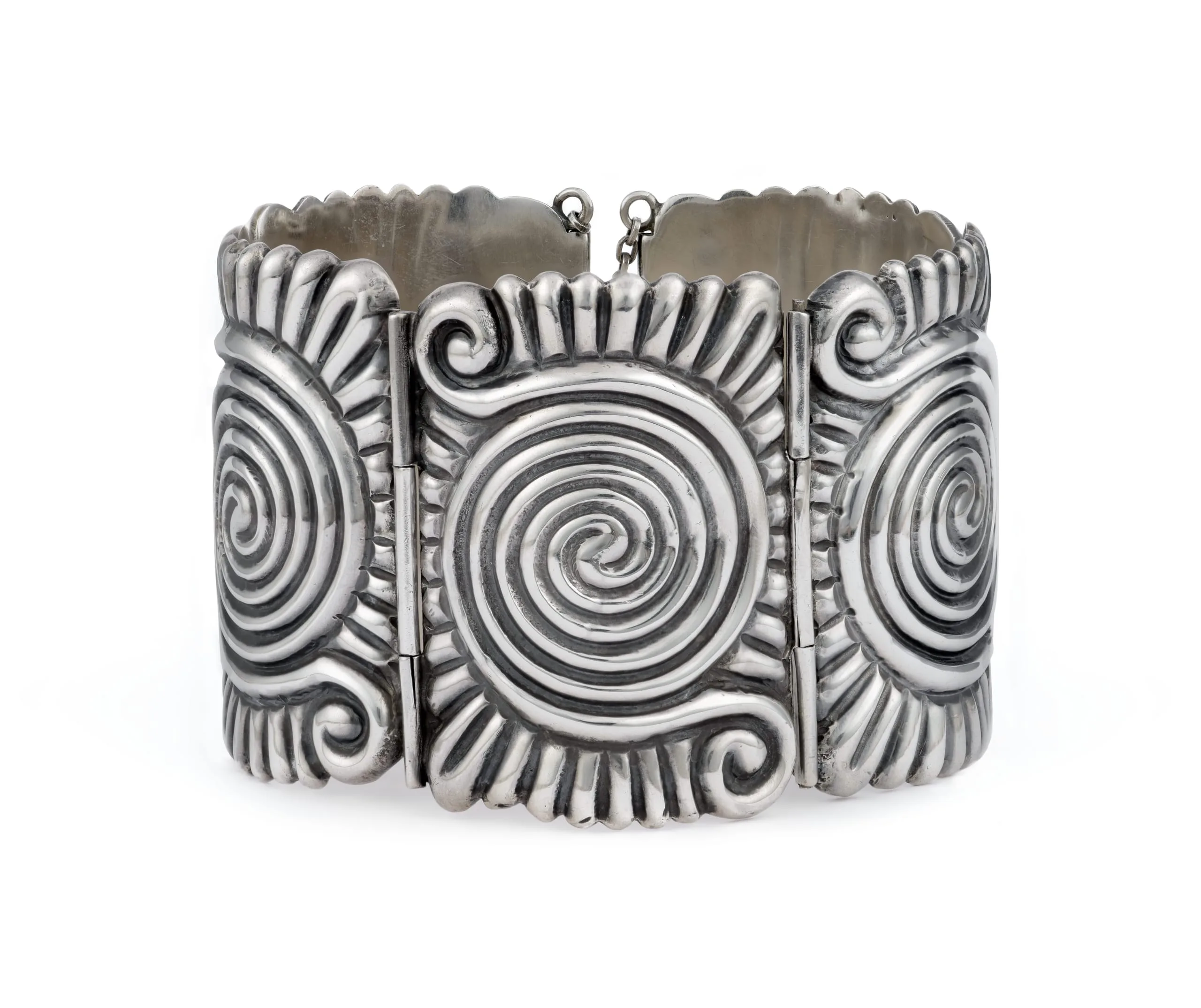
Swirl Glyph Cuff (Brazalete con motivos de espiral)circa 1935

Not on view
Wide silver cuff bracelet with three hinged rectangular panels, each decorated in high relief with a large central spiral, radiating ridges, and corner scroll motifs
Artist or Maker
Frederick Walter Davis
United States, active Mexico, 1878-1961
Title
Swirl Glyph Cuff (Brazalete con motivos de espiral)
Place Made
Mexico, Taxco
Date Made
circa 1935
Medium
Silver
Dimensions
2 1/8 × 4 1/4 × 2 3/4 in. (5.4 × 10.8 × 6.99 cm); diameter: 2 3/4 in. (6.99 cm)
Credit Line
Gift of Ronald A. Belkin, Long Beach, California
Accession Number
M.2013.4.2
Classification
Jewelry and Adornments
Collecting Area
Latin American Art
Curatorial Notes

Frederick Walter Davis was a prominent figure in the Mexican silver renaissance of the twentieth century. His fascination with Mesoamerican art is evident in the design of this bracelet, which is based on a pre-Columbian clay stamp with a swirl glyph motif (see, e.g., M.86.311.13). In ancient times, stamps were used to embellish pottery, textiles, and even the body. Following Davis’s innovative designs, Mesoamerican clay stamps became an important source of inspiration for other designers such as William Spratling (1900–1967; see M.2012.189.4).

Born in Illinois, Davis arrived in Mexico in 1899. He first worked as a clerk for the Sonora News Company, selling newspapers, novelties, and an assortment of Mexican goods along train lines between Mexico and the United States. He became manager of the company’s location in Mexico City, which grew to sell fine art, craftwork, and furnishings. When the Sonora News Company folded in the late 1920s, Davis took over the store as his own enterprise and began producing and selling silver jewelry. His gallery was a destination for collectors from Mexico and the U.S., before he expanded and moved his showroom to Sanborns department store.

Rachel Kaplan

2024
Selected Bibliography
  • Kaplan, Wendy, ed. Found in Translation: Design in California and Mexico, 1915-1985. Los Angeles: Los Angeles County Museum of Art; Munich: DelMonico Books-Prestel, 2017.