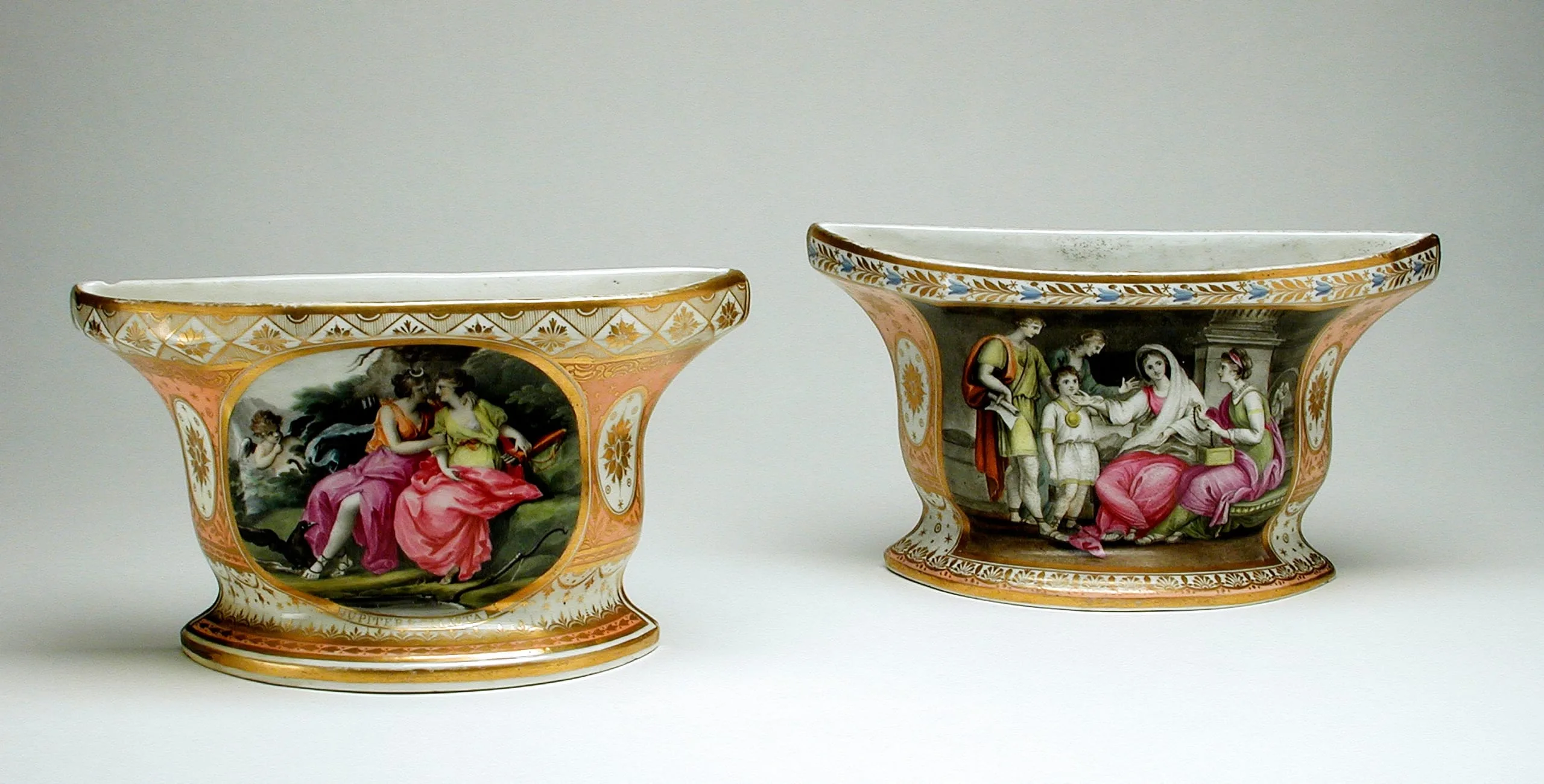
Bough pots were used to hold flower arrangements in water, or alternately bulbs or dried flowers, and typically placed on the hearth in the summer when the fireplace was not in use. They were especially popular in middle- and upper-class English homes in the eighteenth and nineteenth centuries. Because they were intended to be placed against the wall, bough pots were often demilune (half-circle) in shape with unornamented backs.
While these two pots are similarly decorated with colorful central scenes reimagining classical myths and gilded detail on salmon-colored backgrounds, they were not originally a pair. The scene in the oval is titled “Jupiter and Calista,” while the scene in the rectangle depicts “Cornelia, Mother of the Gracchi.” Painted by Thomas Baxter, a renowned porcelain artist, both compositions were taken from famous paintings, by Angelica Kauffman and Benjamin West respectively, which also circulated as prints.
Baxter trained at the Royal Academy under painter Henry Fuseli (1741–1825) before joining his father’s enameling studio. The Baxters primarily bought porcelain blanks that they would paint and gild to sell to middle- and upper-class consumers. In 1814, due to his ill health, Baxter, his wife, and children moved to Worcester, where he painted for porcelain manufactories in the region, including Flight & Barr, the Cambrian Pottery at Swansea, and the Worcester Chamberlain factory. Although he remained in Worcester until his death in 1821, Baxter expressed a longing for the culture of London and regularly painted scenes from the city’s theater on his ceramics.
Cynthia Kok
2025