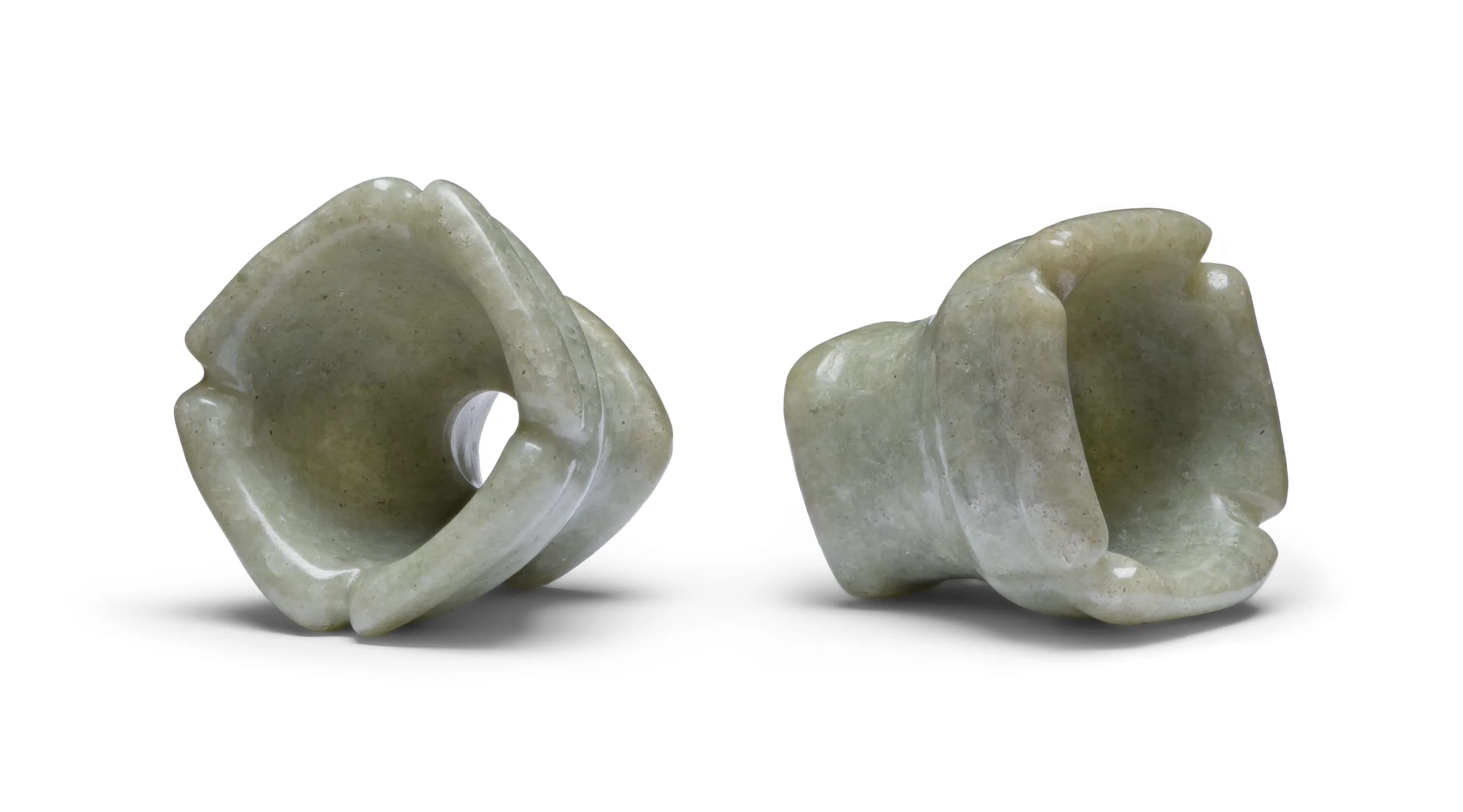
Each earflare in this set consists of a solid piece of greenstone, carved and polished to resemble a four-petaled flower. The design mimics the organization of the Mesoamerican cosmos, which has four corners, four sides, and a center. These earflares would have formed one component of a larger assemblage: the cylindrical portions would have been inserted into gauged ears, and a beaded string threaded through the perforation in the center of each earflare. A tubular jade bead held against the main body of the earflare in this way would have formed the “pistil” of the flower.
Classic Maya peoples valued objects made of greenstone, above all jade, as embodiments of vital forces like breath, water, and maize. Commonly made of jade, or wood painted to resemble jade, earflares symbolize preciousness and wealth in Maya art. People depicted in Classic Maya art almost always wear ear ornaments, with captives serving as the rare exceptions, suggesting that earflares were a fundamental component of elite personhood.
Alyce de Carteret
2024