LACMA

ShopMembershipMyLACMATickets
LACMA
Los Angeles County Museum of Art
5905 Wilshire Blvd.
Los Angeles, CA 90036
info@lacma.org
(323) 857-6000
Sign up to receive emails
Subscribe
© Museum Associates 2026
  • About LACMA
  • Jobs
  • Building LACMA
  • Host An Event
  • Unframed
  • Press
  • FAQs
  • Log in to MyLACMA
  • Privacy Policy
© Museum Associates 2026
Collections

An Ancestor's Stone200–450 CE

On view:
Geffen Galleries
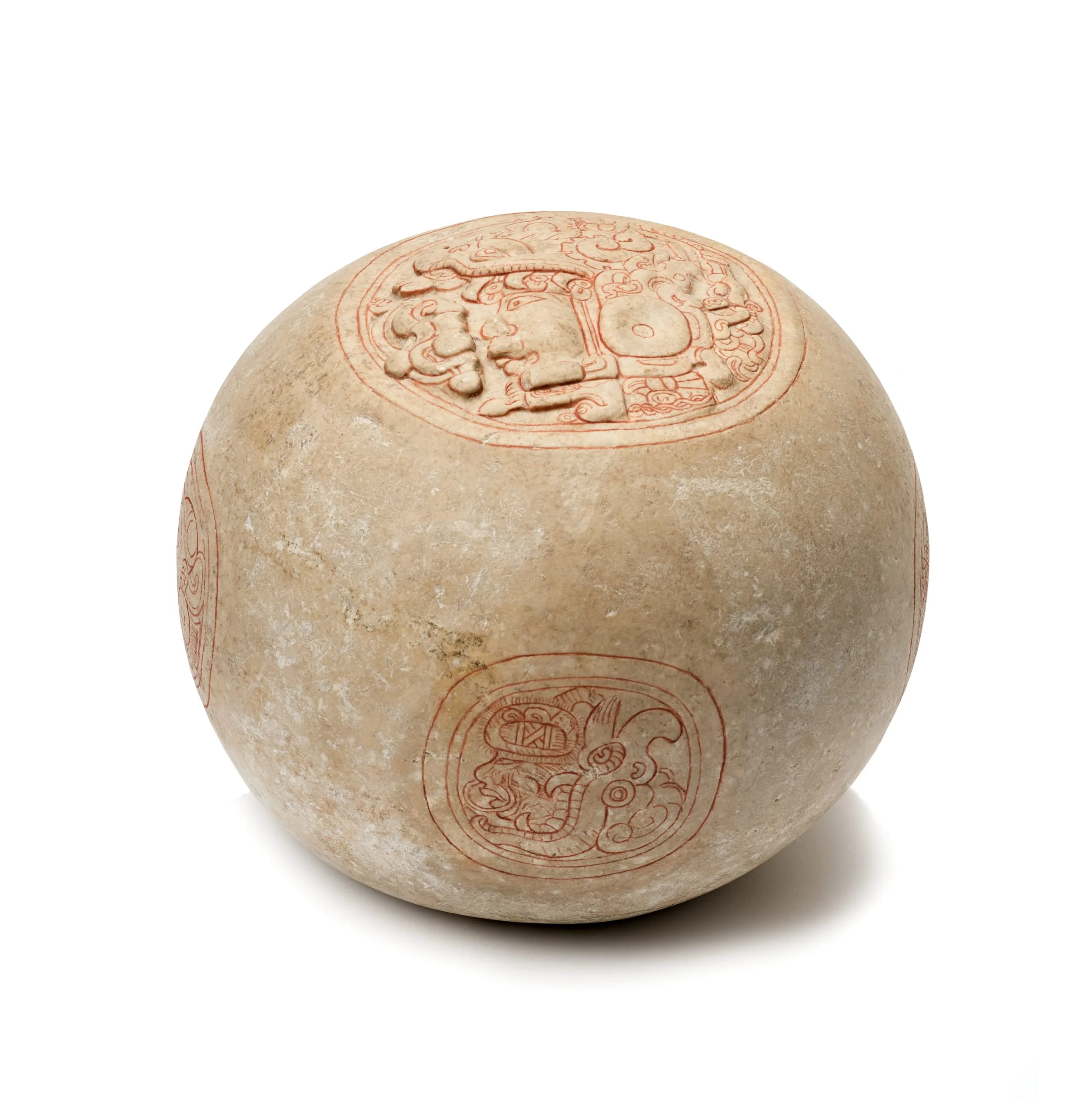
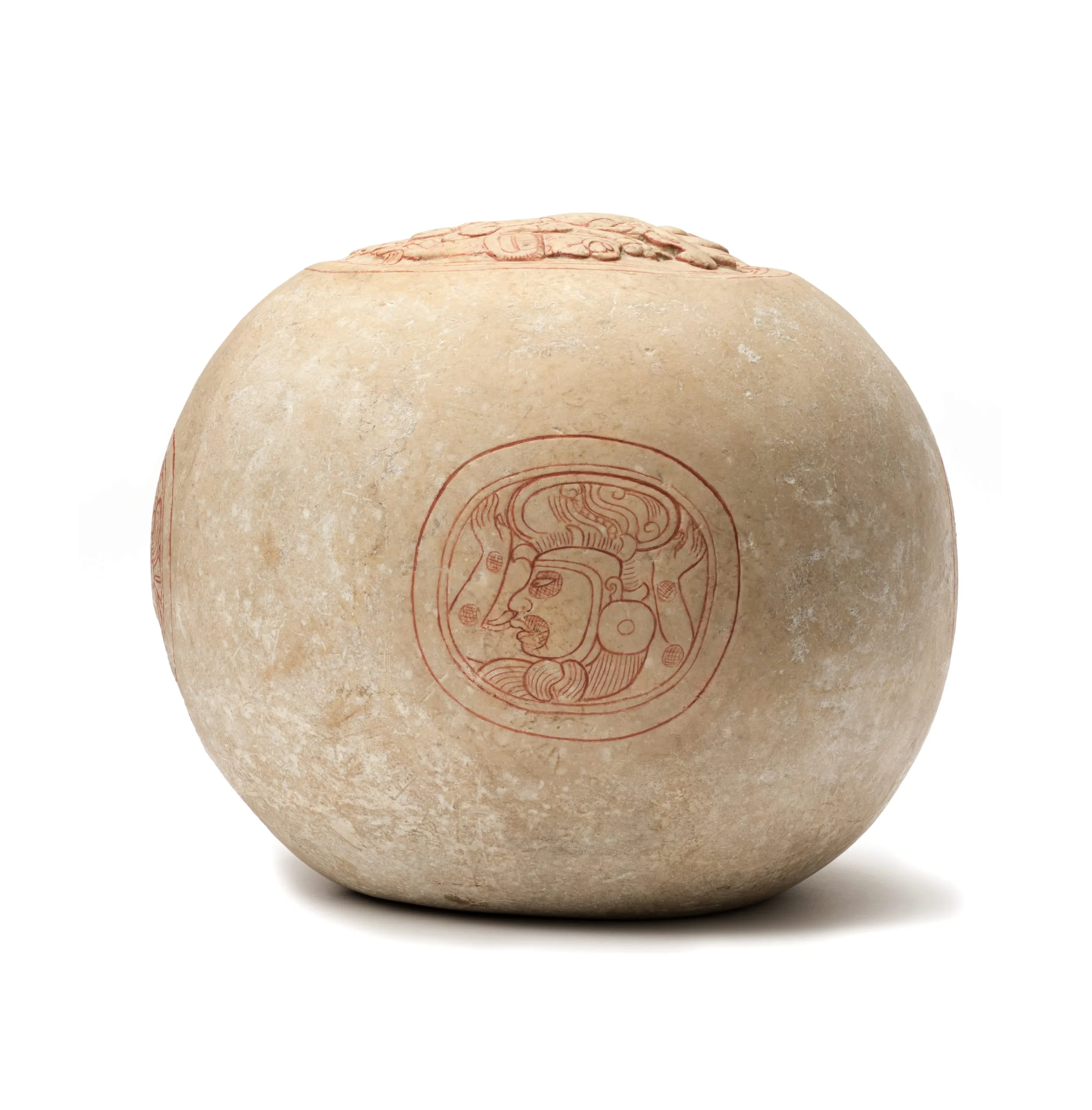
Spherical ceramic vessel with cream slip surface, decorated with an incised red-line cartouche depicting a profile face in an elaborate headdress, with low-relief carving along the top
Spherical stone or ceramic object with a flat base, decorated with multiple circular cartouches containing incised Maya glyphic figures outlined in red pigment against a pale gray-beige surface.
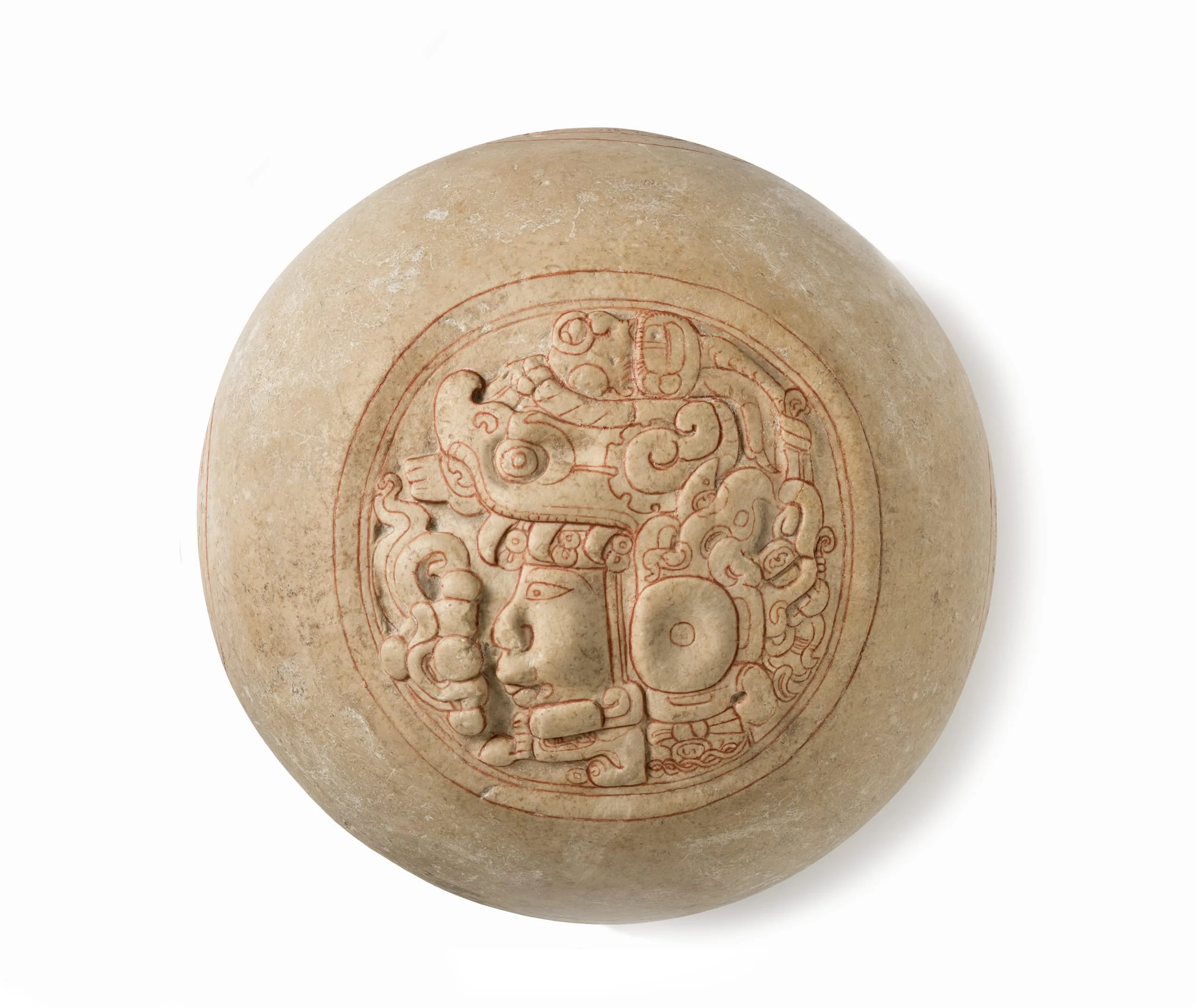
Carved stone vessel, domed and rounded, with a low-relief medallion on the flat top surface depicting a frontal face with elaborate headdress and scroll motifs, highlighted with red pigment, in Maya style.
Title
An Ancestor's Stone
Culture
Maya
Place Made
Guatemala
Date Made
200–450 CE
Medium
Limestone
Dimensions
8 4/5 x 10 x 10 in. (22.352 x 25.4 x 25.4 cm)
Credit Line
Purchased with funds provided by Camilla Chandler Frost
Accession Number
M.2010.115.247
Classification
Stone
Collecting Area
Art of the Ancient Americas
Curatorial Notes

An unusual and puzzling object, this carved limestone sphere features a portrait carved in relief on top, four incised cartouches around the sides, and a flattened bottom that forms its base. The portrait appears to depict the head of an ancestor, whose jeweled breath emanates from his mouth. His elaborate headdress includes a number of fantastic elements, such as a serpent with a shark’s tooth, that spell his name. The four incised cartouches depict different personages, ancestral and divine. In one, a figure whose body is marked with dark spots, a characteristic associated with Huun Ajaw, one of the Maya “Hero Twins,” raises a stone above his head. Moving counterclockwise around the sphere, the next cartouche depicts an old man with fishy attributes, including a watery spiral that forms his eye and a fin at the back of his head. In the next, a human head appears in the open mouth of a serpent with a shark’s tooth, the same elements that appear on the top of the sphere in the ancestor’s headdress. The final cartouche features a personage whose voluminous hair is bedecked with jewels.

This quartet of characters forms an Early Classic (c. 250–600) text, which, though partially undeciphered, can be read as a dedication of the stone sphere by its owner, the depicted ancestor. The first cartouche names a stone-raising event (k’al-tuun) used to describe the dedication of stelae or stone monuments. The subsequent three cartouches name the owner of the sphere as an ancestor (mam), provide his personal name, and give his title as the lord of an unknown city in the Classic Maya lowlands. The final cartouche resembles later versions of the Emblem Glyph (i.e., a glyph that denotes a political lineage associated with a Classic Maya city) of Tikal, a major political center in the region, though there may be other possible readings. Given this inscription, it stands to reason that the sphere once stood in a place of importance, perhaps raised upon an altar.

Alyce de Carteret

2024
Selected Bibliography
  • Hellmuth, Nicholas M. Monster und Menschen in der Maya-Kunst: Eine Ikonographie der Alten Religionen Mexikos und Guatemalas. Graz: Akademische Druck- u. Verlagsanstalt, 1987.
  • O'Neil, Megan E. Forces of Nature: Ancient Maya Arts from the Los Angeles County Museum of Art. Beijing Shi: Wen wu chu ban she, 2018.
  • Magaloni, Diana, Davide Domenici, and Alyce de Carteret. We Live in Painting: the Nature of Color in Mesoamerican Art. Los Angeles: Los Angeles County Museum of Art, 2024.
Selected Exhibition History
  • The Ancient Maya World: Masterworks from the Permanent Collection. Saturday, December 1, 2012- Sunday, March 2, 2014

Related Exhibitions