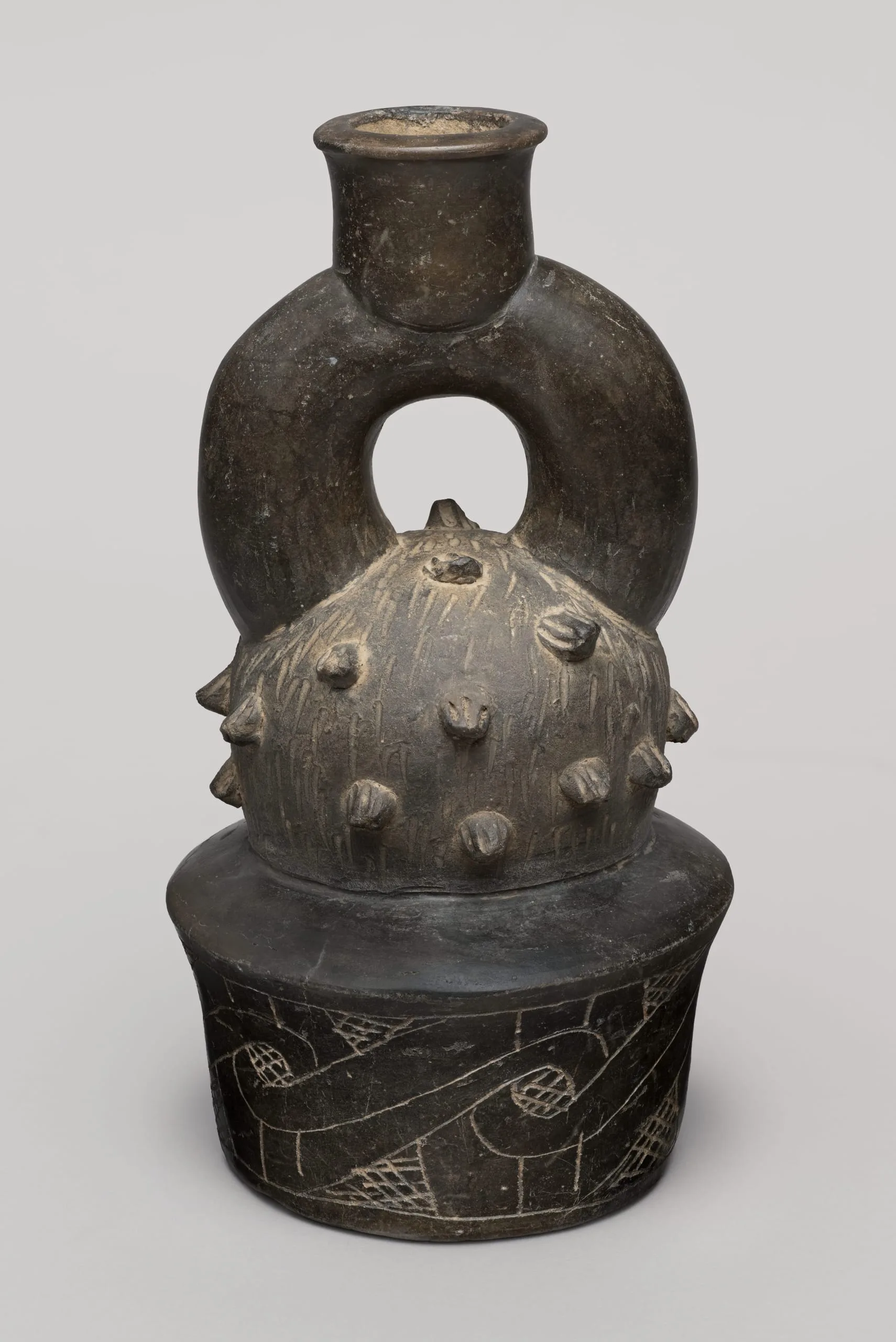
The artist of this vessel, typical of Late Cupisnique stirrup-spout bottles, created visual interest by contrasting the smooth, burnished surfaces of the base, handle, and spout with a rough-textured central section. The characteristic black-brown finish was achieved through controlled firing in reducing atmospheres.
The twisted, interlocking design around the base was incised after firing. This motif, sometimes seen forming the bodies of snakes, has been interpreted as symbolizing movement, transformation, or duality—all key themes in ancient Andean cosmology. The center section probably represents a Spondylus shell (spiny oyster), a coveted bright-red material that was traded all over South and Central America and Mesoamerica in pre-Hispanic times. In honor of, or perhaps in lieu of, the real thing, artists along the north coast of Peru would replicate the surface texture or complete shell in their ceramic creations for millennia.
Based on the iconography, it is clear that these elaborate vessels carried significant ritual and symbolic value. They were often found in elite burials or offering contexts, further evidence of their importance in religious contexts. The so-called stirrup-spout form, which originated from earlier traditions in Ecuador, endured for centuries in Peruvian art, ending only with the Spanish invasion in the sixteenth century. (See also M.2009.21 and M.2010.115.309.)
Julia Burtenshaw
2025
Selected Bibliography
Burtenshaw-Zumstein, Julia. “Cupisnique, Tembladera, Chongoyape, Chavín? A Typology of Ceramic Styles from Formative Period Northern Peru, 1800200 BC.” Doctoral thesis, University of East Anglia, 2014.