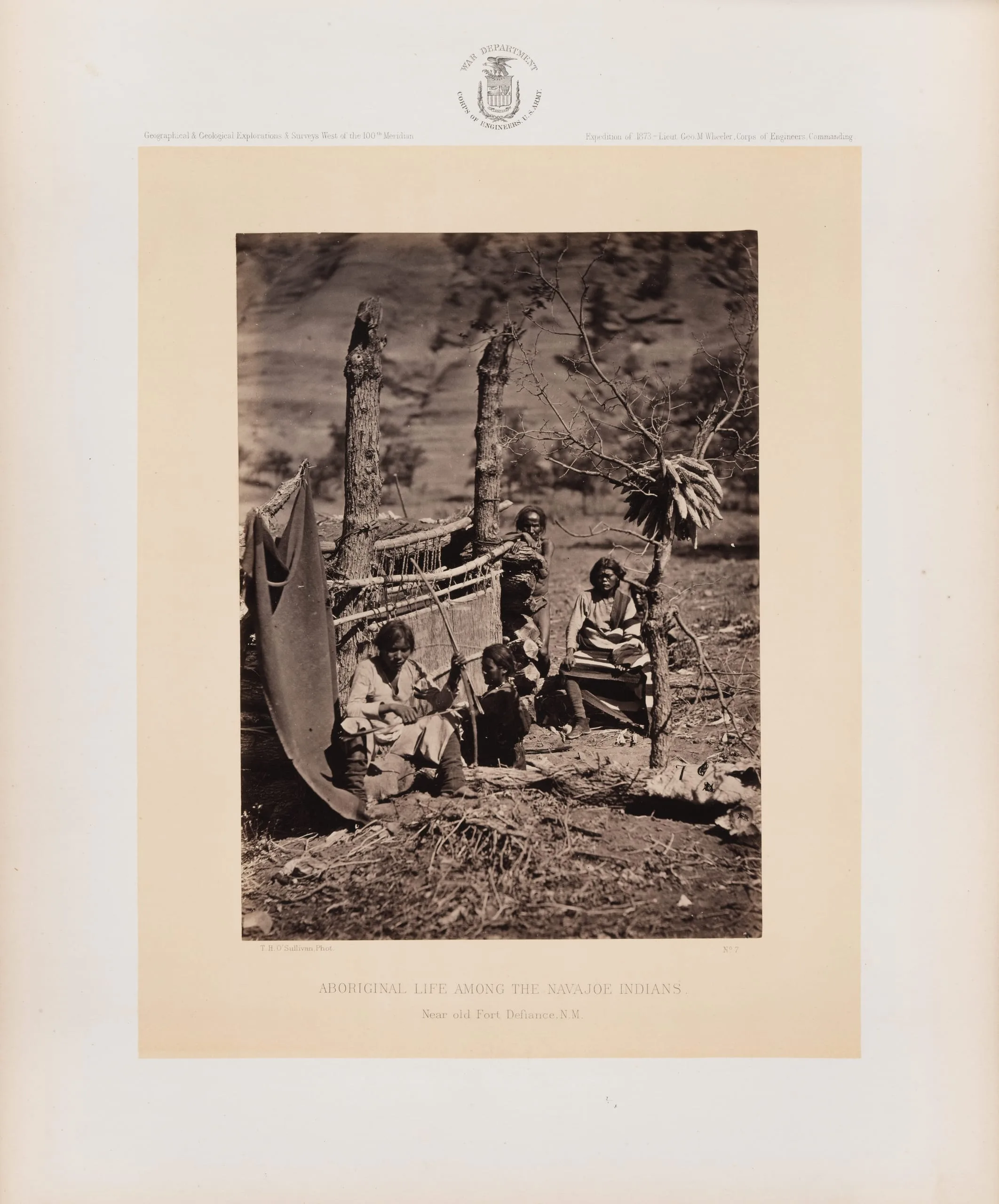
In the years following the Civil War, large-scale government-sponsored expeditions led by Clarence King, Ferdinand V. Hayden, John Wesley Powell, and George M. Wheeler employed photographers to record continental westward expansion. Between 1871 and 1874, Timothy O’Sullivan and William Bell alternated as the photographers attached to Lieutenant Wheeler’s survey party exploring and documenting the geology of the United States west of the 100th meridian for the U.S. Army Corps of Engineers. The two photographers faced significant challenges, hauling bulky cameras, 10 × 12−inch glass-plate negatives, trays, and chemicals over rough terrain in mule-drawn wagons. Water was often scarce or excessively alkaline, and pervasive dust could easily spoil a collodion silver negative. Successful negatives were coated with protective varnish in the field and brought back to Washington, D.C., for printing.
The photographic documentation of Wheeler’s survey was compiled in fifty albums. LACMA’s album, which includes Distant View of Camp Apache, Arizona, photographed by O’Sullivan, documents the expeditions of 1871, 1872, and 1873. In subsequent years, Wheeler sent bound albums to government officials, including President Rutherford B. Hayes. However, the photographs held little appeal for their first audiences, who were accustomed to more idealized visions of landscape. Generations later, they were rediscovered by artists such as Ansel Adams, and today are valued equally as works of art and documents of Manifest Destiny.
Britt Salvesen
2025