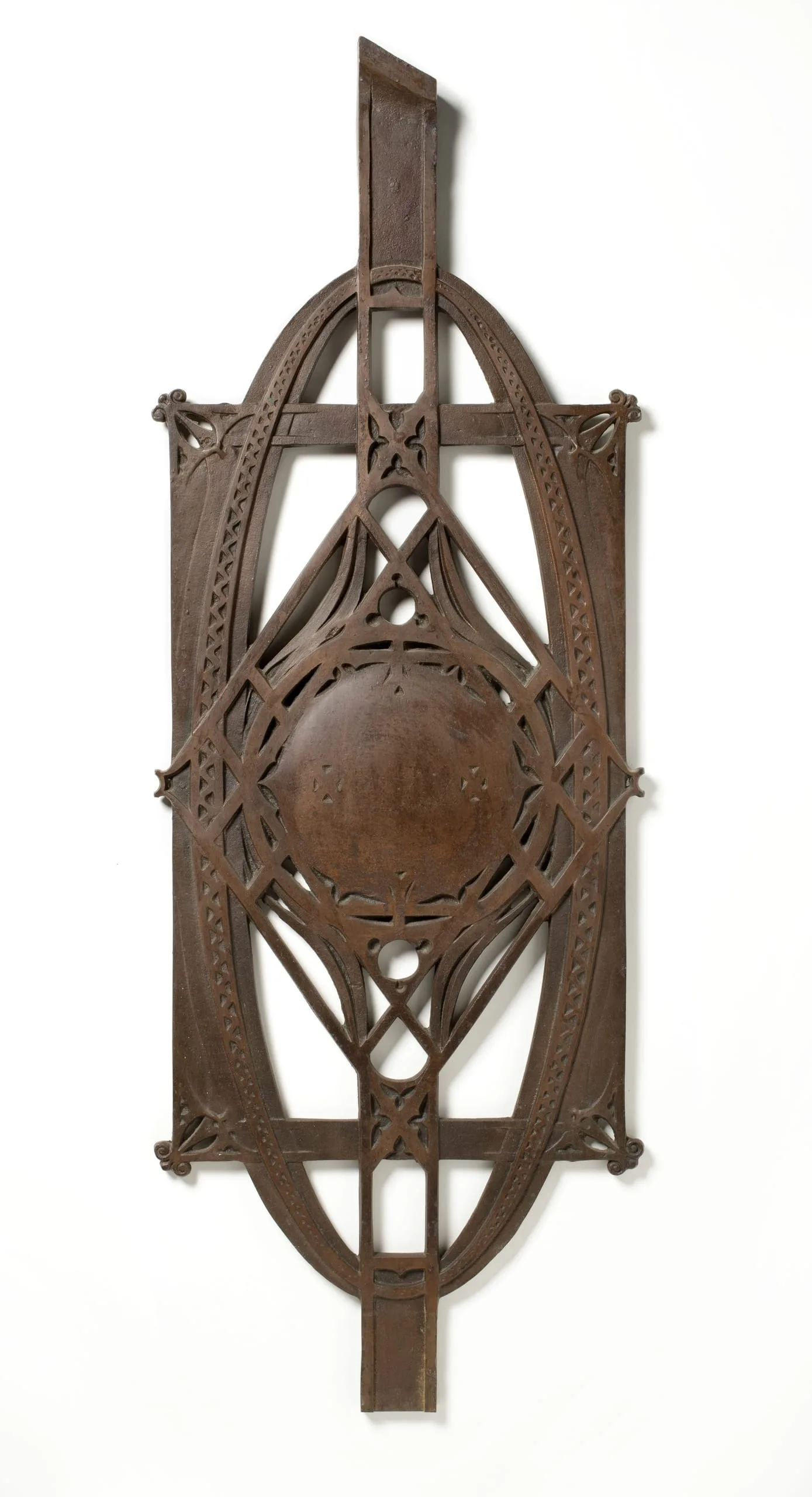
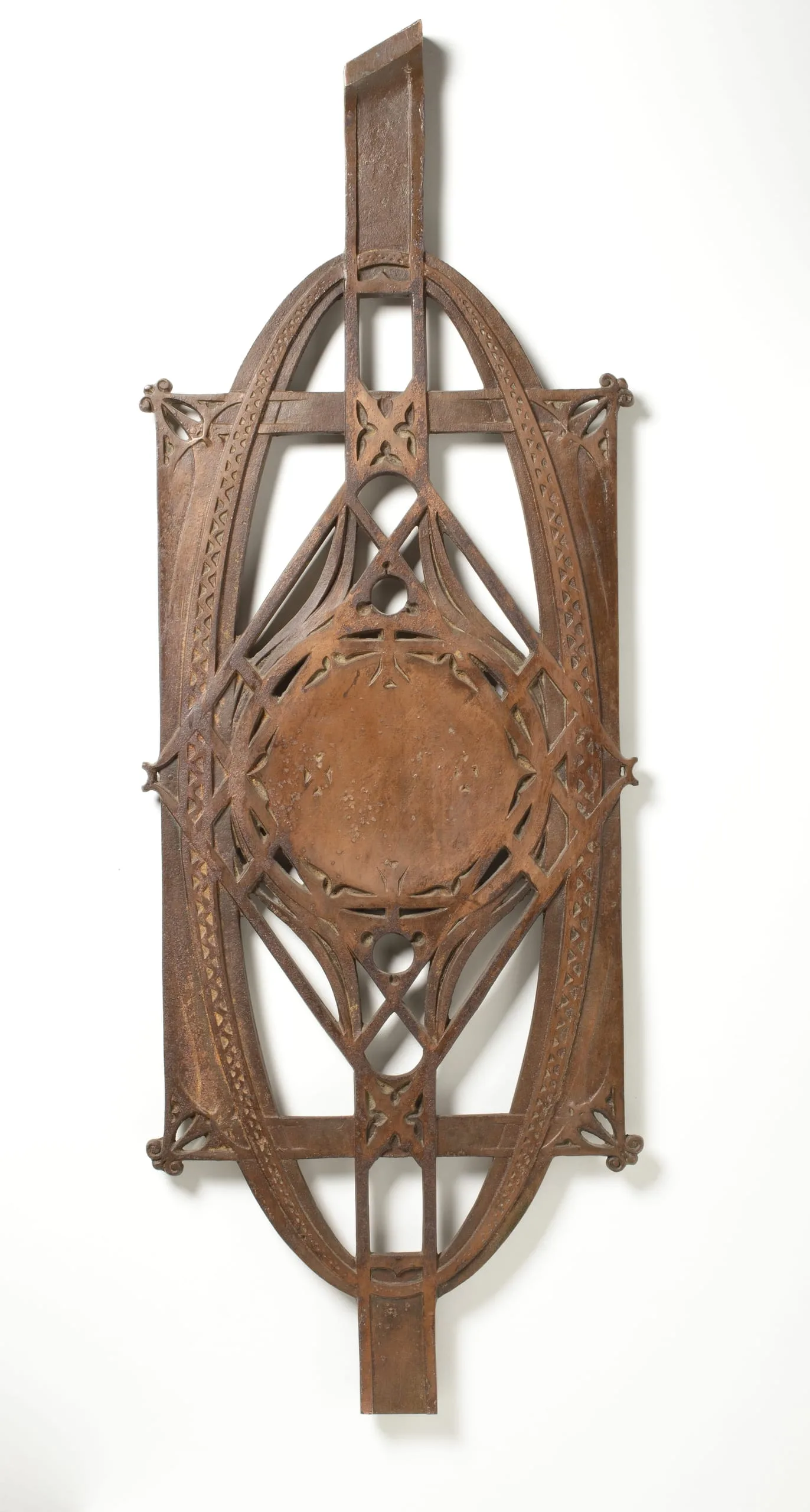
In the early 1890s, the architecture firm of Dankmar Adler and Louis Sullivan was commissioned to build a high-rise structure at LaSalle and Washington streets in Chicago. The building was a metal-framed thirteen-story office tower with a large double-height space on the second floor for the trading room of the Chicago Stock Exchange, which received a rent-free, fifteen-year lease.
Sullivan strongly believed in the integration of architecture and ornament, writing in 1892: “It must be manifest that an ornamental design will be more beautiful if it seems a part of the surface or substance that receives it than if it looks ‘stuck on,’ so to speak.” (1) Like many adherents of the Arts and Crafts movement, Sullivan often unified the decorative program by repeating a single motif or group of motifs in many different elements of a building. The design on the baluster, consisting of a concentric circle, diamond, oval, and rectangle, with surfaces decorated with geometric and floral motifs, relates closely to the polychrome stenciled walls, the architectural metalwork, and the plaster decoration on the arched entrance of the building.
(1) Louis Sullivan, “Ornament in Architecture,” The Engineering Magazine, August 1892 [reprinted in Louis H. Sullivan, Kindergarten Chats and Other Writings (New York: Dover Publications, 1979), 189].