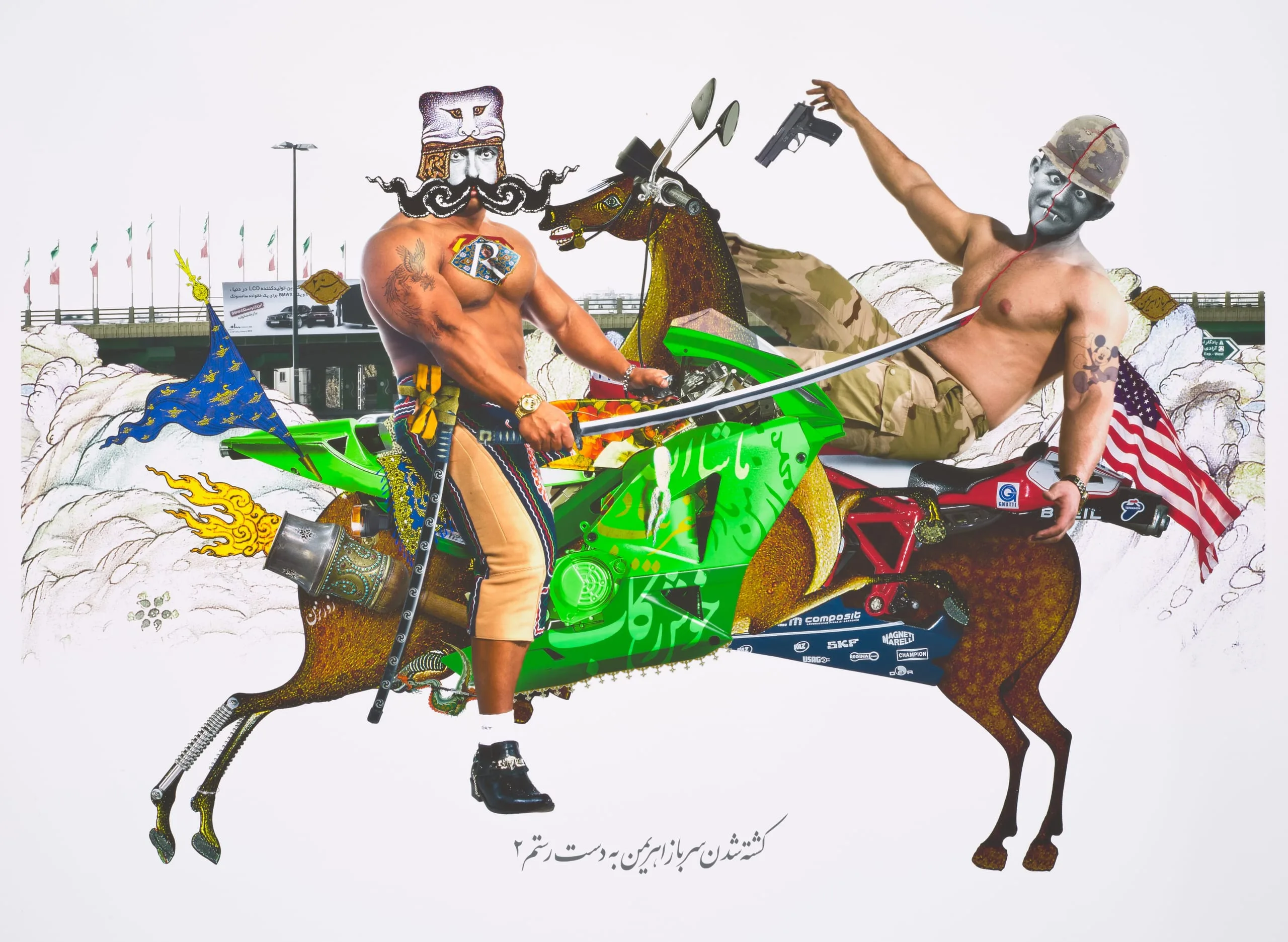
In his ingenious mixed-media series "Rostam 2 – Return," the Iranian artist Siamak Filizadeh transports the mythical Persian hero Rostam into the context of the present day. Riding a souped-up hybrid vehicle—half horse, half motorcycle—Rostam 2 performs his deeds of valor against the backdrop of twenty-first-century Tehran. Filizadeh has cleverly and seamlessly refashioned this ancient account, enacted across four generations and set amidst tragedy, romance, and heroism, in much the same manner as director Baz Luhrmann modernized Shakespeare’s Romeo and Juliet in the 1996 film version. But in his retelling of this classic Persian tale from the Shahnameh or Book of Kings, the Iranian national epic, Filizadeh bypasses its universalities in favor of more specific social commentary. As with other literary masterpieces, the Shahnameh has an appeal and an elasticity that has allowed successive generations to discover or invent new meanings.
Nearby a highway overpass, Rostam 2 astride Rakhsh overcomes one of the soldiers of evil, as revealed in the next large-format print. The nationality of the cross-eyed, fang-toothed soldier with Mickey Mouse tattoo riding a hybridized horse-like motorcycle is revealed by the American flag mounted behind him. As Rostam 2’s sword slices him from helmet to chest, the soldier drops his gun. The formalized and rigid combat, set against a quiet, unsuspecting landscape, follows the standard format of battle scenes in Persian miniature painting, rendering it difficult for the viewer to become caught up in the calamity implied by the gory scene. After all, as has often been pointed out, in Persian painting it is always a beautiful day.